
Adversity Is a Horrible Thing to Waste
The Paradox That Stops You Cold
I want to share something that caught me off guard the first time I heard it. It still does.
When researchers studied Vietnam prisoners of war, they found something that defied every assumption. "The men who were there the longest, who were tortured the most, came back the healthiest. The ones struggling were the men shot down near the end of the war, held briefly, released quickly."
Sit with that for a moment. The men who suffered most came home strongest. The men who got out fast were the ones falling apart. That is not what you would expect. It is not what I expected. And it raises a question worth spending some time with: what if adversity, handled a certain way, grows something in us that comfort never could?
One Man's Numbers
This is not a feel-good story dressed up as data. The numbers are specific.
"30.6 percent of Vietnam combat veterans have PTSD. But of the prisoners of war, only 4 percent do."
Think about that. The men who endured the worst conditions, years of captivity, isolation, torture, came home with a fraction of the psychological damage. Something happened inside those prison walls that built resilience instead of breaking it.
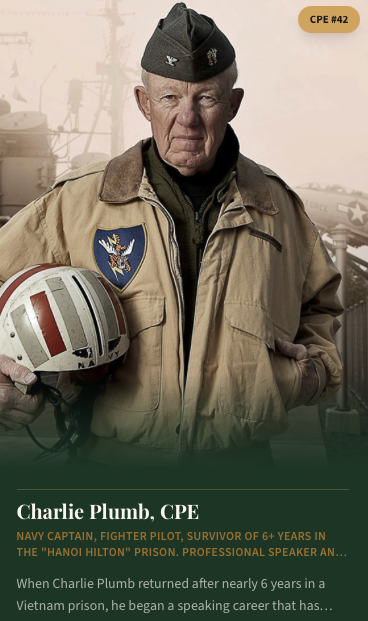
One of those men was Captain Charlie Plumb. He flew 74 combat missions as a Navy fighter pilot. On his 75th mission, five days before he was supposed to come home, his F-4 Phantom was shot down. He parachuted into enemy hands and spent 2,103 days as a prisoner of war. Nearly six years.
The Gentlest Soul in the Room
I have known Charlie for years. And what strikes me every time is not his toughness. It is his warmth.
"He's one of the gentlest souls I know. Here's a man who endured unimaginable brutality, yet returned home without bitterness, without the trauma that haunts so many veterans."
You would expect someone with that history to carry an edge. A guardedness. Charlie carries none of it. He is proof that what you do with your suffering matters more than the suffering itself.
The Man in the Restaurant
This is the story that changed everything for Charlie, and it has stayed with me since the first time I heard it.
"Years after coming home, Charlie was in a Kansas City restaurant when a man approached him. 'I'm the guy that packed your parachute,' he said."
Charlie looked at this man. A stranger. Someone he had never met, never spoken to, never thanked. And yet this was the person whose careful, invisible work had saved his life. The sailor had folded that silk canopy, checked every line, sealed it into the pack. He did his job with precision, knowing that someone's survival depended on it. And then he moved on to the next one.
Charlie told me the man smiled and said, "I guess it worked." Charlie was speechless. He could barely respond. Here was a man who had done the most important work of Charlie's life, and Charlie had never known his name.
That moment became the seed of everything Charlie teaches. Not heroism. Not endurance. Service. The quiet, unseen kind.
The Two Questions Worth Sitting With
Charlie built his message around two questions. They are simple. They are not easy.
"Who packs your parachute? Who do you depend on when everything falls apart? And then the harder question: Whose parachute are you packing? Are you a servant leader?"
The first question invites gratitude. Most of us can name the people who held us up when things got difficult. A mentor, a spouse, a colleague who covered for us, a friend who listened when we needed it.
The second question invites responsibility. It asks you to look at your own life and notice whether you are doing that quiet, invisible work for someone else. Not for applause. Not for a title. Just because someone's well-being depends on it.
I find the second question harder. Most people do.
Bitter or Better
Charlie did not plan to become a speaker. "He made 400 speeches his first year home, all unpaid. He didn't even know you could make money speaking." People kept asking him to share his story, and he kept saying yes. Then, "when a man approached him on an elevator with tears in his eyes, saying Charlie's story made his own problems feel manageable, something shifted. Charlie found his purpose."
"He realized that the emotional pain he'd endured, frustration, isolation, loss of control, was universal. Anyone facing adversity could learn from his example."
And here is the framework that holds it all together: "Adversity is a horrible thing to waste. You can become bitter about it, or you can become better because of it."
Bitter or better. That is the choice. It is not a one-time decision. It is a daily one. The POWs who came home healthiest were the ones who made that choice over and over, in cells, in darkness, in pain. They chose to grow. And growth, even in terrible soil, produces something strong.
Your Story Is Worth Mining
You may not have spent six years in a prison camp. I hope you have not. But you have faced something. Loss, failure, disappointment, seasons where the ground felt like it was giving way beneath you.
"We all have a story. The question is whether we're willing to mine it for meaning and share it with others."
Your adversity is not a waste unless you leave it unmined. There is something in your experience, some insight, some hard-won understanding, that someone else needs to hear. Not because you are a hero. Because you are human, and you kept going.
So I will leave you with Charlie's two questions. Who packs your parachute? And whose parachute are you packing?
In the spirit of growth,
Jim Cathcart
Nurture Your Nature.