

Season 2, Episode 24
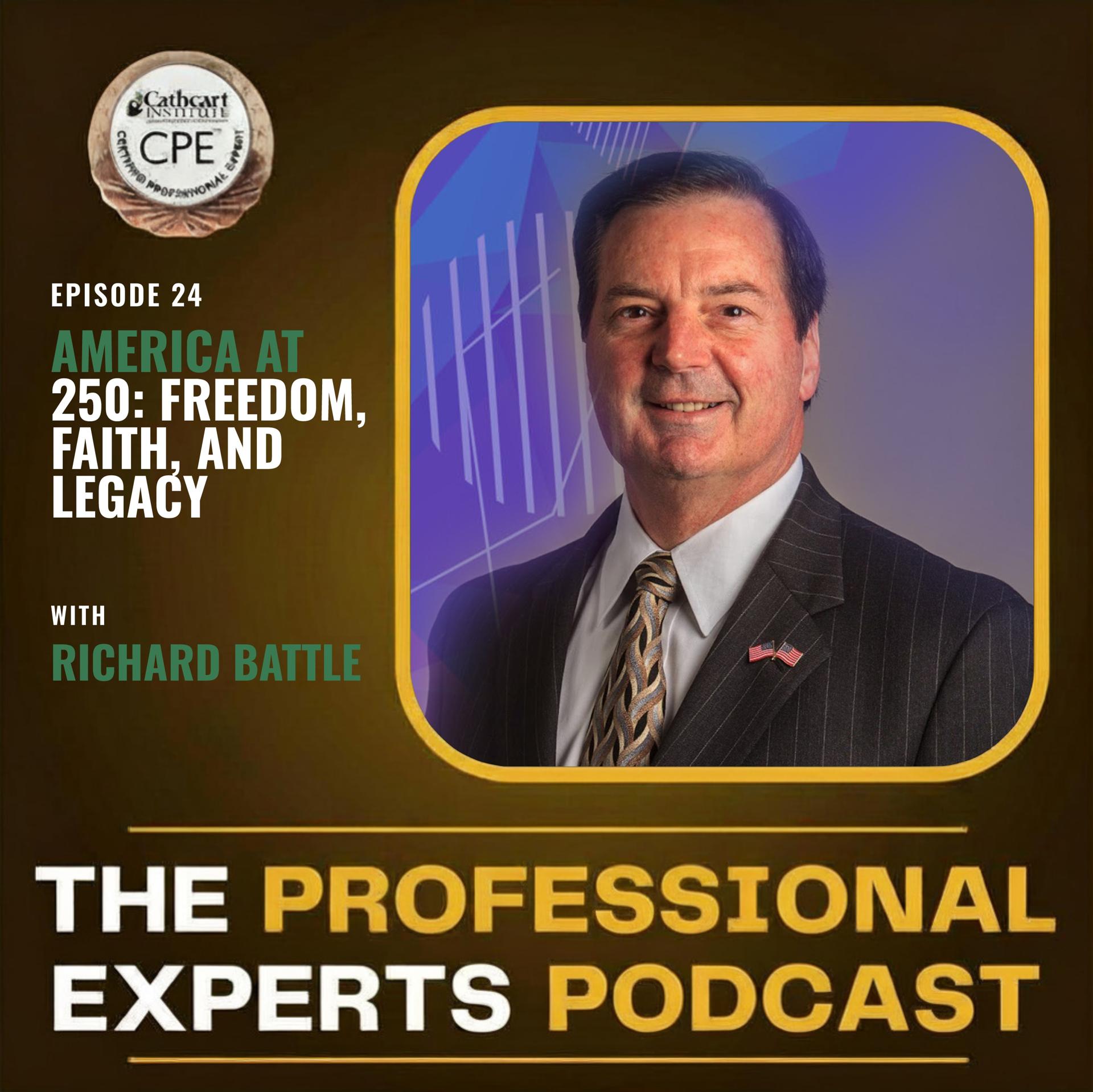
America at 250: Freedom, Faith, and Legacy with Richard Battle
A conversation with Richard Battle
Watch This Episode
About This Episode
Richard Battle joined me for one of those conversations that feels less like an interview and more like a long breakfast between old friends. Richard is the author of the Americans Who Made America series, and he lives right here in Lakeway, Texas, not far from my front door. We have known each other since our Junior Chamber of Commerce days, and that shared history gave this conversation a warmth and depth that I think you will feel from the first minute.
What America's 250th Asks of Us
Richard's books are not nostalgia. They are civics education in story form. We talked about why the founders were so brilliant, how the Connecticut Compromise and the Electoral College protect minority voices, and why a republic is not the same thing as a democracy. Aristotle said it plainly 2,500 years ago: republics decline into democracies, and democracies degenerate into despotism. That is not ancient history. That is a live warning.
Capitalism, Fairness, and Human Nature
We explored why free enterprise, for all its imperfections, remains the most generous and life-affirming economic system ever tried. Voluntary exchange is the key phrase. No government agency required. No guilt attached. Just people freely trading the gifts they were given. We also talked about why fairness, as a governing ideal, collapses the moment you apply it to real life. Nature is not fair. An acorn does not get to choose whether it becomes an oak.
Returning the Favor
The phrase that stayed with me longest was this one: paying it forward is an incomplete gesture. What we owe the people who built this country is not a small kindness passed to the next stranger in line. It is a full return of the blessing, passed deliberately to the generations we will never meet. That is the obligation Richard writes about, and it is the obligation I feel every time I sit down to teach.
Books and Resources Mentioned
Richard's full library, including Americans Who Made America, Made in America, The Unopened Present, and eleven other titles, is available at richardbattle.com. All books ship signed. You can also find him on social media as RichardV Battle. V for victory.
In the spirit of growth.
About the Host: Jim Cathcart, CSP, CPAE is one of the top 5 most award-winning speakers in the world. His Top 1% TEDx video has over 2.8 million views, his 27 books are translated into multiple languages, including 3 International bestsellers. He is a Certified Virtual Presenter and past National President of the National Speakers Association. Jim’s PBS television programs, podcast appearances and radio shows have reached millions of Success Seekers and he is often retained to advise achievers and their companies.
Even his colleagues, some of the top speakers in the world, have hired Jim to speak at their own events. Jim is an Executive MBA Professor at California Lutheran University School of Management and serves as their first Entrepreneur in Residence. He has been inducted into the Sales & Marketing Hall of Fame in London for his pioneering work with his concept of “Relationship Selling.” He is also in the Professional Speakers Hall of Fame and has received The Cavett Award and The Golden Gavel Award.
Jim has written 27 books, hundreds of articles and he is always writing at least one new book. His most recent book is HI-REV for Small Business, The Faster Way to Profits. Audiences buy his books by the hundreds and he happily adds autograph sessions to his speeches.
https://www.linkedin.com/in/cathcartinstitute/
https://www.facebook.com/jim.cathcart
Chapters
- 0:00Welcome and introducing Richard Battle
- 4:15What sparked the Americans series
- 11:56Why capitalism outlasts every alternative
- 19:58Republic vs. democracy: the founders knew
- 31:02The Unopened Present and a God moment
- 35:46Reuniting a divided country
- 47:34Local freedom and citizen representation
- 57:56Passing the blessing to the next generation
Notable Moments
“To be born free is an accident. To live free is responsibility. And to die free is an obligation.”
“Paying it forward is an incomplete gesture. I like much better return the favor.”
“Capitalism, compared to every other alternative known to man, is head and shoulders the best, most reliable, most generous, most compassionate, most life-affirming of all the economic systems that have ever existed.”
“The question I believe is right for us is what now? I experienced this. What am I supposed to learn from this so that I can live a better life and help others?”
“You cannot avoid leading by example.”
Full Transcript
Hello, folks. This is Jim Cathcart. Welcome to the Professional Experts Podcast. This is the Patriots edition. I decided, since we have the 250th anniversary of America being celebrated, that it would be best to bring in an expert that I know and admire who is deeply, deeply involved in American history and American culture and American values. He's my friend, Richard Battle, and he lives, coincidentally, right here in Lakewood, Texas, where I live. And we get together occasionally for a nice leisurely breakfast and reflect on our common connections back all the way to the Junior Chamber of Commerce Days and then bring it forward to now. And Richard has a new book out called Americans, with the emphasis on the word can. Americans who made America? The 20th century was the American Century. And let me give you just a quick thumbnail of the kind of people that are profiled in this book. Neil Armstrong, George M. Cohan, Jimmy Doolittle, Audie Murphy, John Wayne, Helen Keller, Dwight Eisenhower, Billy Graham, John Wooden, Mary Kay Ash, Will Rogers, Henry Ford, Colonel Harland Sanders, Sam Walton, etc. So you can see that this is not just a story of the Founding Fathers, but it's a story of the people that showed what America really is and how they lived an American life that all of us can learn from. So, Richard, welcome to the Professional Experts podcast. Thank you so much.
Well, Jim, thank you so much for having us. And the latest edition is the fourth of five planned volumes celebrating the Amera Can Do Spirit. And it did focus on the 20th century, but we focused on 18th and 19th century into previous volumes.
Wow. Well, the folks that are watching this on video can see behind you all of your various books, or a lot of them. And there you go, a handful of three Americans who Made America. And then here's a brochure that you shared with me that shows all those many titles. You know, even the. The little book, the Five Leadership Secrets of Old MacDonald, who had a Farm, the Unopened Present, which is a very moving and touching book. Made in America, Life's Daily treasures and so forth. Wonderful work. But the nice thing that's not instantly noticeable about it is that it all conveys a conviction that there is a loving creator from whom we came. That America is unique and exceptional in all the history of the world and really deserves our best efforts to keep it thriving for eternity. And that being a patriot doesn't mean joining the Army, Navy, Air Force, Marines, or Space Force. It means serving America in whatever ways advance the culture and the society and the goodness of Humanity. And I just, you know, that's heart tonic to me. I love hearing that. Share with us just where you're coming from and what. What are you up to in all of this effort?
Well, what started this particular series, and it was definitely inspired, was at the end of COVID I was working on another volume, and all of a sudden one day I had inspiration because I got sick and tired of people putting down the country and telling us how bad America is. And it's not special or unique. And so I decided at that point that what made our country what it is was our forebears from before the founders, through our parents and onto our generation. It was the Americando spirit that's driven by providence and the hand of God in so many different places. And so I wanted to inspire people to recognize our heritage one and two, provide tools so they could better live and pass down to their children and grandchildren those values and someone that you'll remember who was a hero and mentor to me, and I'm sure you, you too passed. USJC President John Ben Shepard, who was Attorney General and Secretary of State of Texas, said, to be born free is an accident. To live free is responsibility, but to die is an obligation. And that's.
I like that. To be born free is an accident, a coincidence of nature. To live free is responsibility. Responsibility.
And to die free is an obligation.
Right. Because if we don't keep it free and pass it along.
Yes.
Then we've stopped the chain. Yeah.
The popular term today is paying it forward, but I don't believe that's complete. I believe that's an incomplete gesture. So, for example, if you and I are standing in line for ice cream cones and you're in front of me and you get your cone and you tell them to pay for my cone, you've paid it forward to me. And if I turn around and pay for the next person behind me, I paid it forward to them. But those are based on us seeing someone, and it's very limited to that situation. I like much better return the favor. Because that.
Yeah, return the favor, return the blessing,
even return the blessing, but because we have millions of people known and unknown to us from our past and even as we grew up that we knew or didn't know who did things to build this country that we've been given. And so when we do things for people today and do things to influence people beyond our lifetime that we'll never know, then we're returning that favor to people like they gave us. I like that more and deeper and more complete gesture than paying it forward.
I like that. Yeah. And by the way, for any people that are concerned about whether what Richard and I are doing is selling religion, the answer is absolutely not. This is not about religion. It's about. It's about preserving our culture. And our culture was formed with the underlying assumption that there's a benevolent creator, that whatever source that is, however, whatever form that takes, there was a beginning of life source that was in favor of more life. Not an angry, judgmental guy with gray beard sitting up in the clouds wanting to make you feel bad because you didn't do today's ritual. You know, it's just the acknowledgment that we came from somewhere good and we can go somewhere good and we can do good while we're here.
Well, absolutely. And I think we evolved or came down from Western civilization, if you will. And what's made America unique and exceptional is how we took that Western civilization and, and our founders were so brilliant by studying previous civilizations that they came up and gave us the twin freedoms of economic liberty and political freedom. Those two in joint sequence are what gave that American do spirit, the birth, the freedoms. And that freedom is very given in the Bible, if you will. Freedom given individually. And we hear people today talking about the warmth of collectivism. Well, there's no freedom in collectivism. You're just one of many people in a group. Whereas the freedoms that our founders gave us. And there are God given rights, not man given rights are all individual. Each of us get to be an individual and live our lives, to chase our dreams and hopefully serve others. Our joint experience in the jc service to humanity is the best work of life. And I think you and I, and I'm sure your audience are people that want to impact and influence the future and return that favor these gifts that we were given.
Absolutely, absolutely. Wow. My mind went a thousand different directions, all rooted in what you were saying. But I just think of, you know, the people that say, for example, socialism or communism or some of those other isms are the way to, the way to improve the world. And you just have to put on the emergency brake and say, wait a minute, wait a minute. Okay, I'm willing to have this conversation. I'm willing to consider your suggestion if you can give me one solid example, one solid example where it's ever worked over an extended period of time. Just one. But it has to be tangible, you know, real, rational, something that people can rely on. And of course there is none, because everywhere those concepts have been tried, they've had short term payoffs, long term misery, ultimate disaster, and, and, and then a revolution and an upheaval and you know, they start to cycle over again and they say, well, you know, you know, that's, it's just, they didn't do it right. Nor would you, nor would I. Because the concept, the model, you know, it's kind of like if we've got a bicycle with square wheels, it's not a rider problem. You know, riding techniques and more schooling in riding and higher quality square tires is not going to make that a better bike. It'll never work because it's got fundamental elements of it missing. And you said economic freedom. Capitalism, of course, is imperfect. Everything's imperfect. So capitalism, compared to every other alternative known to man for an economic system is head and shoulders, the best, most reliable, most generous, most compassionate, most life affirming of all the economic systems that have ever existed. And yet it's under attack virtually every day. Unbelievable. Yes, well, give us some insights there.
All we have to do is look at human nature, about the individual freedoms and go to a little kid and I've written a piece that'll be in the next book called no Kid Ever Grew Up Wanting to be a Socialist. And I was observing a little kid about 4 years old at a Houston Astros baseball game and he was expressing his individualism. He didn't want to be part of a group on certain things, even the family. He wanted certain things for himself when he wanted them. And if he didn't get it, he showed his displeasure. And so that's something I think that we can see in young people. They're born naturally with this individual desire. You try to help them. Oh no, don't. I'm going to do it myself. And so we see that in little kids and they have to be indoctrinated with socialism. It's not natural to them. Free expression and individual liberty is natural.
Yeah. And as a person matures from childhood into adulthood, they become more aware of other people and more desirous of being connected with other people. They become more compassionate, considerate, cooperative and so forth. And so it's not a difference between, I mean, socialism and capitalism or America's free society versus the other, more controlled societies around the world is not a matter of whether you care about people or not, whether you're compassionate or, or considerate or not. Because when you look at what America and America's system has produced, there have never been more people giving more willingly to other people in the history of humanity than there have been under this system and generosity, charitable giving in America with no guilt requiring it, no government agency saying you must, and no huge tax incentives that if you do that, you finally be able to breathe with only minimal influences from the outside. We are the most generous society, most compassionate society that's ever been in existence. Wow.
Yes. Well, the capitalism or free enterprise is the voluntary exchange of goods and services. Voluntary is the key word. And that's the difference.
There it is. Yeah.
Other type of societies, and the billionaires are berated. But if you look on donations and charitable works, you see them giving so much money. You see it when their names are put on buildings and stadiums and things of this nature that's again, all voluntary. And so that's what's, what's so important and part of the socialism thing is everybody being equal. Well, there's no way. I don't care who's running the government. You can make people equal. You can't even make kids in the same family equal, even though they're raised the same. How are you going to make exactly body in society equal? So it's a false premise that it's unbelievable that people even believe it's possible.
Yeah. And people say, you know, the younger people, when I've gotten into this kind of discussion with them, occasionally, you know, they say, well, that's not fair. I said, well, fair is giving everybody a size medium. Do you believe in fairness when it comes to clothing assignment? Well, no, I, you know, that wouldn't be right. Well, precisely. Fairness is everybody gets the same treatment, everybody gets the same opportunity, everybody gets whatever, but they're not able to express their individuality. And so if you love music but none of the other people in the room do, the fair thing is suppress your musical impulses and, and just go without music. I just, I get exhausted with the concept of fairness is like more pure than anything else on earth. No, it's not. You know, nature is not fair, for heaven's sakes. Nature is, is built in such a way. Survival of the fittest and such, and natural growth processes. It's not fair that an acorn has to become an oak tree. What if it wanted to be in a spru? Should you criticize it because it's still an acorn and not an oak yet, you know, I mean, there's just. You just apply it to life in general and all of the arguments fall apart. Yes.
And I think it's so important for parents to teach their kids early. And I worked with my daughter because when she was 4 or 5, something happened and that she gave that response, that's not fair. So immediately I started asking her questions.
Is it.
Is it fair your older brother didn't live to see his first birthday? Well, no. Is it fair that, you know, you don't have some of the things that other kids have? No. Is it fair you have things other kids don't have? No. And so she finally got the point.
And then, is it fair that you're. That you're taller than so. And so.
Yes.
Is it fair that you're shorter than.
Life's not fair. And I went through the exercise again, and by the third time when she did it, I just looked at her and I said, okay, what do we say about life being fair? She goes, life's not fair. And then I didn't have to tell her that anymore because she knew.
Yeah. And nor should it be. You know, that shouldn't. That's. That's an inappropriate goal.
No. Because we've been given individual gifts, and you're better than I am at many things. I may be better than you at one thing. And I'm a great believer in the invisible hand. That was Adam Smith that wrote about in the wealth of nations in 1776. And rather than make us all alike and miserable, we ought to identify what our gifts are, and everyone perform their gifts to their best ability, and then we will help each other by voluntarily trading production of those gifts so that we have a better life.
And that's. And something you said earlier, you know, you were talking about the brilliance of the founding Fathers, and I absolutely concur that the level of intellectual enlightenment among those people in 1770s, you know, I mean, it was a long, long time ago that much of what the world knows today wasn't even implied back then. And yet these were students of Latin, students of ancient culture, students of Aristotle and Plato, and, you know, all the minds of the. Of the day that had been published and publishing was even new in 1700s, and not everybody was able to read. But these people were highly, highly educated people who were deeply convicted in their. Their religious beliefs as well. And trying to do the right thing for everybody involved in a way that would stick. That was the big challenge. You get together in the room, and it's easy for South Carolina to tell you what the farmers down there need. But in Massachusetts, they have different seasons, and it's not necessarily all agricultural. There's some industry, there's. And so they had to go through all those intense debates to preserve the representation, the equitable representation of each of the Points of view and unique needs of each state.
Two examples. One was the Connecticut compromise, because they were having a problem with the big states and small states arguing about how they'd be represented. And in a single legislative body, they couldn't represent with the same numbers for big states as small states. And so the kinetic compromise came up with a dual legislature with the Senate, two per state, with the House based on population. That was brilliant.
Yes, it was.
College is brilliant. Because if we don't have that, then we don't have a republic. We've got a democracy. And then you take the cities of New York, Louisiana, Chicago, about five or six cities, decide all the elections, and the rest of us get left out. Aristotle said 2500 years ago, republics decline into democracies, democracies degenerate into despotism. And that's how close we are. You don't hear any public leaders today talking about the republic. They talk about our democracy. We don't want democracy. That's mob rule. Because what the public does is it protects the political interest of the minority interest, and that's key. If you don't have that, then the majority runs over the minority interest, and you get what you're dealt with.
No, listen, let's go a little further with that, because I think that there's a major blind spot in America about the difference between a republic and a democracy. Now, democracy means that the one with the most votes wins. So it's just clearly, everybody gets a vote, and your vote has a power of one. And no matter what the other considerations are, the majority always wins. That's kind of like when you look at parliamentary procedure. Parliamentary procedure. Robert, the last name of the fellow who came up with it, Colonel or General Robert, developed this system. And Robert's Rules of Order was designed so that in any debate, the minority voice was always heard. The majority vote would rule, but the minority got to be heard before the majority vote was taken. So you had a shot at swaying things your way or swaying one or two votes your way. And it gave you more ground than you would have had just naturally, by going to the meeting and being overwhelmed by the most popular idea. And people say, well, that's too rigid. And too. Now that people that don't understand and haven't practiced Robert's Rules of Order or parliamentary procedure, they're the ones who criticize it. The ones who've used it love it because it's so efficient and so easy, and so it's so caring for the minority voices. Whereas the other kind of debate Would not be. So let's go back to democracy and republic. In a democracy, as you said, mob rule means the one with the greatest numbers runs everything. And that would mean New York, Chicago, Houston, you know, Miami, Los Angeles, whatever the biggest cities were, if they were all voting as they currently do these days, liberally, you know, toward the left, then the Democratic dominance would be unstoppable. But you've got Montana, you've got Missouri, and you've got, you know, every other state in the nation that deserves representation. So explain how a republic gets them represented.
Well, and in Robert's Rules of Order, and you're correct, and it's very similar to our Constitution, there are certain motions in Robert's Rules of Order that require super majority votes where it's not 50 plus 1%. And it's the same thing in our Constitution. So for example, if you want to amend the Constitution, you have to have 2/3 of the votes in both houses, then you have to have 3/4 of the states adopted as well. And so it's set up brilliantly to avoid emotional swings. And that was a big difference in our revolution and than the French Revolution, which resulted in a lot of lopped off heads because it didn't have the guardrails, if you will, to the mob. And so there were many people executed because of the emotions. Our Constitution.
And what's their slogan? Liberty, equality and something else.
Fraternity.
Fraternity, wow. What a difference between us and them. I mean liberty, yeah, that's us. Okay. Equality, not so much, because it's not about equality, it's about everybody being cared for, not everybody being equal. And fraternity, yeah, the bond between people, but that's a, that's in a society anyway. So ours is life, liberty and the ability to pursue what makes you happy.
Yes.
Which originally was life, liberty and property. Right? Yes, which I think is probably a more solid way of saying it. But it couldn't get passed through the discussion because we're, we're assured life, meaning that we are able to, to live without threat of being killed over our opinions or our actions. Right. Liberty, the ability to move freely, act freely, decide freely and speak freely. Right. Spend our money freely. Okay. And the pursuit of happiness, or take it the other way, the ownership of property, which is typically the way we pursue happiness, is to acquire a home, to, you know, build a career, to write a book, to have a copyright that we own to something that, to acquire ownership that perpetuates your state of security and satisfaction. Other word for that is happiness. Because I don't Think it ever meant to life, liberty and the pursuit of feeling good. Now for the pursuit of glee. Yes, it's the pursuit of satisfying joy, continuing happiness. Not sugar, but protein.
Well, yes, absolutely. And one of the examples of that is the ability to build a life in an estate and pass it along to your children and heirs. And that's under attack today. And of course, the politics of socialism is all the politics of greed and envy. Somebody having something you don't and you having the power to take it away from them for yourself without any effort to earn it. And that's what so much has been achieved in free enterprise. Because we have that freedom to pursue the purpose in life that we've been given. And we have the opportunity by doing that to help generations beyond ourselves. If we have our production stolen, if you will, by politicians, we do not have the influence on future generations we have under free enterprise.
Wow. Well, you must have really, really, really spent a lot of time reading the. The books that constitute the underpinning of. Of America as we know it today. Give us just some additional insights because you're at the level where you're not just a knowledge source, you're a source of wisdom. You've been at this a long, long time, expressing it in many, many forms and, you know, speaking in public thousands of times. So you've had the feedback and the challenges and you scars and battle, battle worn edges that come from wisdom. I don't ever want a wise leader who doesn't have any scar tissue, you know, I want one like, like you and me, who's been there and, and suffered the slings and arrows of outrageous fortune and made it through.
Yes. Well, there's. There's a quote that I thought was Yogi Berra, but it's. I don't know who said it, but I love it. And it says, in theory. There's no difference in theory and practice. In practice there is. And we see these people who are complaining about our country today. Most of them are operating in theory. Most of them have no experience. Most of them have not built or created anything. It doesn't take much to tear down something, but it takes a talent and a blessing to build something. And that's so important. And so when I write about these people over three centuries, I look for their Americando spirit. But I also. I didn't go in and bash them over the heads of what they failed at. I wanted to look at the good things because we're all imperfect and we all fail. But if we exclude ourselves from future creation, when we fail, then we give up our ability to change the future in our lives. And so we have to learn from those shortcomings and failures. We have to give people second chances and let them grow from that mistake. And to me, my failures have been bad and I don't like them, but I learned from them. But my biggest pain is from regret of things I didn't do. And so when I suffer and when I lost my son, which was the greatest suffering I experienced, I looked and instead of saying why me? Which is the natural response, why did I have to suffer? The question I believe is right for us is what now? I experienced this. Everybody experiences suffering. What am I supposed to learn from this so that I can live a better life and help others. And so my goal is to have one adversity, one lesson. I don't want to miss the lesson and have to have two adversities for one lesson.
Exactly that.
That's more future looking than it is saying, why me?
Yeah. And your book, the unopened Present about the loss of your son and what you learned from that and what we can learn from that is a very moving book and I recommend that people reach out and get a copy of that.
Well, if I, if I may just kind of give the God moment that spawned that.
Sure.
Paul. When my son passed and I didn't, my way of grieving was to study the Bible, read every book I could get my hands on about the loss of a child and to journal. And another couple at church lost a son five months after my loss. I shared my notes and they, they suggested I write about my loss. And so that was surviving grief by God's grace. And my son, when he was six months old, I was afraid I wouldn't live to teach him life's important lessons because I was an older father. So I wrote him a letter and unfortunately he passed away three months later. Well, I put that letter as an appendix in the grief book, but it sat for over 20 years. And four years ago, part of the radio pitches that we were doing around the country was talking about Father's Day, my loss of my son and the lessons from that letter. And I had a four minute interview in Cedar Rapids, Iowa at 7:37 on Thursday morning.
I had to drop off right wow.
In huddle at a ford store at 7:00 in the morning. So I'm looking and I ended up doing this four minute interview in the sales lounge. And while I'm talking for this four minutes, I hear somebody open a door and walk behind Me, I don't see or hear them. After that. I finished the interview. I'm halfway back home, my hour long drive, and the phone rings. I don't pick it up because I don't recognize the number at the next lot. I look at the voicemail and it's from the dealership. And of course my thought is, oh gosh, they screwed something up. I got to go back and get my truck fixed. I call and this guy says, were you the person talking in the sales lounge? He didn't know I was doing a radio interview. I said yes. And he goes, well, I just wanted to call and say thank you last night. I prayed to God all night long to send somebody to say something that could help me. I think he sent you. I lost my daughter two months ago. And when he said that, every time I say that story, I get goosebumps. And I talked to a friend who had known about my situation with my son. He said that was a God moment. Said, you need to take that story, go back and take the letter and lessons and expand upon them because those lessons can help other parents and other kids growing up. And that was how I put aside a book I was working on, wrote the Unopened Present, which came out three years ago. And I've been so blessed with people telling me how much it's, it's helped them and their families.
Oh wow. Wow. Who? There's so, you know, we could go so deep and so wide with all of this. We're talking about a very important subject. 2026, we had the big Fourth of July celebration, the epic, epic, epic fireworks display. Good heavens, it looked like Washington D.C. was on fire at the end of it. And all of the, you know, the American State Fair, the, the tall ships coming through the New York harbor and all the, the beauty of, of the celebration of 250. I was here as you were for, for the bicentennial in 7, 1976. And in fact I was in Boston when the tall ships came there because I was there for the Million Dollar roundtable annual meeting for the life insurance industry. And I was a guest of the president of that association at the time. So I've seen both of us have seen 17 or 1976 and 2026. And we're both pretty, pretty well aware of what took place in 1776 that began all this process. What, what do you feel is our biggest priority? I don't want to go into fighting all the socialist campaigning that's going on as a discussion point for us. But what do you feel is the kind of the fundamental 1, 2, 3, that we need to be focused on going forward so that things like the threat of communism, socialism, and et cetera, growing up from within becomes less of an issue.
Well, that's a great question. And I was blessed to be in Washington, D.C. on Independence Day and see those things firsthand. It was an unbelievable experience, and I'm so grateful to have that. And I get this question a lot because in my 19th century book, which was subtitled Growth, Division and Reunification, I used the picture at promontory point of the golden spike when the transcontinental railroads came together. And I picked that because it was a metaphor for one of the things that helped the country come together after the Civil War. Because I think most of us would believe as fractured as we are today, things are not as bad as they were that created the Civil war, that over 600,000 soldiers died.
They came back and united families, killing families. Yeah.
Yes. They came back and united. So I believe we can come back and unite as well. If they did it, we can do it. They had one thing different at that time than we do now, and I think there's a solution for that, too. At that time, both sides loved the country. Yes, the Confederates. But when that war was over, there was a rebuilding of love of country that came back together. Whereas today we've got some people who don't love the country and hate the country. And some of them have just been here a very short time that don't even really know who we are or what we're about. And so I believe it's a combination of rebuilding, love of country, which is part of my efforts here, to help parents and grandparents teach their kids about our country and why they should love it and feel blessed to be here. But I also believe it's a return to faith and acknowledgment of the providence that we've been given that's given us this exceptionalism. And I think those two are the biggest two of many things that we can do to help.
Yeah, I think everybody believes, you know, everybody's got a God. For some people, it's science. For some people, it's philosophy, you know, whatever. But they've got what they believe in. And. And we need to understand that what makes America unique is not that we're all Christians or all Methodists, we're all whatever. It's that we all acknowledge that there's something greater than everything, that that something is, is where life came from, and that we are a little in History, you know, a little synapse compared to the span of time. And that we've been given an opportunity to have a meaningful life and to make a difference while we're here, a positive difference. And that it's not about getting all you can while you can because there's nothing else. If you believe there's nothing else, I guess you might as well do that. But when you realize there's something bigger, you don't have to understand what it is. You just have to acknowledge that you're not the whole deal. And that makes service to humanity a noble gesture and a worthwhile venture, a satisfying thing to do. We should, you know, talk about the joy of giving. Well, greedy people and greed, I'm defining as wanting to the exclusion of others. You know, wanting in a way that even takes from others. That, that's not desire, that's pure on greed and it's. And it's bad, you know, from the source. So wanting is simply life trying to emerge through you by helping you acquire the thing or build the, the company or, you know, have the experience so that you live more fully and joyfully and bring more goodness to the world.
Well, yes, and again, I go back to. That's the whole objective of the Americans who Made America series is trying to share those stories of people you, some you may know, but you don't know the story and some you don't know. And those examples of how they did it to inspire us and our children and grandchildren that, hey, they did this and we still have the freedom to pursue our dreams or to take care of needs. And just think back to the pioneers going on the wagon trains when they left Missouri, headed to Oregon or the the west coast when they Left, there was no 911 number to call the government. When they had a problem, they had to take care of it on their own, individually or as a group, and depend on each other and every single thing do spirit serve them to overcome those vagaries of life, if you will. Whereas today, unfortunately, we have too many people that think the government, some form of our government is the fixer of first resort, if you will. Anytime there's a hiccup or a problem and that breeds a weaker population than if we have that individual, rugged individualism where we think we're going to try to fix it or we'll get our family or our neighbors to help first.
Yeah, well, there are a lot of people that, that kind of roll their eyes when you say, hey, read this. It's about the Founding Fathers. Although there are wonderful, wonderful and inspiring and enjoyable books about the early settlers of America and all the processes they went through. Here's what I like about this that I have not mentioned yet. Your book, Americans who made America the 20th century and the other ones before the 20th century. Here's the thing that I like about it is that the examples in here are not the storybook examples. You know, they're not the people that, that you say, oh, yeah, well, that's good for them, you know, because they were whatever. I mean, Martin Luther King, Henry Ford, Helen Keller, these are very, very different people. You know that Audie Murphy, the number one hero of World War II who became later a movie star, and Billy Graham, Good heavens. There are differences. Some of the people in there, like Henry Ford and, and Charles Lindbergh, have been criticized for being anti Semitic or, or something else. Okay, I get that. But that doesn't mean they didn't do something profoundly important and also do a number of really good things. You could say, J. David, John David Rockefeller was one of the greediest people ever. Yeah. But then again, he operated according to a set of a creed, a set of standards and beliefs that are displayed prominently at Rockefeller center in New York City above the skating rink. And that's an inspiring creed to live by. Forget about what he did with it. Wow.
I appreciate you bringing up John D. Rockefeller, because my beliefs before I did the research was, you know, he was a greedy business guy and took advantage of everybody on his deals and became very wealthy. Robert Barrett, most people know, but his story is incredible. His dad was a low life that abandoned the family and taught him how to do business deals. But his mother, from an early age taught him his faith, taught him the importance of charitable giving, regardless of how much you made. And so as he. He retired from the business world at 56 and spent the rest of his life just trying to give his fortune up. And he gave millions of dollars to universities, all kinds of charities. He'd walk around and see adults and give them a dime and give little kids nickels, but he read his Bible regularly. He hosted Sunday school type classes. He gave to charity all the time through his life. And so most people don't understand that side of his life because it's a contradiction that came from the difference of his two parents. And to me, that's an illustration. And when I came up with this 43 people, I started with a list of over 200 and spent a full day just whittling it down to that particular number because there's so many Great stories from our country that I could have chosen.
That's coincidental. 43 is coincidental because at the time of this recording, right now there are 43 certified professional experts in the Cathcart Institute. Experts. Civics. When we grew up, civics education and American history with it were taught in every school. There were no exceptions. It was always taught. So every child growing up in America learned about the history of America, the sacrifices and the fundamental beliefs that made sacrifice worth doing to grow the country into what it is today. And then we were also taught how on a local level. That how the city through itself to represent everybody. I'm getting, I notice your, your gesture of sound. I'm getting a low network bandwidth message occasionally. So if there's a. In this soundtrack, that's the source of it. But what I wanted to say about civics is these books, your books are civics education. They teach how life and business and America works. And people who are not getting that in public school need to be getting that somewhere. And I think you are a superior source from which to get that.
Well, I appreciate that. That was what started everything was the made in America by Americans, not Americans. And this was a series of essays, the how tos, if you will, so that people could practice their citizenship better. Because in a republic and what we have, citizenship is a valuable asset, but there's a responsibility with it as well. So if we don't vote, if we don't participate in elections, if we don't make sure our elected representatives, not leaders, their representatives, they serve us. If they don't follow what we want, then we need to replace them. But if the public doesn't get involved, then fewer and fewer people can win elections and can lead, if you will, and serve us as subjects, make us subjects much more like in England and other countries. As anyone who's come here from England, just as an example of the difference in being a subject and being a citizen, and I guarantee you they would prefer to be a citizen because there's more individual freedom.
Absolutely. And the most freedom you've got is available on the local level. And that's why it's important to know your city council members and to be careful in electing them and the other offices that you have immediate impact on. One of my pet peeves, and it's heartbreaking to see it continue, is emotional voting. People that say, well, I'm not voting for so and so because he said da da da da da the other day and that was just rude. And I'm not voting for Him. Excuse me. Hang on a second. You know, when you cast a vote, you're saying, I want the results of this person's leadership. So if you, like, take it to the national level, if you won't vote, if you decide not to vote for someone who's running for President of the United States because of an emotional item, you're basically, you're throwing a tantrum. It's a childish action because that person's leadership, likable or not, is going to either cause more freedom or less freedom. It's either going to resolve problems or weaken the country and, and allow more. And so emotional voting, shallow decision making, is something we need to get ourselves beyond because that's one of the great weaknesses of society is that someone with a great charismatic appeal, like an Adolf Hitler going back over time, you know, can sway people to vote and put him in power just strictly on the emotion, not on the logic of, of proven systems.
Oh, you're exactly right. I think there's. There's two illustrations that frost my cake, so to speak. And one of them is people voting based on how somebody looks or how they make. Make a speech. And they have no experience except in government. They've never run as much as a lemonade stand. I would rather, like William F. Buckley said, have the first 435 people in the New York City phone book govern me than Congress. I want plumbers and electricians and home builders and different jobs because they understand the real world. So that's one thing. And then the second thing, we have these silly no kings protests. Well, we haven't had a king since 1776.
And the whole point of America is no kings.
Yeah, a Michigan congressional seat that's been in one family for 97 years. Years. Now, a gentleman named Dingle got elected in 1929. When he left, his son took it over in 1955. And then five or 10 years ago, when he got ready and passed away, his wife took it over and she's still sitting in that seat. And we as voters should not be voting. That's part of what we gave up leaving England was the lordship, House of Lords, if you will. Yeah, we just saw it this week with the appointment of the Congress or the Senator in South Carolina for Lindsey Graham's. So we saw a flavor of that there, which I don't think serves us well either. Nothing against her, but we shouldn't be looking for relatives to fill seats generation after generation after generation. We have too many qualified people on both sides that could serve the country well.
Yeah, Typically, the candidates that you see will. There will be a larger representation of school teachers, attorneys, and government workers who go into government, you know, running for office instead of the citizen soldiers and the, you know, the people that have that leave their farm to go serve for a short while and then they're going back to the farm. You know, they're looking at entire careers there. And Lindsey Graham, for all the good he did, was an example of that, stayed way too long for it to be truly, I don't know, healthy. You know, because if we were to take term limits and apply it across the board, there would be a refreshing of the leadership every several years. And in the refreshing of the leadership, you have a revisiting of all the fundamental debates. So once again, somebody's challenging the status quo and somebody else has to defend it. And if you hadn't been there for your whole lifetime, then maybe it's time for a change.
Well, there's another benefit to that. And we go back to the founding and they didn't put term limits in. They haven't done it since because it was a sacrifice to go to Congress. You didn't have the big salaries, the expense accounts, the staff, all the perks that come with that that they do today. And that's only occurred since World War II. And what would happen is Joe would leave the farm. Farm and go serve for two years or so, and then he would come back to the farm and then his neighbor down the street would go and serve for two years or so. And the other benefit to that is Joe had to watch what legislation he passed because if he passed something to hurt Bill. Well, when Bill went, then he'd come back and hurt Joe. Well, now when they're there forever, they can hurt whoever they want to because nobody ever comes to hurt them.
Yeah, yeah. They end up with a free ride for life. And, and that's something that's like tenure for school teachers. I get it. But it's a bad idea. It really is, because it exempts them from accountability for today's actions.
Yes.
You know it. And I don't want to get into a debate with all the school teachers out there, because my daughter in law is one and she has tenure, but she's a responsible and admirable person and, and loves being an educator. So she's not in it for a free ride. She's in it to, to help kids grow. But things like tenure policies like that, that exempt you from the, the laws of nature, more or less, that creates a bubble in the system that Makes the system unfair. And I don't mean fairness in an equality sense. Unfair in that we all have equal access to step in and see if we can do better.
Yes, no, absolutely. And yeah, we're better off if we have citizen representation. People who've been in the community for a long time, unlike people that have come in and five years later they're running something. People who have regular experience versus people who've only worked in the government. And the people that I see, they come out of college, they go to work on the staff for an elected official, and the next thing you know, they're running for office. And if they get in, then they're there for the rest of their lives. Yeah, it's a country club at what I call the all you can take buffet.
That's a good way to characterize it. Well, I did something very intentionally on July 4th. I went. I got up early that morning, got on my motorcycle and rode over to downtown Lakeway, Texas, just outside of Austin. And I stood there with the crowd among the kids and the parents and the grandparents and the veterans and everybody else, and watched the Lakeway fourth of July parade. And it was pure small town Americana. I mean, it felt like when I was a kid back in the 1950s in Little Rock, Arkansas. And we went downtown to see the big fourth of July parade because you had floats that were made on a flatbed truck trailer by people in a local community out of whatever they could find in their garage. And you had American flags everywhere and you had people dressing up like founding fathers, and you had a parade of veterans coming down the street who had served in all the various branches of the military. We had people on horseback. We had policemen and, and high school bands and things like that. But it was just, it was such a great example of people with a common interest coming together with no judgment whatsoever about each other and making space for each other on blankets or folding chairs right there on the side of the street and cheering for their neighbors. They don't know as they all come down the street and standing up and saluting or applauding the veterans and, you know, just showing gratitude for life in America. I. I left there feeling so good. It was, it was heart tonic. And we had a flyover because there's a small airport in Lake Way. And we not only had some of the local planes, small planes, but they had a couple of jets come over. There was a little boy right next to me dressed as George Washington with the wig and the whole get up. That was hilarious. I took Pictures of that. I'm an army veteran, so I identified with those folks. And I just think, you know, when people feel that it's not like ancient rituals from. From Greece or, you know, places in Europe or other places like that, it's. It's just. It's a different level of feeling. It's. It bonds you together with the people here. You're not just watching history. You're connecting with others you don't know.
Well, you're exactly right. And it's up to us as parents and grandparents to pass that along to children and grandchildren and not only tell them that we love the country and go to a parade or something like that, but we need to give them those whys and why they have things that other kids around the world don't, and who paid for that and gave it to them. And the obligation to return that favor to future generations and others as well. And that's a very important thing. That's a. That's a gift that my parents gave me. And I'm so grateful that they instill that in me when I was younger. And that's part of my responsibility and obligation now to try to do that.
Yeah, absolutely. Me too. My mom served in the Women's Volunteer Army Corps, which was before the WACS, you know, Women's Army Corps. She, in World War II, stepped up and volunteered and we lived in Little Rock, Arkansas. She lived in Little Rock, Arkansas, at the time time. And my dad was in Little Rock. And he joined the army, ended up serving on Guadalcanal in combat and then went to the Philippines and. And had 163 consecutive days of combat. How does anyone survive that, even psychologically? And then he went on to Japan. When we, when we won the war and occupied Japan briefly, most countries throughout history would occupy it forever. They would take it over. We just occupied it until we could get it back on its feet and make it non aggressive. But my dad, at age 22 or something like that, as an army captain, was acting mayor of a city in Japan. Wow, what an experience. And he came back home and he taught me some Japanese language. And, you know, just. I became a real admirer of him as Major Cathcart. When he joined the National Guard, he got promoted and I got a picture of him right across from me here today and a certificate with a photograph of him pinning the lieutenant bars on me when I got back from Officers Candidate School. But I really admired my dad and wanted to grow up to be like that version of him even more than the telephone repairman version of him, which I also loved.
Yeah, no, I mean, I think that's great. And the example, and that's something we all provide an example to others and we provide example as a little kid. And I can remember my daughter when she was a couple of years old and she looked up to the four and five year old little kids. And so being an example. Being an example starts early. I'll give you one funny story of that. I came home from out of town one day on business and she was in two or three years old, she was eating popcorn and so I came in and said hi and everything and she was eating one little piece at a time and I grabbed a fistful of popcorn and shoved it in my mouth and went in the other room to change clothes. Well, by the time I came back in the room, guess what she was doing? She was shoving a fistful popcorn in her face too. So we're an example all the time, whether we realize it or not.
That's right. You cannot avoid leading by example.
Yes. We have that opportunity not by what we say, but by what we do. And so there's so many things we can do to model love of country and our citizenship and our gratitude and all these things for people who observe us, most of the time we don't even realize they're observing us.
Exactly. Well, you've set a great example today. We've got to wrap this up and I appreciate your time today, but the thing I want to be sure and say is that you are a great example and the work you've done with all your books and all of your works over these years has led a lot of people toward a more light filled path in life. And I appreciate all the time that you've put in to that and all the heart and soul that you've invested. So thank you for. Well, thank you for being my friend and I'm glad we're neighbors. And, and I love having you on the Professional Experts podcast. How do people reach you, Richard?
Well, my website is richardbattle.com all books there are signed. If people go there and want books and would like them inscribed, which we're happy to do, email me richardichardbattle.com after you order. All 14 books are on Amazon. The latest one's not in Kindle and audio yet, but will be within a month. We have 12, Kendall and nine will be in audio versions after that as well. And RichardV battle is social media handle where people.
Richard. V. Okay. V for victory.
Well, you can say that. Yes.
Okay. I'll do that. Richard v. Battle. And richardbattle.com is the main website, right?
Yes, sir.
Outstanding. Well, God bless you and thank you and God bless America.
Nurture Your Nature.
Never Miss a Conversation
New episodes drop regularly. Subscribe on your favorite platform and never miss a conversation.