

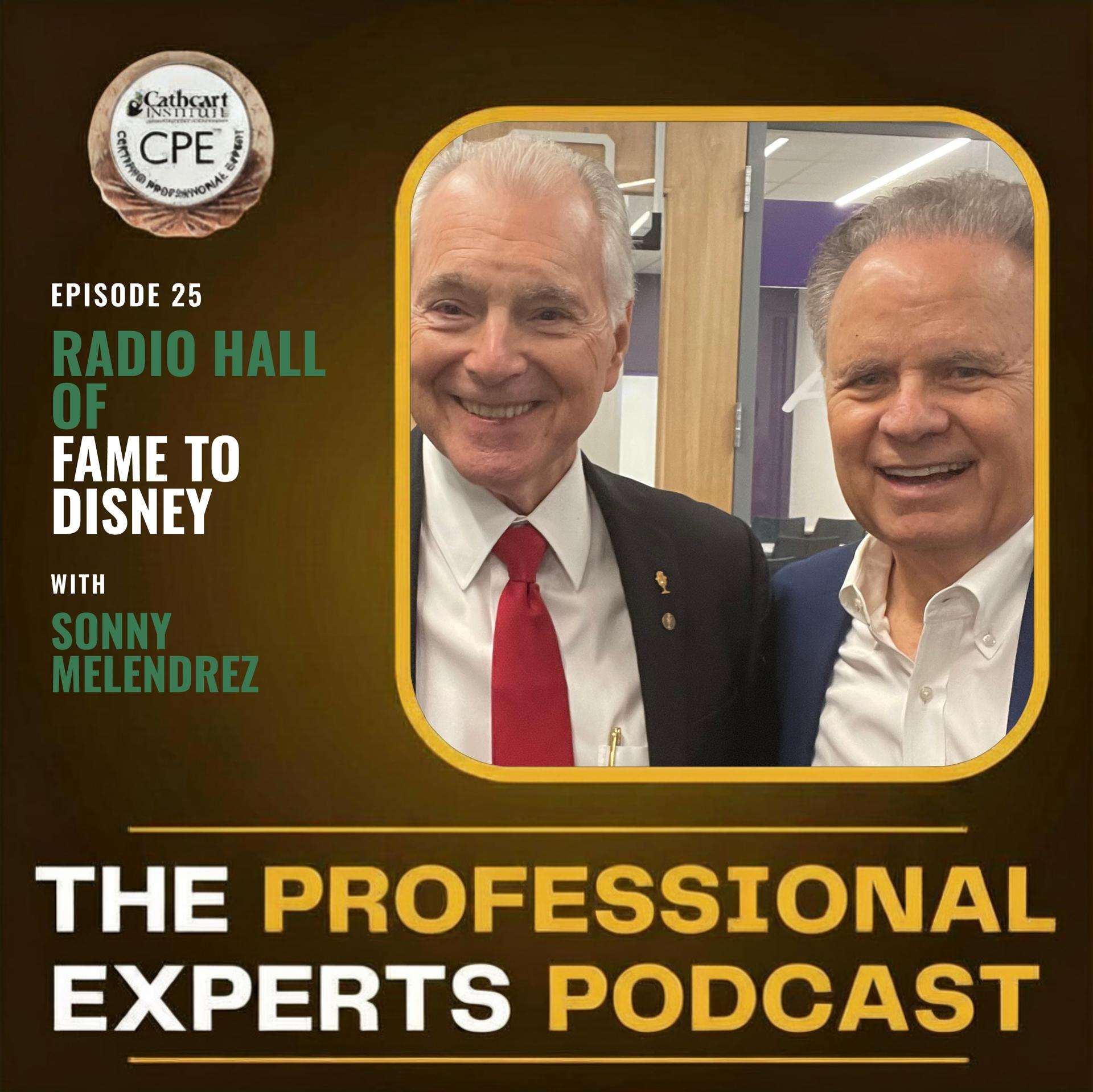
Season 2, Episode 25
Radio Hall of Fame to Disney with Sonny Melendrez
A conversation with Sonny Melendrez
Watch This Episode
About This Episode
Sonny Melendrez joined me for one of the most joyful conversations I have had on this podcast. Sonny is a Radio Broadcasters Hall of Fame inductee, a Disney Channel pioneer, a voice artist mentored by Mel Blanc himself, and a professional speaker whose career spans more than five decades. But what struck me most was not the resume. It was the thread running through all of it: a kid in a tree house, dreaming without limits, who simply never stopped.
The Dream Does Not Wait for the Ready
Sonny grew up behind his father's barbershop, calling friends one at a time from a payphone, playing his little homemade radio shows into the receiver. He was podcasting before the word existed. What he was really doing was giving himself permission. That is the principle I kept returning to in our conversation. Dreams find people who have no idea they are ready. They found Sonny in San Antonio. They found me in Little Rock. The question is whether you give them room to grow.
Intentional Enthusiasm as a Way of Life
Sonny coined the phrase intentional enthusiasm, and he lives it fully. He reflected on three things that powered every success in his career: belief in himself, a clear vision of what he wanted, and gratitude as a daily practice. He writes his goals. He begins each morning in quiet. He treats every relationship as a door with a small glass window, waiting to be opened. That is not a technique. That is a way of being.
What We Covered
We talked about breaking into voice work and radio with nothing but a transistor radio and a dream. We traced Sonny's path from San Antonio college radio to KMPC in Los Angeles, from Hanna-Barbera Studios with Mel Blanc to becoming the first male host on the Disney Channel. We talked about gratitude as spiritual magnetism, the Walt Disney and Mike Vance story about fulfillment, and why the child inside you is not something to outgrow.
Find Sonny Melendrez
You can reach Sonny at sonnymelendrez.com and across all major platforms. Look him up. His story will stay with you.
In the spirit of growth.
About the Host: Jim Cathcart, CSP, CPAE is one of the top 5 most award-winning speakers in the world. His Top 1% TEDx video has over 2.8 million views, his 27 books are translated into multiple languages, including 3 International bestsellers. He is a Certified Virtual Presenter and past National President of the National Speakers Association. Jim’s PBS television programs, podcast appearances and radio shows have reached millions of Success Seekers and he is often retained to advise achievers and their companies.
Even his colleagues, some of the top speakers in the world, have hired Jim to speak at their own events. Jim is an Executive MBA Professor at California Lutheran University School of Management and serves as their first Entrepreneur in Residence. He has been inducted into the Sales & Marketing Hall of Fame in London for his pioneering work with his concept of “Relationship Selling.” He is also in the Professional Speakers Hall of Fame and has received The Cavett Award and The Golden Gavel Award.
Jim has written 27 books, hundreds of articles and he is always writing at least one new book. His most recent book is HI-REV for Small Business, The Faster Way to Profits. Audiences buy his books by the hundreds and he happily adds autograph sessions to his speeches.
https://www.linkedin.com/in/cathcartinstitute/
https://www.facebook.com/jim.cathcart
Chapters
- 0:00Welcome and introducing Sonny Melendrez
- 4:11A tree house, three dreams, and Yogi Bear
- 7:41Mel Blanc becomes a mentor at Hanna-Barbera
- 16:57From a payphone to the radio hall of fame
- 32:06Intentional enthusiasm and daily gratitude
- 40:52Hosting the Disney Channel and living the dream
- 47:19Dreams find people who are not yet ready
- 52:11Walt Disney, Mike Vance, and fulfillment
Notable Moments
“Dreams don't wait for people that are already there. Dreams find people who have no clue they could ever consider being there.”
“Gratitude is spiritual magnetism and it draws to you more of what you were grateful for.”
“You're not just the age you are. You're every age you ever were. They're all inside there. Just let them come out and play.”
“To be grown ups like we are, to remember the kids we were back then, and to know that we have become the kind of person that that little child hoped and dreamed someday we might become. That's called fulfillment.”
“When I could see it, three things were going on. I believed in myself. I had a clear vision of what I wanted. And I never lost sight of the fact that gratitude is the greatest prayer.”
Full Transcript
Hey, folks. Welcome. This is the Professional Experts Podcast, and I am the lesser of two participants today. I'm your host, Jim Cathcart, and this podcast is designed for people who are making a living by being the product of their business. Professional speakers, authors, coaches, consultants, advisors, fractional executives, anyone who's selling the application of their specialty to try to help make life better for someone else or some company. So it's Professional Experts, and, boy, do we have one today. Sonny Melendrez and I have known each other at arm's length, basically, for a couple of years through the National Speakers Association. But you have known him for many years and didn't even realize it. I mean, going back a long way. Although he doesn't look old enough to go back a long way. He was one of the voices of the cartoon series the Jetsons. I mean, this guy's been on stages. He's been worldwide. You know, big event in Paris with Princess Grace of Monaco. Wow. Been acknowledged by President Ronald Reagan, awarded by the. The head of. Of the CIA. Was it, Sonny? It was. Of the FBI, yes.
FBI.
FBI.
One of those, Yeah.
I mean, this guy, he's a professional entertainer. He's a voiceover artist. He's a very inspiring professional speaker. He's a. In the Radio Broadcasters hall of Fame. He's even one of the top 100 radio personalities in the Rock and Roll hall of Fame. So, folks, I'm clearly the junior player today. Sonny, thank you so much for being with us. I appreciate it.
Oh, listen, it's my pleasure, Jim. And believe me, I've told you this many times. I'm really inspired by all that you've done, so don't sell yourself short.
Well, thank you for that. Well, what I want folks to do is get a different view with each of our podcasts. I do this. Get a. Yet a different take on how can you take one or multiple talents and monetize those not just to make a little bit of money, but to build a career path that accumulates and becomes, you know, a collective mass of good things that you can live with for an entire lifetime. And you've certainly done that. One of the. One of the things that I want to emphasize the most is that most all of the experts I've brought to this program have started with no advantage. And clearly, when you were living next door to the Piggly Wiggly behind your dad's barber shop, there was not a noticeable advantage that would get you seven times to the White House to be a spokesperson there or to be part of As I was the Just say no campaign. Wow. How did you even get started?
Well, you know, I tell everybody that when I was, like, 11 years old, my father built a dream machine for my brother and me in our backyard. My little brother. And if you looked at it, you see was a tree house. And I used to go up there, Jim. And usually around dusk, as the stars began to twinkle, I would just sit there and contemplate who I would be, where I would go, people I would meet, and really all that I would become. And I didn't know that you couldn't dream big because when you're a kid, you don't know what you can't dream. And wow. Specifically had three dreams at that young age. One was radio. I was infatuated with the idea that you could talk into a microphone, make people laugh, play music and entertain them and do it for miles and miles around and have hundreds and thousands of people listening to you. That, to me, just blew my mind. But I knew that one day I would be on the radio. One day I'd have my own show. And the other dream, the second one, happened quite by accident. I was watching my favorite cartoon show, Yogi Bear. And I found out, Jim, at this very early age that I had this kind of uncanny ability to. To mimic voices that I heard. So I'd watch Yogi and everything. Every time he'd talk, I would talk, hey, I'm the Ogi bear, smarter than the average bear. And what was his little friend's name?
Boo Boo.
Yogi, Yogi, we're gonna get in trouble with your ranger. Now, let me tell you something. I'm gonna fast forward here for a little bit because this. This completely blows my mind. You mentioned that I did voices on the Jetsons. Well, as my career went on, I went to Los Angeles from San Antonio. And I'll tell you how I got there. But I was on the air on radio station in Los Angeles, kmpc, and an agent calls me and says, have you ever thought about doing cartoon voices? Because I've heard you do all these impressions on the air. I said, are you kidding? Since I was a kid. So within two weeks, he took a sample of my work, and I landed my first job without even auditioning. And I was driving my car into the parking lot of the Hanna Barbera Studios.
Oh, my gosh.
Myself thinking to myself, what am I doing here? I wasn't an intern. I wasn't a visitor. I was there to work with the original cast of the Jetsons. And imagine I'm in Top of the world, Ma.
Right.
You could appreciate this. I'm in the studio and I'm meeting these people for the first time. The original voices, there's daughter Judy, there's Jane, there's George. And I'm hearing these voices, and I'm very professionally introducing myself. I'm looking forward to working with you. I love your work. And inside, I'm jumping up and down.
I can't believe this.
I can't believe this. Yeah, well, the. The. The man that was Mr. Spacy, which was the. The Spacey sp.
I remember the boss.
Yeah, exactly. That was Mel Blanc, the Great.
The voice of all time.
He became my mentor. And on top of that, now, here's the. Here's the crazy part, okay? I'm 10 years old. I'm watching Yogi Bear and Boo Boo. Now. I'm in the room with all these. These professionals. And the voice of. The voice of Elroy was also the voice of Boo Boo. Excuse me, of the voice of. Of Yogi.
Yeah.
And the voice of.
Of.
Of the dog, Astro was also the voice of Boo Boo. So I was not only doing what I dreamt of doing, but I was in the room with the people that
I had heard in the room where it happened. Wow.
Unbelievable.
Bringing up the name Mel Blanc. Mel Blanc was. Gosh, I remember seeing him on the Tonight show with Johnny Carson years ago, and he's just sitting there doing character after character after character. You know, all of his Looney Tunes characters, like Bugs Bunny and Elmer Fudd and. And on and on. No, say again. No. Pepe Le Pew. Yeah, he did that one. And then not Pecos Bill, but Foghorn Leghorn.
Yosemite.
Yeah, Foghorn Leghorn and something Pete.
Yeah.
Anyway, I was so enamored by that as a kid, and to see him later as a young adult talking about that and mimicking that on. On the Tonight Show. And now to know that you hung with the guy, I mean, you spent just quiet quality time with one of the greatest voice artists of all time.
I did. He really became a mentor of sorts and taught me. This is unheard of, but he actually not. Not just how to do cartoon voices, but he taught me how to do many of his voices. You want to hear some?
Sure.
Okay. Here's Bugs Bunny, Sylvester and Tweety, Elmer Fudd and Yosemite Sam.
Yosemite Sam was the one I was thinking about.
There you go.
Yeah.
Be very, very quiet. I'm looking for a widow gray wabbit. And when I fight him, I'm going to Tear him apart. Whim from whimsical. What's up, doc? Have you seen a widow gray rabbit? Big eyes?
Yeah.
Big teeth. Yeah. Big smile. Yeah. I ain't seen him. Ain't I a stinker? Ooh, I tore it. I threw a puddy tat. I did. I talked it to a pudding set. I saw a puddy tat. You bet you saw a puddy set. The puddy tat was me. I'm the wildest rudeness. Tootness shootness. Shit up.
Wow. Fabulous. Fabulous. That brings back so many memories, man. And anybody that's been following Looney Tunes over the years would certainly appreciate that. That little lineup of all the greatest hits.
Yeah, you don't hold back when you're doing cartoons. If we were here in person, you'd be taking the spit off your face.
Yeah, yeah. By the way, I've got a colleague, Lisa Marie David out of Memphis, who has a wonderful Southern voice. And she's just one of these Southern ladies that, when she talks Jim, you know, it's just pure magnolia blossoms and sweet honey on. On. On biscuits. And I told her, you have got to get into the voice business. But that's what a. What a great talent and what an amazing way to be a professional expert. An expert what? Expert at creating and. And living through a particular voice Persona. That's. I mean, it's not just making the sounds, because lots of people can make the sounds, but they can't pull off a convincing effect. And that's. That's yet another dimension to it. Would you comment on that part of it a little bit?
Sure. Well, you know, everything that I do is a stage. Whether I'm on stage behind a microphone, in a. In a session, doing cartoon work, voiceover work, whether I'm on the radio, whether I'm in front of a camera, whether or now I'm on stage as a speaker. Those are all stages. And having done what I did at a very early age gave me all of that experience and all of that confidence. And I learned through osmosis. I literally was a sponge from everything that I learned. And I would encourage anyone who wants to do something, maybe has wanted to do that all their life, to not hold back. Because now we live in a day and age where we have everything. Can you imagine if I had had the Internet?
Wow.
That age when you and I would have been, you know, just trying to do whatever we do with. With the. So there's an incredible.
Yeah. We'd have to go to the public library.
Right.
Look things up and if we were exactly in a town that. With a small library, too bad for us we have to wait till we got to a bigger one because there was no connection between them.
You're right.
Wow. Yeah. So how did you. Better yet, how would you advise someone today that wants to pursue that aspect of it? Say the voice side of it. And then we'll get to radio. How do they break. Break through their own small.
Sure.
Bubble and. And start pursuing it?
Well, there are websites where you can register, build a profile and then upload work. Upload your voices. And once you do that now you have people that are looking for voices and if they. If it, if it's. If you fit the profile, they'll send you an email and then you get the copy of what it is they want done, you send it to them. And what's amazing is that you could be a producer in Australia and put out a call for a particular voice that you're looking for. And as a result of that they get like maybe 100, 200 in just a matter of minutes. Voices. Because people are ready with their microphones and everything else. One of those sites is voices.com. if you go there, of course it
is not only be able.
Exactly. You'll not only be able to. To find out more about how this works, but you'll also listen to the top people who are doing it all over the world. You'll listen to the best in the world and if you think you are. You can get to that stage, you think you're that good, then you should definitely pursue it. But a lot of yeah. Are great among their friends, they're great among the, you know, the things that they do in private. But when it comes because you're. You're trying to do the voice of somebody else, when they want you to be a warm and friendly, you know, 35 year old or whatever, it's, that's, it's not you talking, it's them. So you now have to be. You become a voice actor.
Well, I can see where, where today they would have probably have an AI algorithm in place.
Yeah.
To take that hundred or so voice application samples and to sort through them and file them according to vocal quality, pacing, believability, you know, whatever their categories would be and get it down to the final candidates they're going to interview. A quick question. Do you know the name Bruce Belland?
B E L L A N D No, I don't.
Okay. Do you know the group the Four Preps 26?
Absolutely.
Bruce Belland is the lead singer of the Four Preps.
Ah.
Who used. His band, used to play behind Ricky Nelson. And Bruce was on about 100 episodes of the Ozzy and Harriet show as Ricky's sidekick, Bruce.
Right.
And Bruce did the voices of the. The crows or ravens or whatever they were in Jungle Book. Sitting on the. Sitting on the limb and.
Right.
Singing. Yeah. And he wrote the song 26 miles across the Sea and many, many other songs and still performs even today in his 80s and God bless him. What a. What an amazing guy. Let's go to radio now. I mean, you went from a kid who heard the radio and thought that would be a nice job to a guy who's inducted into the hall of Fame in the same category. Boom. Mic drop moment. How did you even get to a mic in the first place?
All right, so keep in mind I'm just a kid listening to the radio. And my favorite station was a station here in San Antonio. KTSA was a top 40 station. And I would have. I'd spend my allowance buying batteries for my transistor radio because I would play it underneath my pillow all night long. And I would say to myself, one day, that's going to be me. One day. Little did I know that I was beginning to manifest what my future would be. Well, I couldn't wait, Jim, to grow up and get a job. So I decided to make my own shows. I had a little recorder and a portable record player. I had five, 45 records and I would play them over and over. I would introduce them just like they did on the radio and record the whole thing and make these little five minute shows. Then I would play them for my friends on the phone one at a time. I was podcasting.
Wow.
The problem was we didn't have a phone. Our phone was the. The payphone inside the barbershop. My dad felt bad about that because the reason, by the way, the reason we, we lived in the back of my dad's barbershop was so that my parents could afford to send my brother and me to Catholic school and then eventually to college.
And what a wonderful commitment by your parents.
Yeah, it was. So I would go in the dark at night with the three dimes. I'd go to the pay phone, I'd sit on the shoeshine stand and I would dial one friend at a time and. And play my little productions. Now, I didn't realize it at the time, but I was giving myself an experience. So by the time I got to college, San Antonio college, and that happened quite by accident. I was going to Be an artist. I was going to be a commercial artist. I love to draw. So I got all my classes on registration day. I'm walking down the hall, Jim, and I see a door with a little square window on it. And I think to myself, where have I seen a door like that? I look over. Inside is this beautiful site. It was a small radio station, control board and a microphone. Well, my head was spinning. So I, I asked, I asked the somebody from maintenance. I said, what's going on there? He says, well, it's radio, tv, department. Radio, tv. What I don't understand. Well, you get a degree in radio, you can get a degree in radio. I made a beeline for the closest phone call. My dad asked him if I could change my major. And he said, this is what you've always wanted. And I've never looked back. So it's really amazing now.
Beautiful.
Between registration day and the first day of school, it was like September. There was a big teen fair in San Antonio. Teen Fair of Texas. It was Bill that. And it was a 10 day affair with all these popular bands and singers. And they all came from all over the country. They had all had top 10 hits. And by that time I was doing impersonations of the different singers. And one of them was Bobby V. Remember Rubber ball?
Oh, yeah, yeah.
It has a thousand eyes. Take care of my baby.
Take good care of my baby.
Yeah, we could do a duet on that. So I was, I was, I thought to myself, I've got to meet this guy. I've got to meet him. But I couldn't afford the $3.50 for the, for the ticket to get in. And my mom, God bless her, she's reading the paper, she says, son, they're looking for people to sell lemonade at the teen fair. Why don't you get a job there and maybe you can meet Bobby V. I said, mom, you're a genius. And so I did. I got a job. And I told the lady who was in charge of the catering for the press parties. I said, now I'm going to need time off to interview the various singers because I'm with WSAC radio. I didn't tell her that was the college station that broadcasted to the cafeteria.
Close enough.
Sure enough, I get back there and it's the day that Bobby V. Is going to have this press conference. And I walk into this room. He wasn't there yet, but there were five guys just milling about all the food. And I'd recognized them. Their poster said friends of the Beatles and So I, they were from England and so I started talking to them and one of them says, what's that? Pointing to my tape recorder. And I said, that's to interview the, the singers and the bands. And then I realized they're singers in the bands. Why wouldn't I interview them? So I kind of reluctantly pushed record because I wanted to save the tape for, for Bobby V. And so I'm asking questions like, who's your favorite beetle, George? How do you like Texas? I mean, stupid questions.
Sure.
Because this is my first interview ever. Yeah, Bobby.
I knew what to ask. Entry level. There we go. Yeah.
So now Bobby shows up and I make a beeline for him. And I said, I introduced myself and ask him if I could interview him. He says, absolutely. Very gracious. And so there I am asking these questions. Now the real radio people come in and they're going, hey, Bobby. And he says, hey, guys, can you hold it down? I'm doing an interview over here. I'm a 17 year old kid and he's treating me like I was one of the. One of the radio people.
Exactly.
Now here's the crazy thing. The guys, I found this out later. The guys that I was interviewing, my first interview, they had come from England. It was their first American tour. And without realizing it, I'd been among the first in the US to interview Mick Jagger and the Rolling Stones.
No.
Yes.
Oh, man, you're blowing my mind over. And by the way, Bobby V. Was my wife's heartthrob. As a teenager she was listening to him on the radio and just. Yeah. Oh, and even today, you know, when he comes on, she says, yeah, and, and she'll turn it up and, and play one of his songs from the oldies stations. And he was the guy who, who filled in for Buddy Holly after Buddy died in the plane crash on the day the music died.
Exactly.
And he had the same, oh, vocal technique in his delivery that Buddy Holly used sometimes.
And here's what's crazy about it, is that once I made it to Los Angeles, I was on the air and his career had kind of come and gone and he was now going, he went back to Michigan and he was still recording. I think he had a little record store. And I came across an album that came out was like a country album and it was by Robert Thomas Valine. And I recognized it was Bobby. So I call the record company, I said, I'm going to play this, this album. He says, you are? I said, yes, I am. I said, but I want an interview with, with Rob, Bob, this is Bobby V. He says, yes, absolutely. So I then arranged for a telephone interview. I'm in the big studio at KMPC waiting for the call. The receptionist says, there's a, there's a guest in the lobby. I said, I can't, I can't go. I've got, I'm waiting for an important call. Says, no, this is your important call. This is the interview. He, when he found out that somebody wanted to play his music in Los Angeles, he came to the studio and we had like a two hour interview and, and talked about his entire career, as gracious as he could be. And I, I reminded him about when I was 17 and he gave me the, the time of day, so to speak. Just a wonderful guy.
Wow. That there's so many directions we could go from here. But I want to be conscious of our, our listening audience. What we've looked at so far was what I call life seeking expression. I'm writing a book that may be my magnum opus of all the messages I've ever delivered. And that is you. You are meant to exist.
How like.
And thank you. And in the, in the content of the book, one of the first things I, I say is that life needs outlets. And so it seeks a plant, a person, an animal, you know, a brook, whatever looks for something. And so life wants to express itself fully through us. What inhibits it is when we don't do the, the discipline required to be a better portal by developing our skill sets, developing our relationships, keeping our, our mindset in a positive, growth oriented way instead of a reductive and judgmental way. When we do what you were doing in your tree house, what you were doing when you walked down the hallway and said, oh my gosh, I'm going to try change majors. When you were calling your friends on the pay phone, that was a very clear message about the future of Sonny Melendrez wanting to be expressed. And all you needed was to give it permission and develop the skills and the experience that would allow you to become a bigger and bigger microphone over the course of your life. So radio, you got into it at first doing, you know, some of the more traditional gigs. How did it evolve?
Well, after San Antonio College, I transferred over to Texas Western, which became UTEP in El Paso. And that's where I landed my first job at the number one station in town, working weekends from 5am on Sunday till noon. Now, as you know, a radio, the radio show usually is about three to four hours, this was seven hours. And I would look at the Clock. And I would say to myself, oh good, I still have four more. I still have three more. I still have. To this day, whenever I'm doing what I love, I look at the clock and say, oh good, I still have. Yeah, great. I still have. And I was right. A whopping $25 an hour. I thought minimum wage, 200 bucks a month. That's exactly right.
Working, unloading trucks and boxcars for this.
Were you really in Arkansas?
Yeah.
And then from there I landed a job at the competition and, and now they wanted to pay me a dollar fifty an hour full time. And that's where I really became a broadcaster, Jim. I learned all the things that radio could do, public service and just be able to not only entertain a community, but also to, to do things that, that benefited the community.
Well, that got paused for a minute and let the shock effect sink in for our listeners. He, he got a promotion to a full time radio position making 300 bucks a month.
That's right.
Okay. And thought he had arrived.
Oh my goodness, dude, I've made it.
I'm at the top of the mountain. Wow. I've had the same feeling at points in my career that I look back on and laugh with, with gentle amusement. So, yeah, amazing. And then from there, of course, once you're in the business and you're on the air, you start meeting all the people that can open the next doors.
That's right.
Someone told me recently, they said you already know everybody you need to know to make all your dreams come true.
Wow.
Well, that's certainly true for you and me, but it's also true for most other people long before they ever have a sense that it might be true, you know, so we, I think we ought to treat every relationship as the beginning of opening a door with a little glass window in it that lets us into the studio where they actually do radio shows.
Well said, well said. But don't you think, Jim, that it starts with a vision for yourself? If you. Oh, yeah, see that, that and, and that path sometimes is, you know, your own spouse, your friends, your family, they
don't see what you see.
And you can't let go of it, you know, because it's a very.
Yeah. They tell you, hey, when are you going to get a real job?
Yeah, you're right. Exactly.
That's sort of the common theme among all of us is, you know, when are you going to give up on this and get a real job? Well, my, my dream was to either grow up and be a movie actor like Roy Rogers or You know, Tarzan or all my various movies really at the time. Or, or Davy Crockett, who I met twice. Once as a child and once as an adult.
Parker.
Yeah, yeah, Fess Parker. And the other dream was to be a rock and roll singer. And I was gonna. I was gonna go to Nashville because I lived in Little Rock and that was closer than Hollywood or, or some of the other places like New York. And so I was going to go to Nashville and just get a day job, take music lessons on weekends and work nights in clubs until I got discovered and had a career. Well, that didn't happen. But what did happen was you take the acting and the performing and you look at what I've been doing for the last 53 years as a professional speaker and author and trainer. I've been taking performance and not acting so much, but teaching and doing all the things that I dreamed of doing. And then when I chose an avocation, a part time job that actually pays. I play guitar and sing in nightclubs and at events. I've done it all over the world now. But it all started out with me faking an Elvis song when I was 10 years old. You know, Love Me Tender, Love Me True. And. And then me acting and making very elaborate outfits so that I looked like Davy Crockett or I looked like Gene Autry or Roy Rogers or somebody. Boy, I was into it. And I had a tree house too. But something you said a moment ago. And by the way, thank you, dad, and thank you Lord for tree houses. That was such a special place.
Amen.
You said something about envisioning having a vision and a dream. The interesting thing to me in observant is we don't make the dreams, they come through us. We're the portal. And we can either just dream the dream as a fantasy or we can start building a doorway for that dream and make it become the reality. Actually let it become the reality, because it's got all the power. Does that make sense?
No. It does, it does. You know, I also believe that, you know, there's a child inside all of us. And when you're a kid, you have these dreams. And again, like I say, you don't know what you can't dream. But as you get older, you can't tell. Tend to. To get programmed into the. You can't do that. You. That. You know that's not possible.
And all of those are things that make the doorway smaller.
But if you can make that kid come out and play, if you can realize that you're not just the age you are, you're every age you ever were. And if you can go through the file cabinet of your memories, all the great stuff, throw out the bad stuff, and now you've got all these perspectives of all those different people that you have become. It's. They're all inside there. Just let them come out and play.
Someone asked me the other day, how old are you? And I said, same age I've always been, but my body is older. And they said, do you ever plan to retire? And I said, well, no, but my body or my mind might retire me at some point. And if so, I accept. But until then, I'm. I'm going full blast.
Good for you.
And obviously you are, too, because that's what you call intentional enthusiasm.
Right?
How does that. How has that played out in your life?
Well, see, I was reflecting back on my career several years ago, and I was looking at all these serendipities, all these successes, all the things that have happened, and I realized that every one of them took root with this feeling that I had. When I could see it, I. There were three things that were going on. One was I believed in myself. The second one was I had this clear vision of what did. I wanted, what I wanted to accomplish. And the third one, Jim, was that I never lost sight of the fact that. That gratitude is the greatest prayer. And helping others is really our. Our biggest purpose.
That is a hard truth that. I mean, that's one of those foundational rocks, I think, of how the world works. Gratitude. You know, people think, oh, thank you. You know. No, really, I really appreciate that. Okay, That's a. That's a superficial expression of gratitude. And it's a good thing to do. It's polite and it's courteous and it's appropriate. But gratitude is deeper than that. I was in charge of a big event at the Ronald Reagan Presidential Library when they dedicated the Air Force One Pavilion. And ours was the first public event in that pavilion. It was a fundraiser for the Boys and Girls Clubs, and we had 409 people come out and raised a quarter of a million dollars for the Boys and Girls Club. So it was a big win. But the joy and the honor of being the first in that place. First ever, you know, can imagine. First ever was Nancy Reagan having a thank you lunch for the donors. But the first public event was our event that. That afternoon and evening. And after our event was over, I told my committee, and I had 71 volunteers on my committee. We started with two and grew it to 71. I said, Folks, you're not off duty, the event's over and we received the funds, but you've got a new job. You are now the gratitude brigade. And I said, we had 409 people come to this event. Some were guests, some were just tag alongs, you know, that had no connection with us at all. But all of them get us now. They've been here, they felt it, they see it, they know who we are. We don't have to go seeking them. They've already found us and we found them. So I want them to feel thanked. And they said, okay, I'll, you know, I'll, I'll thank people, I'll send notes and I'll make phone calls. And I said, well, those are all good things, but you could send someone 11 different forms of thank you and they'd still not necessarily feel thanked. So the goal is not to send, not to express, but to impact. Your goal is to get all 409 to feel our gratitude because gratitude is spiritual magnetism and it draws to you more of what you were grateful for. Thank you, Lord.
That's it. That's it. That's what I. Every morning I, I not only I actually write my prayer. I good for you. End with, with good morning, God. And then I begin with thank you for this, thank you for that, thank you for all these blessings that, that are in my life. And, and then I sign it, I dated and signed it.
What a wonderful practice.
You looked at my, my journal. It's not really a journal as much as it is just a, a thank you book. You'd see all these days that sometimes I have a little small prayer, sometimes I have a big long one. But I found that in writing them there's a certain, I don't know what it is. It's like not only when you're writing a letter to someone, it's different than sending them an email or a text or even a phone call, but to be able to write something down, it really kind of puts it inside your heart and it keeps it there and it also sets the stage for the rest of the day. You know, there's so many people who start their day with negativity, whether they're listening to the news or whatever. But when you start your day in a very positive, grateful way, now you're able to really open the curtains on, on this, these coming attractions that are, you know, just, just wonderful because we have so that grateful for.
Yeah, that is a thing of beauty. And I want our listeners to seriously consider that I Often share a photograph of some notes from my goal setting back in 1974. I think you saw it the other day at that national speakers meeting.
Yeah.
Goals that are written or goals. Goals that are not written are wishes or intentions. An intention is not enough. Intentionality is powerful when you act on it, but intentions are not enough. And writing things down I love. I'm inspired by your example of written prayers each morning. I've got a rule in my own life that I will not begin the day by listening to the radio or television. I begin the day with quiet in my mind so that whatever I woke up with has more room to grow.
Right.
I find that even before my head leaves the pillow in the morning, a lot of times I just lay there a little longer to work on whatever that awareness was or whatever that item happens to be. It matters for sure.
I agree. I agree.
So all of a sudden, you've reached the peak. Not all of a sudden. After all this work and all this experience and all this joyful living, you reach the pinnacle of an assortment of industries, and you're working with the people whose names are world famous. And you've got a photo collection of you standing beside. Oh, my God, the entire 20th century and a big chunk of the 21st. Seriously, I mean, it's amazing. I mean, not just the Rolling Stones, you know, but the Princess Grace and the presidents and the everybody else. Wow. So at that point, top of the mountain. Where's the next mountain? What do you do at that level?
Well, the third dream that I had as a child was I knew that one day I was going to work for Walt Disney. I would watch the Mickey Mouse Club, the Wonderful World of Disney. And I thought, I want to be a part of that fun. And I didn't know how, but I told my mom one day, I'm going to work for Walt Disney. Says, I know you will, son. I know you will. Well, in 1981, I found out that Disney was going to have its own channel. And I thought, this is my chance. I'm going to host a show on the Disney Channel. And I didn't wait for that, you know, to read in the trades that they were having an audition for this or that. I created a show, got my agent to get me in front of the suits. There were three men and all wearing suits and a young. A lady. And. And so I walk in, my heart's beating out of my chest, Jim. And they said, okay, Sonny Melendrez, what do you got? And so I said, okay. It's called Saturday in the park, go to parks all over the country. And I have 20 kids with me. And as we go through the parks, we'll have all the guest stars show up and they'll perform at this park and that. And I'm doing all my gyrations, and at one point, I see the lady looking at one of the men going. And I'm thinking to myself, great. They're making fun of me. And so I just kept going. And so when I finished, they said, sonny, that's. That's a nice idea. Not what we're looking for, but with your enthusiasm, we think it'd be perfect for a show we're about to produce called you and me, Kid. Would you be interested? Yes.
Yeah, let me. Let me get back to you. Yes.
Yeah. Anyway, I ended up hosting. I was the first male host on the Disney Channel, and I ended up hosting this. Oh, my goodness. So such a precious program with real parents and real kids, and I would lead them into all these different activities, and then at home, you would do the same with your child. Hence the name you and me, Kid. But it was just one of the most wonderful experiences, and it ran for nine seasons.
Wow, that's impressive. And I love the fact that it engaged the audience, even though it was through the television.
Right.
It was like Winky Dink. And you at the early days of TV was the first show to ever cause the audience.
By the way, if you're listening and you're a millennial, you're going to have to Google all these terms and.
Oh, absolutely. Yeah.
Because we're going down memory lane here.
We're. We're talking baby boom archives. Let's. Let's dust them off. Blow the dust off. But it's worth it, because today you can get that on YouTube and you can. When we were growing up, you had to go somewhere to get it.
Yeah, exactly.
Oh, man, I'm so tempted to just gush all the childhood memories that are connected with what you were doing in the world, but that's not what. What we're here to do, you know, what we're here to do is to not only inform and entertain professional experts, but to give yet another example of one more thing they could do that could turn into the most fabulous career that you never even considered might be a reality and thought maybe it was only a fantasy you had at one time. So today, I mean, clearly, you. You're still intensely active in the marketplace. I'm just getting started. Part of your activity today?
Well, my. My big focus today is on speaking
and on speaking at conventions and such.
Exactly. I usually do the opening keynote for, for conferences. And what I love about it is that I'm, you know, for the longest time, when you're on the radio, you're imagining the audience, your, your, your, your, your applause comes in the telephones when you get the calls or you meet people, you know, on the streets, but with, with being on stage, and I didn't even know this was a career. And so being on stage, as I have been for the last 20 years, actually all my life, but as a professional speaker, it gives me such great joy to be able to, to not only use these stories to inspire people, but also to let them know that it doesn't matter where you are. You know, dreams don't care who the dreamer is or where the dreamer came from or what the background is. All you have to do is have one and do something about it. And, and that's what I, I, I've been able to do. I think I just lost your sound. I can't hear you. Can you hear me? Hold on, Wait a minute. I can't, I can't, I can't hear you.
You can't hear me yet?
Oh, yeah, now I can hear you.
Okay.
I don't know why.
I've got a unstable network connection.
Okay. So anyway, and so really, when you are able to do something, it doesn't matter. The dream doesn't care who the dreamer is. All you have to do is just start, do one thing, another, another, another. Because the work will show you how that's true.
And can you hear me? Okay?
I can.
Can you hear me? Good.
Can you hear me now?
Yeah. The, the thing that I noticed about that is dreams don't wait for people that are already there. Dreams find people who have no clue they could ever consider being there. They go to the back of a barber shop next to a Piggly Wiggly in San Antonio, Texas, and they find some kid and they say, I think I'm a, I'm going to come through this one, you know? Or they go to Little Rock, Arkansas, to the son of a telephone repairman, and they say, I'm going to come through that one, so I'll see you at the top. As Zig Ziglar used to say. Yeah, and that's such a beautiful thing. And I just, this has been joyful, and you're such a generous friend to, to agree to be part of the podcast.
It's my pleasure. And let me just insert one other thing here. Don't you Believe, Jim, that sometimes things are never the way you think they're going to be. And you can have the best of intentions, you can have put all this work into this dream that you've got. And, and it didn't go that way, but something else even bigger opened up. Don't you think?
Yeah, absolutely. That's the thing. My, my brother in law, Sam Duggar, just retired from Delta Airlines after a lifetime of flying all over the world. When he was eight years old, he told the family, I'm going to be an astronaut. His dad worked in a factory. He had four sisters, older sisters, and his mom took in laundry to help pay the bills. And they were in industrial neighborhood in Tulsa, Oklahoma, and then Little Rock, Arkansas. That's where he grew up. And he had no hope of ever becoming an astronaut. And when I married his sister, he was 13 and I sat down with him and we worked on that goal
a little bit, really?
And he's. Yeah. And he started taking his goal seriously. And he went to high school with that in mind and never ran with the bad kids, never got in trouble, did exceptional work, graduated as valedictorian, joined Air Force rotc. And when he graduated high school, he was able to get nominated to and accepted by West Point and the Air Force Academy.
Wow.
He took the Air Force Academy. He majored in astronautical engineering, graduated, went on to fly an assortment of jets, and then flew the big C130s, the transport jets, planes all over the world. And then he said, you know what? I don't want to be an astronaut. That's all in on one pathway. And it's your entire life. I just want to fly airplanes. Wow. And so he became a commercial pilot and he's a happy clam. You know, he just, he looks back at his career and says, yep, that's what I wanted to do.
Meant to be.
But he, yeah, he wouldn't have gotten
there had he not had that particular dream to bring him to that stage. Yeah, you're right.
And if I hadn't been dressing up like all the characters in the westerns and the other movies that I wanted to be like, you know, it wouldn't have been nurturing the dream that became me the professional speaker in the hall of Fame and all the things I've had the privilege of doing. So what a great thing to be in a position like you and me and be able to look back and see that entire path back to that inexpensive little bedroom with, with just a few pieces of furniture, you know?
Yeah. Wow. I know what you're saying? Yeah.
And to know that we didn't close the door behind us.
No, not at all. And also to know two other things. One is we have helped other people along the way. I remember there was a. When I was on the radio at KTSA in San Antonio, the radio station was in the middle of this. Of this field with all these blue bonnets, and there was a little trail looking out from the control room window. And this one kid came on a bicycle every afternoon. He'd park his bicycle. He had a little radio that was duct taped to his handlebars. And he would sit there and he'd watch me. I had to do the afternoon show. And then when it was over at 6, he would get on his bike and just going back and he did it over and over. And I went out and I would encourage him. He wanted to be in radio. I would, you know, give him tickets. Yeah. And then one day, Jim, he stopped coming. And I wonder whatever happened to that kid 20 years later again. No, no, the young man, he was now older, obviously.
Yeah.
And he had. After. After high school, he had gone to college, majored in radio and television, and was now the general manager of a radio station in upstate New York. And he said in the email, he said he'd never forgotten how kind I was to him. And he'd always look for an opportunity to help someone else who wanted to get to where he was.
Wow, that comes back to gratitude once again.
Yeah, yeah.
Man, that is beautiful. Well, I want to wrap this up with a quick story that you'll be able to identify with.
Good.
I don't know if you met him, but Mike Vance was the first. The foundational president or head of Disney University for the internal workers at Disney.
Sure.
And he was in LA area and he was on a TV show and. And Walt Disney came to him and said, hey, you know, my daughter and I were watching your show and I. I want you to come work with me. So Mike came and worked with him. One day they were in Disneyland, and it was a rainy morning. You know, it doesn't rain very often in Southern California, but it does. And he was standing there at Disneyland before the park opened under a little awning. And Walt Disney drove up and ran through the rain over to where Mike was, and he said, mike, it's raining. And Mike said, yes, sir. And he said, don't you realize rain is something you get out into? And Mike said, no. And he said, well, come on, let's walk in the rain. And so they go, they're splashing through the rain, you know, jumping in puddles like little kids. And they're, they're grown adults, you know, and they're going through Disneyland. It's not open yet. And they stop in front of one of the storefronts on Main street with all the little frames around the glass in a bay window effect.
Yeah, yeah.
And they're looking at the rain going down and Walt turns to Mike and he said, Mike, you remember when you were a little kid how much fun it was to sit inside a window like this and look out at the rain? And Mike said, I sure do. He said, do you remember while you were sitting in there thinking, boy, you wait till I get to be a grown up what I'm gonna do. And Mike laughed and said, yes, sir. And he said, you know what's nice, Mike? What? To be grown ups like we are. To remember the kids we were back then and to know that we have become the kind of person that that little child hoped and dreamed someday we might become. And Mike just said, wow. And Walt said, that's very important, Mike. Do you know what that's called? No. It's called fulfillment. And it's something every human being dreams to achieve. And then here's what he said as his closing statement to Mike that I'd like to make as my grateful statement to you for being here today and to our listeners as well. I hope you always have the kind of thinking that'll cause you to be the sort of person that as a child you hoped and dreamed someday you might become.
Wow. Wow.
Thank you, Sonny Melendras.
Oh, thank you, Jim Cathcart. You just gave me such an incredible gift because you told me a story of my hero and what he said was like, you know, coming down from the mountain. But you're right. How lucky we are to be able to still have the joy that we had when we were children, pinch ourselves and say, I can't wait for what's next.
Absolutely. Thank you, my friend. It's been wonderful having this time with you.
Oh, thank you. Thank you so much, Jim. And congratulations on all that you've accomplished. You're thankful. My hero.
Thank you. Well, how do they, how do we reach you?
Sunnymelendres.com sonnymelendres.com if you go M E
L E N D R E R
E Z D R e Z yeah. M E L E N D R E Z and, and you'll find me online and you can, you know, all on all the platforms and as a, as new platforms show up. We'll. We'll do the same thing. We'll splash through the rain.
Dynamite. Well, I'll send you a link to this and. And you're welcome to share it with anybody. Thank you. You can bet I'm going to be sharing it.
Thank you. God bless you.
Take care, my friend. You
Nurture Your Nature.
Never Miss a Conversation
New episodes drop regularly. Subscribe on your favorite platform and never miss a conversation.