
Season 2, Episode 3
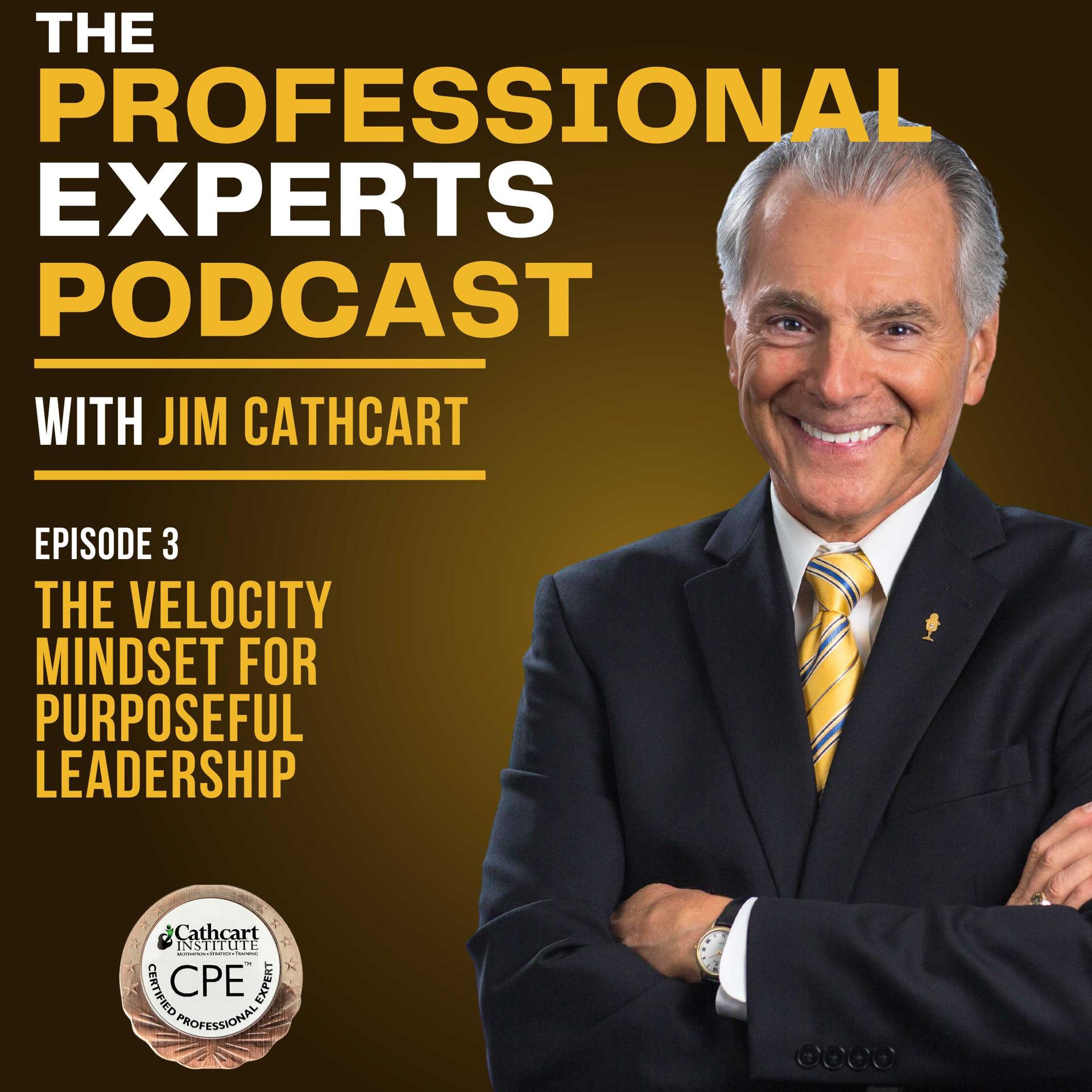
The Velocity Mindset for Purposeful Leadership
A conversation with Ron Karr
About This Episode
In this episode
, host Jim Cathcart is joined by Ron Karr, a distinguished Certified Professional Expert and the creator of the "Velocity Mindset." Known for his profound insights and strategic approach, Ron Karr discusses the essence of effective leadership and communication, advocating the importance of listening to and understanding audience needs to drive meaningful engagement. He elaborates on the evolution of the "Titan Principle" into "Lead, Sell or Get Out of the Way," providing a framework for unifying corporate cultures and enhancing performance. Ron shares compelling examples from his career, demonstrating how focusing on significant problem-solving has led to substantial outcomes, including helping a company recoup $8 million and facilitating a $1 billion business unit sale. The episode underscores the value of aligning actions with clear goals and purposes and explores how the art of pause and strategic questioning can redefine leadership and client interactions. This episode is a must-listen for professionals seeking to deepen their expertise and achieve measurable success through purposeful actions. Join us for an engaging and thought-provoking discussion that promises to deliver valuable lessons and strategies from one of the industry's leading minds. Tune in to discover how to transform your approach to consulting and leadership with the profound insights of Ron Karr.
About the Host
Jim Cathcart, CSP, CPAE is one of the top 5 most award-winning speakers in the world. His Top 1% TEDx video has over 2.6 million views, his 25 books are translated into multiple languages, including 3 International bestsellers. He is a Certified Virtual Presenter and past National President of the National Speakers Association. Jim’s PBS television programs, podcast appearances and radio shows have reached millions of Success Seekers and he is often retained to advise achievers and their companies. Even his colleagues, some of the top speakers in the world, have hired Jim to speak at their own events. Jim is an Executive MBA Professor at California Lutheran University School of Management and serves as their first Entrepreneur in Residence. He has been inducted into the Sales & Marketing Hall of Fame in London for his pioneering work with his concept of “Relationship Selling.” He is also in the Professional Speakers Hall of Fame and has received The Cavett Award and The Golden Gavel Award. Jim has written 25 books, hundreds of articles and he is always writing at least one new book. His most recent book is HI-REV for Small Business, The Faster Way to Profits . Audiences buy his books by the hundreds and he happily adds autograph sessions to his speeches. https://cathcart.com/ https://www.linkedin.com/in/cathcartinstitute/ https://www.facebook.com/jim.cathcart https://www.youtube.com/user/jimcathcart Tedx: https://www.youtube.com/watch?v=-ki9-oaPwHs
Full Transcript
Welcome to a thoughtful discussion of important ideas among people who are committed to succeeding in life. This is a gathering of leaders from a variety of industries and our role here is to help you reach the top 1% of your field of choice. I'm Jim Cathcart, so come with me and let's discover how much more successful you could be. Hello, folks, and welcome to the Professional Experts podcast. Our special guest today is Ron Carr. Now, what makes Ron Carr the best choice for today? Well, he's a professional expert. He is. He's certified professional expert through Cathcart Institute. Let me tell you a little bit about Ron. Ron has worked with leaders on six continents to eliminate risk, gain, buy in and achieve better results faster with what he calls the velocity mindset, which is his trademark. His presentations and his advisory services have generated over a billion. That's with a b billion dollars in incremental revenues for his clients. Pretty impressive stuff. Ron's the author of five books, most notably his latest Velocity Mindset and the best selling lead Sell or Get out of the Way. Love that title. Ron facilitates the Chief Revenue Officer, Mastermind Group and he calls that CRO. And that's made up of CEOs and VPs of high growth companies that are looking at to build high performance sales cultures. He's also passed in the past, served as the 2013, 2014 President of the National Speakers Association. I was president of that group many years before that and I worked as part of Ron's team during his year. So let's welcome Ron Carr. Ron, glad to have you on the show.
Thank you, Jim. It's a pleasure to be here with you.
Well, one of the things you talk about is turning vision into reality using your trademark, the velocity mindset. Now, velocity, I think of velocity as rate of advancement toward your goal. How do you define it?
Well, everybody has that definition. If I ask an audience, what, what do you think of when you think of velocity? They all say some version of speed. Well, as you said, advancement. But if that's all you think it is, then you're not going to get velocity. You will probably get burnout. The physics definition of velocity is speed with direction.
So.
So this is going to give.
There's got to be a target, there's got to go or it's meaningless.
Absolutely. Now this is where we're getting to. I found in my work with high level executives, all the way down to lower level executives, that they all do the same thing. They are prisoners of their to do list.
Yeah.
And they're not centered on Purpose. Purpose is your direction. Purpose is the place you want to get to. You have to start with first, the purpose, the end in sight. You got to start with that first and then move your way back. Jim, take it like a pilot. If you went to an airport in Austin and you asked a pilot where we're going, and if he says to you, wherever the winds take us, would you stay on that plane? And the answer is no, right? Because when a pilot does, it starts with the end in sight. First he says, I'm going to Newark ewr. That's where he's going. Now, he works his way back and picks two or three waypoints so he knows if he flies over those, he's on the right path. And then he factors in obstacles like wind speed and lightning and all that good stuff to come up with the safest and fastest flight plan to get to Newark. The problem is, if you are not always asking this question of yourself when you're about to do a task, Is this germane to getting to Newark your purpose? Then you're probably going to be doing quite a few tasks that are not germane. It's going to hinder your performance. It's going to prevent you. It's going to create drag in your velocity, and you may not even get there to begin with. And the way I like to talk about it, because, Jim, as you know, doing this work like I do, and I personally have this trouble, if we ask someone, what does success look like to you? It's really hard to answer that sometimes. And I was interviewing Nito Quebein, former president of nsa, a good friend of ours, president of High Point University. Nito was kind enough to write the Forward to the velocity mindset. So when the book came out, we did a a live on Facebook, and I said, nito, you know, you have a great story. You came from Lebanon with $15 in your pocket. You settled in High Point. You had a vision of what you wanted to become in the U.S. talk to us about that. And Nito gave me a distinction that will last a lifetime. He said, ron, I had a vision. But the clarity of vision comes from walking the journey. And that helped me even because I realized when I'm having trouble getting all the details of the vision, it's okay, because you and I know this book, the Science of Getting Rich by the Science of Being a Millionaire, written by Wallace Wattles. One of the things he talks about, the people that were the. The industrialists who made it big, they had one thing in common. They were all comfortable not having the answers up front.
So put a frame around that. They were comfortable not having the answers up front. So many people say, you know, I would set a goal if I knew how to get there. No, no, no, no. You know, kind of like you've illustrated, you set the goal whether you know how to get there or not. And then it becomes more and more clear as you walk that journey.
Yes. So what Wallace said, let's suppose he didn't use this example. I made this one up. But let's suppose in the 1990s when New York's starting to clean itself up and it's moving up Manhattan and 110th street is still in disrepair, but you drive by and you see this huge block long building that has so much potential and you think it's coming up to that part. And you say, this could be a great rehab. But I never did that before. I know I do it. I don't have the answer. 20, 19. 19 out of 20 people like that will have that same thought and keep driving because they don't have the answers. But that one person will stop and they're okay not having the answers. All they know is have this vision in your head and let it sit in your conscious moment, every waking moment, and questions will come to you, answers will come. Then before you know it, he goes to an architect who takes the ideas out of his head, puts it on paper, creates a model. Now you can touch it, feel it, look at it, it starts becoming real. Then he figures out how to build it. No clue. Calls a subcontractor. They get educated and what the process is. Before you know it, the building goes up and it becomes a reality. Yeah, but the only reason it worked was because that person didn't stop because he didn't have the answers up front.
That's the thing you hear so many people say, oh, I had that idea years ago. But they didn't do anything with the idea. I did that in Tulsa, Oklahoma. I was a jogger on Riverside Drive every day. And I thought, you know, this little place right here would be a good spot for a runner center where you could have lockers where people could put their bicycles and things like that and have them ready whenever they wanted them. And you could have a concession stand and so on. Anyway, I put it all down on paper, but then I. I didn't see how to monetize it and so I just let it go. Well, sure enough, about five years later, somebody did almost exactly what I had in mind. And I hadn't told a soul about it.
So I find at that one point when you were thinking about it, you had no idea how to do it. What I started doing that helped me a lot in those situations. I said a friend of mine who was a mentor to me told me, number one, get in touch with somebody, talk it out. Because what you're thinking about, you're creating a story that may or may not be true.
And that's a committee. So pretty limited point of view. Yeah.
Yeah. So just by talking to somebody who knows something, all of a sudden ideas come to you and either keeps the conversation going or maybe then you have a legitimate reason to give it up. But most people don't even take that step.
Yeah. And they certainly don't take the time to write it down. I mean, I at least that much. But had I done more, you know, I possibly could have been the owner or the leaseholder of that site. And that might have been fun. But I'm content that I didn't do it. So I'm not. This is not sour grapes. Yeah. So let me tell you what I've gained so far is all of us know about how to work harder. All of us know that if you keep working harder, you'll probably go farther. But what I get from the velocity mindset is that purpose has to be the driving force, not harder work. Because harder work on the same things without a clarity of purpose is just going to consume all your energy and your resources.
And just to extend that one bit, if you have purpose, you energize, you move forward, you get through obstacles, and more importantly, you're thinking clearer and your creativity is being unleashed.
Yeah. That really adds credence to things we've heard. Like Simon Sinek says, start with why? You know, when I, when I'm doing the coaching that I do in the professional experts academy, the opening question I have for people is, what do you want? What do you really want? Let's get clarity first. Everything else comes.
We, you and I speak at conferences, but I also get called in by boards and CEOs to work and create the culture. It's not just the sales team. And I say, well, we'll start with doing a make sure everybody's at the same wavelength in the C suite. Oh, don't worry about it. They all are. I said, I understand, but I need to have this conversation. And 99.5%, there's always disagreement. And the point is, if we don't get them clear and agree to on a path, think about all the drag in your velocity as an organization is going to creep up when people are doing tasks that are going against what you're doing.
Yeah. You know, I think of another application of this. If you ask parents, what do you want for your kids? A whole lot of them are going to say, I just want them to be happy. And I say that's negligent parenting. What? How is that negligent parenting? Because if you just want them to be happy, it's kind of like I just want them to smile. So I'm going to give them sugar for their meals. Right. Because happy is the sugar. And what they need is nourishment, which is the protein and the minerals and such. And that comes from guidance and it comes from helping them set goals and helping them face their fears and learn how to overcome their hang ups and inhibitions and so forth to become a self sufficient adult.
And that's what I do when I coach even CEOs, I'll say, I'll say so and I'll say, what comes up for you? Because I'm trying to assess how they're internalizing it and how they think about it. And then I'll say, okay, now that you have this, what's your next step? And they'll say, well, I'm not sure. They said think about it. Your purpose is this. What's the next step? Well, what did you tell me? I said, because if I tell you I'm taking away the learning you're going to get by you figuring out on your own. But don't worry, I'll be here to have the guardrails on.
Yeah. You don't learn by reading a book. You learn by interpreting what it told you and then applying.
And that's because we as a society have changed over the years. We always want that magic pill. There is no magic pill. But there are processes on how you can concentrate on what you want and making sure you're doing what you have to. So A, you get there and B, you get there in the fastest way possible.
So one of the things you teach is the art of the pause. But the art of the pause, that sounds like a compelling idea and it sounds like something anybody could do. But there's got to be a technique to it.
Yeah. So this came from my first sales job, Jim. I was selling copiers and I was seduced into this job in 1980. Tells you how old I am. It was when they came out with the first plain bond copier, meaning no more liquid, no more spills in your clothes. Simple cartridge pull out, put in it was so simple, and it created 15 crisp copies. And they seduced me, and I said, do you have the collar? Oh, don't worry about it. It's coming in a few months. The other duplicate it. Don't worry, it's coming out. So all you have right now is a great copier. Fifteen copies? Yeah. Okay. I took the job because I always like a challenge. So I go into my first office manager cold calling at that time, and I tell them, selling copies. And the first thing she says is, well, can you meet what we have on the third floor with the big Xerox machine? And said, what, the one that correlates and duplicates and does all that stuff? She goes, yeah, no. All right, come back when you can. Well, after that happening about multiple times over three months and my butt getting black and blue from having the door headed too many times, I decided to have a board meeting. Now, who do you have a board meeting with in New Jersey? When you're out there by yourself, you have it with me, myself and I. So. And where do you have a board meeting in New Jersey? What was that?
Mandatory attendance?
Mandatory. Tenants. And where do you go? A diner. That's where you go in New Jersey. So I'm sitting in the board meeting and I'm saying, okay, so what's the problem? I don't know. I'm having a conversation with selling a copier getting nowhere. They want to compare me to that big machine on the third floor. I can't even touch it. Well, what are you selling? Copier? Is that really what you're selling? Isn't that how you do something? What's the outcome? And I started saying, well, you know, it's probably a communication vehicle. I say, well, why don't you do something different? Next call and talk about communications. So I go to the next call and speak to an office manager who saw me, and I said, would you agree with me that a copier is nothing more than a communications vehicle? She said, absolutely. And Jim, I felt like I was a psychiatrist and she was the patient on my couch. She goes, well, can you share with me what the issues are when it comes to using copies and communications? And she goes, how much time do you have? She goes, it takes Sally or Bob two hours to make one single copy. They get up from the desk on the first floor, they go to the staircase, they chit chat with everybody along the way. They go up the stairs, and then they have to wait behind these three behemoth jobs to make one copy. And then 20 minutes later they make the one copy, then they come back
and have the half hour trip back.
Chit chatting with everybody on the. I go, wow, how often does this happen? She goes, we have two full time employees. And out of nowhere I said, how would you like those two full time employees back? She goes, how are you going to do that? I said, look, I'm not here to sell you a copier. I'm here to sell you three. Because you got the big one on the third floor. You got to keep that because it's great. But what you don't have is a solution for your one and two copies and you're wasting two full time employees. You put one on every floor, you get that down from two hours to 10 minutes. You get your two full time employees and whatever you spend on those three copies you'll make back in multiples. And she bought three right then and there.
Brilliant. Brilliant. You go to.
So the point is we're not even sell it.
Yeah.
We're not even selling the right thing. I'm selling a copy of that's the how. Like when you and I go for a speech or consulting. We're not selling the speech or consulting. That's the how. We're selling the outcome. Someone wants the purpose.
Exactly.
If you just think about that and then ask yourself, what do I have to do to get to that purpose? Most things will usually fall into place.
Yeah. And it's the outcome that's worth paying for.
Right. That's the value.
Copier is not worth anything. But the effect of a copier is worth a lot, as you just illustrated.
Yeah. When you want to buy a drill, you're not buying it for the features. You buy it for the 3 quarter inch hole you need. Once you know you need a hole, then you look.
So the art, the art of the pause would be interrupting your own thinking and your own behavior long enough to rethink and get a different perspective.
Yes. And here's the payoff. When we speak to others or do things, we start creating story in their minds. They take what I say, they take what I do, they mix it with their biases, with their experiences and then they know what I am talking about. So two things are coming out. A. Is the story serving them well? If it does, don't touch it. Let it be. Like for example, a teacher, a music teacher is doing tryouts in elementary school. Two kids have no talent whatsoever. Kid A, she goes to kid A and says, you have absolutely no talent. Don't waste your time. Do something else that you like that kid will never speak to that teacher again and will never look at music and will hate music the rest of their life. Kid B gets told the same thing. Only difference now is they take it differently and create a different story. They're now bent on proven it wrong and becoming the best piano player in the world.
Yeah.
That story you're not going to touch. Let them go, become the. Unless it becomes too much and then disregarding their family and so forth. But the first story is not serving the person well, Kid A. Because they're taking it like they're never going to like music. And that's not what she was saying. She wanted a kid to have fun. And so all of a sudden now he created a story that's not going to serve him well. Well, Jim, here's the good news. He who writes the story can we write. Yeah.
He who writes the story can rewrite the story.
That's pretty awkward.
Yeah.
So the reason of the pause and the board meeting is to really look at it a little deeper than what you've been looking at and to make sure that the story you created is real or if it's not serving you well, like it wasn't for me in a copier looking at what the real situation is to find a potential different road to take. And in this case at work. And I thought it's. It became when every time I called my manager in that job and he swore it was me, he'd answered major account desk. So I was selling agreement at a time or whatever.
You are really good at asking questions. And the questions that you posed when you were meeting with yourself that day at the diner were brilliant questions. How do other people learn to ask those kind of questions?
Yeah, I'm asked that a lot. So let me tell you how I hone that skill and then we'll try and apply it to everybody else.
Yeah.
I was the son of a Holocaust survivor, wasn't in Auschwitz, but that caught by the Russians was put in a penal colony for two years. I'm very, very hard life. And you get damaged mentally. And it's been proven that children of Holocaust survivors tend to be abused. And I was physically and verbally, not sexually. But he had no patience because of what he went through and very restrictive life and a very painful life if he didn't do it the way he wanted it to. And then you had to make excuses. You know, when a knife got thrown into your head and you had some bleeding, you had to say you tripped because you didn't want put Anybody in trouble, all that stuff. So I had to, at an early age, learn how to think ahead.
Yeah.
And to me, the outcome was not to get beaten up. And to me the outcome was, you know, to have a good life. And I always had a positive frame, but that just really honed in me the ability to see five steps ahead. So my value to my CEOs is when they're talking, I'm not thinking about where they are now. I'm thinking about where to try to go. And I'm thinking about all the red flags that are in my mind and that's where we have conversations about. And then eventually I'll either validate what they're thinking or they'll see it from a different perspective that will lead to a different way of doing it that turns out better.
Most of the time you talk about the neuroscience of influence and the role of intuition. How does that fit in? It seems like that's what you're describing, but you're telling us stories.
Yeah, I stumbled on this in 2000. There was a major financial services firm that had brokers. This one knew their ideal market, which was retirees because their offices were only staffed by one agent. So they couldn't get people that will keep trading all the time because they wouldn't have time to work for other people. So they wanted a conservative investor that would come in, talk about their goals, have a plan, agree, and come in every quarter to make whatever treats they have to make. And they would cold call these people because they were home. So I'd be in Chicago. We call, calling the Outskirts. And the first call we went in, this agent that was there for about four years and doing pretty well. He spends 12 minutes trying to build a social relationship. Oh, you got pictures of the Bears. It was a horrible game, wasn't it? And they're talking about that for five minutes. And then he goes and, oh, these are your grandchildren. Six of them there. Tell me about them all. You know, and they go, tom and Betty and Louie. And I'm like, oh my God. And I. And these are perfectly nice Midwesterners. Very polite, but you can see their eyes are rolling. Like, what are these guys doing here? And then after 12 minutes of boring them, he goes to a question that just close the conversation. It says, so what are you doing with your stocks and bonds? Now? If you're going to call somebody, they probably have an advisor already. So that's what you're doing. You just did low level positioning and they don't want to talk to you. And that conversation is ending one way or the other. So let me explain to you the hormones. Cortisol is the fight or flight hormone. You don't get rid of it, but you have to make it work for you. So, for example, Jim, if you were sitting down with your lovely wife Paula, having dinner, and your cell phone rang and you thought you recognized the number, and you. You answered it, what's happening to your cortisol at that moment when you're being interrupted? Is it going up?
It's activated. Yep.
So the way you measure cortisol. Cortisol, on a scale of zero to two, very little engagement. They're listening, but they're not really moving. You want them at a 3 to 5 where they're really engaged and they're saying, let's go. Can't wait to do it. They start getting to a six.
They start.
I want. Oh, no. They interrupting them. They're starting to feel a little uncomfortable. They're not listening 100%. And then all of a sudden, you say something that really ticks them more. And. And then they go to an 8% where they shut you down. They either get up or they tune you out mentally.
So it's needed at.
And so it is harmful. What was that?
It's needed.
You wanted at a three to five.
Okay.
Yeah, three to five. One to two. Zero to two is. There's nothing stopping them, but there's nothing pushing them. There's no juice. Yeah, three to five is juice. Passion. And they're being controlled where they're listening.
Six.
They start getting antsy. They don't listen as well. Eight, they got a real issue and they're out of there.
So how do you measure that as a observer or a participant?
Well, when I take two people up on stage, when I do a keynote and we'll make it organic, one person, they create the scene. One person will be a salesperson. One person will be the customer. Or we'll do a leader. And a worker works the same way. And I'll just say to the salesperson, start the conversation and they'll create the scene. They do it 20 seconds later, I say stop. I'll ask the person playing the customer. Before they started talking to you on a scale, you know, I just explained, where was your cortisol about? I don't know. 5. Okay, good. When they asked you that first question, where'd your cortisol go? It was like seven. Why? Why are they bothering me? I already have what they need. I mean, you know, it's the call I made. On my dime. I said, okay. So then I take the person playing the salesperson, I take them aside, turn the mics off, and I'll say, look, I want you to start the same way, but I want you to start when there's one different question. The question is you will think about what it is they want to do. So let's suppose that they want to increase sales. Let's suppose they go to VP of sales. Where are you trying to take your team to this year in sales? And what are your three biggest challenges in getting there? So she asked that question and all of a sudden he starts giving answers. And then I will process it. I'll take that person playing the customer and I'll say, let me ask you this question. When they first came in, you said you had a 5 cortisol. Then when they asked that first question about what are you doing for stocks and bonds, you said it raised the cortisol because you knew they were trying to sell you that. Then I changed the question. I also changed the situation by accident. I just realized. But I'll modify it. The question I gave that company was, when it comes to your future, what are the three things you want your money to provide you for? So that was the question I gave them and all of a sudden gives the answers. So I'll say, if you had a five before she talked and you went to a seven, meaning agitated when she gave you that first question, but now we restarted it and she gave you a different question. Where would your cortisol be after that? And go five. So that more engaged go, yeah. And I go, why? Because she asked me about where I'm trying to go. Everybody's concerned about getting there. And she asked me about the obstacles.
Yep.
And so I asked them on stage. So when they. Did they tell you anything about what they're going to do for you? No. They just asked you a question. What are your three things? Yes. What did that do for you? Because there's a switch in your brain. He goes, yeah. He goes, all of a sudden I stopped thinking someone's trying to sell me, and I'm thinking about where I'm trying to go. And then you gave her information. Right. You gave her the three things. Right. Would you have given her three things if you didn't have any kind of trust in her? No. That's oxytocin, the second hormone, the feel good hormone, the love trust. And do you feel better once you start having a conversation about where you're trying to go? And they go, yeah, even Though they're not giving you any advice. Well, yeah. Why? Because they're giving me the idea that if they're talking about it, they're going to solve it. And that's dopamine, Dopamine, rides, or oxytocin. So that's how he broke it down. As a matter of fact, our good friend Scott Halford, who got his PhD.
Let me interrupt for a second. I just want to recap for our viewers. So we got cortisol, that's the activating item. Then you've got oxytocin, that's the feel good drug that's in. Yeah. And then dopamine, so kills it. And that's the payoff. Kind of a feeling like a sugar high or a runner's high or something you get when you achieve a win.
Yes. And this is where most people are wrong. They think that to get them to that part of feeling that great, they have to tell all the good things they're going to get. We do that with one question.
Yeah. You know, this morning I was responding to a post on Facebook about the famous quote, don't sell the steak, sell the sizzle. And I, I knew the source of that quote. Elmer Wheeler. And I went back and I read an article about him and I had known about him when I was early, early member of the National Speakers Association. But this guy specialized in structuring phrases and statements and questions. It was all applied to selling, but it was exactly what you're talking about is taking just a rearrangement of the words that causes a redirection of the attention. Instead of between us, it's on what I want. Instead of problems, it's on the solutions.
A redirection of the attention. I love that. That activates the passion.
Activates it. Good. Very good. So is that how you gain Buy in fast?
Yes, I love it. Let me go. So in 2000, I'm going back to 2000, because that was another turning point for me. AGFA Medical Imaging. AGFA was a film company in New Jersey from Europe, and they bought out Sterling Medical in Greenville, South Carolina. The executives of Sterling became the executives of agfa, but they kept the ACFA name. So you had two different disparate cultures and they were not getting along. And so I already spoke for one of the AGFA divisions in Vegas. And the guy calls me up, or I keep going after the guy who's the business manager for this one and took me 10 calls and he finally calls me back. He goes, what's up? I said, well, I spoke for this group, and they suggested I speak to you. He goes, as a matter of fact, we got a keynote that we're looking for in February in Vegas, and this was November. Why don't you send me your videotape and we'll talk? I said, sure. And then he said one thing. He goes, listen, if I don't answer, like I didn't do this time, keep calling. Anyway, he answered. They hired me for a keynote and 10 breakups. They were trying to bring the two disparate cultures. I was a linchpin. It worked well. And then I called the VP up and I said, would you like me to give you my findings and recommendations? He goes, what do you mean? And I said, well, most speakers just come in, do their thing, and leave. I stay and listen to your guys presentations because I'll add value by giving you suggestions. So they made it for tax day, when he was getting a big tax bill because of the merger. So he was not happy. But it's me and his three directs. And I goes, okay, you did great. How are you going to penetrate the organization and say, well, you need value added selling. He goes, stop. What if he goes, value add selling. What are these people going to do, hands down? You also need strategic counseling. Stop. He talks about that. What are they going to do hands down? I did a third one, the same thing. And finally I gave up. I closed my computer down and I acted like Columbo. I said, I'm confused. And he goes, what do you mean? You're telling me you need these three things. I know you need them, but yet you're telling me that this won't get any attraction. So what am I missing? He goes, look, and this is what he taught me. I'm as guilty as every other VP that hires guys like you and women like you. We bring you in with an idea, and do we ever follow up on it? I'll tell you, no. I can't afford not to follow up this time. I need some unifying measure to bring these two cultures together. Otherwise, this is a $2 billion failure. And then I said to myself, as I'm listening, well, he's telling me this. Why don't I ask him how to do it? Let him tell me how to do it. So I said, so how do you suggest we do it? Glad you asked. First thing we got to do is get you in front of the 35 field managers in Chicago. You got to get them on board. You get them on board, this becomes older. So, okay, how do we do it? You don't talk. What? You speakers like to do all the talking. If you want to win my managers over, you let them do the talking. Now. This came at a great time, Jim, because I was having problems when I was doing two day management programs. I couldn't walk afterwards because I was using the energy of a keynote. And Dave Yoho Jr. Told me, Just get a hide back bar stool and sit down for 10 seconds. And that helped a lot. But this helped even better because I realized, okay, let them do the talk and find what are the four big issues we need to talk talk about. We got agreement. I create a half hour modules for each one. Let them talk about it for two hours. Let them process it. We did the next one, the next one, the next one. They do the evaluation at the end of two days. And they all said that I was the best speaker they've ever heard. And they did most of the talking.
Excellent. Excellent, man.
They did $600,000 in 18 months after that.
Whoo.
All right.
Yeah.
But it would have happened if I went in there giving my version of what success is to them. When I was talking about value add and all that, I was using coins. They immediately turned me down because it was creating horror images because they knew they don't have a good track record with the people. And this was different. How are we going to do it? Oh, this is what he taught me. Actually, though, then he said to me this. He said, there's a book out there, it's called the Titan Principle. I read it. Pretty good book. I kind of know the author. It was me. And this is what he taught me. He goes, I'm not hiring you to go out and train or speak. I'm hiring you to use the Titan Principle as a unifying process that brings the two cultures together. That was the outcome. It wasn't to bring the Titan Principle in. That was the how. It was to use the Titan Principle to bring them together.
Which begs the question, what's the Titan Principle?
The Titan Principle became the precursor to lead seller get out of the Way.
Okay.
And it was about understanding your purpose and making sure your action supported. And then as I got more clear on that process and I owned it further, we expanded it into Lead, so Get out of the Way. And then as I even got so lead, so get out of the Way is a great book because it gives you the actual questions to ask in all different kinds of situations. But I would suggest read the velocity mindset first because it's an easier read that gives you the overall idea what you have to do to be an effective salesperson and leader today. And then read the questions. Now can I give you an example of how to do this in leadership too?
Right.
So I was in. I have a retainer client for 12 years. They're paying me six figures for 12 years in a row. And obviously we helped them get to where they need to be. So I was in the CEO's office one day and manufacturing supervisor comes in really upset and he starts cursing like a sailor.
He goes, God damn.
I'm going, we're talk. That guy's on his goddamn cell phone and we're 20 minutes late. And I said, what'd you do? Because I told him to get off the goddamn cell phone. What did he do? He told me why everybody else is on it. What did you do? I left. I said, how well did that serve you? I said, let's do this. I do this a lot. So they can feel it. Because you have to feel it. If you don't feel it, that leads to the actions. So I'll say, I'm going to replay that with you. You're him. Put yourself in his mindset. And halfway through he said, stop. I go, what? Because I wouldn't even listen to myself. I said, okay. Now let's get down to business.
Yeah.
What motivates him? What do you mean? Where does he want to go with his career? He wants to become a master welder. What's necessary? Two years of being on time and having quality. How's this quality? It's perfect. That's why we love them. House is on time today. It sucks. He's 20 minutes behind. Here's what you do. You go back out there, forget about the cell phone. That's not the issue. The issue is being on time and you need to link it to his purpose. So just ask him about becoming a master welder and why it's important to him. And we role played it. So why do you want to be a master welder? I get more money. It's a better living. Okay. And you know, you need on time and quality. Yeah. Your quality is great. That's why we love you. You're 20 minutes behind on this one job today. What do you think we can do to get you back on time? So you stay on that track for the master. Well. And all of a sudden, miraculously, it starts coming up ideas and coming up with ideas. Isn't there a better chance he's going to do it because it was his ideas? And so the guy had that conversation and they were back on track within two hours.
Love it. Love it. That illustrates for me why it makes such a difference to bring a person like you in. You and I have both been professional speakers for decades and we've kind of identified ourselves as such at various times in our career. But where our big payoffs have come have not been in our keynote moments. It's been in that follow through. I have one client like yours that kept me on for 15 years and kept finding new ways to use me as an influencer within their organization. You know, writing articles, advising the executive team, doing a training program for the staff, working with their field people, training the people at their exposition on how to sell from a booth more effectively, etc. That's what I see as the main value of Ron Carr. I mean, you bring the influence of the velocity mindset, you bring the structure of the Titan principle and you know, sell follower, get out of the way, lead seller, get out of the way. And once that's applied, they learn how to ask those better questions. And they're probably, they might be able to do it on their own better after you've been there, but they probably say, yeah, but it's so much quicker if we keep run around. How can I have you elbow as like on retainer or something throughout the year? Yeah.
This year client, the new CEO that we got in there, he didn't see the value of meeting with me every week because he didn't know what I do. But he said to his owner, now he goes, I gotta tell you, every meeting that value just keeps going up exponentially because I think I got nothing to talk about. And then he starts asking me questions and before you know it, we're going back and forth.
That's awesome. So how does a person maintain the velocity mindset?
You know, it's every time you're about to do something, say something, ask yourself, what is the goal? What's the purpose? And make sure that what you're about to do is germane to it. An example I say to salespeople is if you're going to call on a prospect for the first time, and you know that your sales cycle is five calls to get a new client on board, why would you try to close them in the first call?
Right, right.
Because what they, they close them on the first call because their goal is to get this as a client. Well, okay, but not in the first call. You're doing what your goal was. I have a better goal for you. How about to qualify whether or not they're Right for you and you're right for them and together come up with a path forward.
Oh, that something that I say to my consulting clients, you know, when they are a consultant and I'm advising them, as I say, item one, solve a bigger problem.
Yes. The bigger the problem, the bigger the payoff. And here's what companies pay a lot of money for execution, getting it done. People don't get that. And for your professional experts, I was brought in by Southwestern Bell, the VP of sales, Tom Paul, he passed. Since then, it was in the beginning of my career. He brought me yo host senior and we were doing roundtable keynotes and all the audience was, I think I remember
my dad had a whole career with Southwestern Bell, 35 years. And I, I was proud when I was hired as their keynote speaker a few times.
Yeah. So Tom took me aside one day and said, I'm going to give you a model and feel free to use it whenever. Okay. And he goes, you know what the three phases of adult education are? I go, what? First one's awareness. That's what a keynote does. You get them emotional, you make them aware there might be a better way of looking at it. Second one is transference of skill. Workshop more in depth engagement where they try it, feel it doesn't work. You assess, you tweak it and it gets better and they start believing in it. Transference of skill. Third one's measurement of results. If you're not moving the needle, you're not going to have passion for long. And I started using that and it's helped me get six figure contracts multiple years by just using that model. Because what I say is when people say I need a keynote. Okay, actually I'll share a story with you. Ryan Tracy, great thought leader, right. He was on my board of directors when I was president. I love the guy, but I'm told by a friend of mine, the early 90s to go to this conference on my own dime, bring 200 handouts, there'll be buyers there and just do your thing and it'll be like dollar bills flying out of the sky. When I get there, I realize my session is at 4:30 on the last day of the tech show. That close at 4. My room is set for 200 people. I get in there, there's 20 people there. Immediately I have a story going off. This is a failure. Why did I do it? And all of a sudden I had to change the story. And I said, look, this is not helping you or them. You have 20 people, you got 15 people there pretend it's 200 and give them the thing. So I gave it to those 10 people, and they gave me the big standing ovation at the end. And then the following week, a VP of sales from Zomed Surgical called me up and he said, three of my regional managers heard you speak last week. And I said, great. And he goes, I need a keynote. I said, all right, what are you trying to do? He says, well, we're 97 million cats on the market, and we came out with a new machine for ear, nose and throat surgeons that can cut like narrow gate. It cuts seven minutes off a surgical procedure. They said, great. What's the problem? It's best in class. What's the problem? Problem is we can't sell it. Why? Well, Stryker, the biggest player, we engineered it, came out with their own offering. Not as good, but they give it away for free, forcing us to give ours away for free and make money on disposables. And then I said, so what's the problem? The problem is I have $8 million out there. I don't want it back. And I said, well, I could do the keynote, but that's not going to give you what you want. Why, you're not good? Well, I'm really good. Keynote is going to give you awareness. You need more awareness. There's three phases. Any transfer skill, I need to go out into the surgical units, sit with the surgeons and see if the new conversation I'm going to teach how to apply. Well, what I didn't realize when I was doing that they were calling each other. The salespeople said, you better listen to this guy. So I'd be in Atlanta and the surgeon now, I was an emt. I wrote ambulance. So surgeon's trying to freak me out. Patients rolled back, mouths open. He goes, come here, Ron, look at this. And he pops up in a tonsil. And I just looked at him and said, is that all you got? And I said, do you mind if I ask you a question? He goes, what? I said, what's your biggest issue in growing your practice? He goes, growing it. I'm losing money because insurance keeps reducing the payments and we're restricted in how often we can operate. I need to make a million dollars more. I said, well, a million dollars. I said, if you can take seven minutes off each of these cases, how many more can you fit into your time slot? Was that in itself? Over a year can get a million dollars? I said, what do we do next? He goes, you got to have the same conversation with the admins. And I have the same conversation. And before you know it, they started paying for the machines they got. So I came, did a day and a half training, gave the keynote. It was a rocket success. They got back the 8 million in two months. But, Jim, this was the payoff in two years. Stryker left that business because they couldn't compete even with the free machine. And two years later. And two years later, they sold that $97 million cap business to Medtronic for a billion dollars.
Wow.
So.
And yet it seems so.
Ryan Tracy. Yeah, Ryan Tracy had me beat as a keynoter. He had more books written than I had years in that time. And I was not that young, and I realized if I'm going to compete, I always tell my clients, don't compete, create. Let me say it again. Don't compete. Create. If all you're doing is competing and trying to do the same thing, there's no difference. There's no difference in the value proposition. But what you're creating is finding solutions to the gaps that no one has figured out yet. And that's why they'll bring you in when there's a competitor or whatever. Create. Don't compete.
Brilliant. So how can people who want to get your insight, how can they work with you? What. What's the easiest, simplest, quickest way for someone to engage with you?
Right. The easiest way is to go to my website, roncar.com and car is spelled K A, R, R, no C. So go to roncar.com we have a contact form that you can fill out or you can actually. There's actually a button there to schedule a zoom call with me. I'll do a free zoom call with anybody who feels that they can benefit from it, and then that will tell us if there's any other opportunities for us to keep talking.
I like that.
Be the best.
So if someone's got an issue that they're wrestling with and they want your input, they can make that the nature of that zoom call and get out
of, see how the process works. They can get engaged.
Yeah, I like it. I like it a lot. Well, folks, we've been meeting today with Ron Carr. And Ron Carr is the guy who originated the Velocity mindset, his trademark. And as you can tell, he's got a knack for knowing how to think about things. He's got a knack for being able to sit down and ask a question that might be obvious to him because of his many years and. And many challenges that he's worked through, but not so obvious to you. And so if you'd like Ron's input, Ron at Ron Carr R O N k a r r.com and or go to roncarr.com and hit the contact form on that website and get in touch with him. Because Ron is, as you can tell, not only a professional expert, but a certified professional expert, a CPE. And if you'd like to be a CPE, like to learn how this works, go to Cathcart.com and check it out. Because we're in the world of making this world. We're in the business of making this world better, one professional expert at a time. Thanks for joining us.
Thank you.
Thank you for joining us today. If you are committed to making more success happen in your own life, go right now to my website, free.cathcart.com and download my free ebook and then watch the video. If you decide that you'd like my assistance in helping grow your success, then come with me and let's take discover how much more successful you can be.
Nurture Your Nature.
Never Miss a Conversation
New episodes drop regularly. Subscribe on your favorite platform and never miss a conversation.