
Season 2, Episode 18
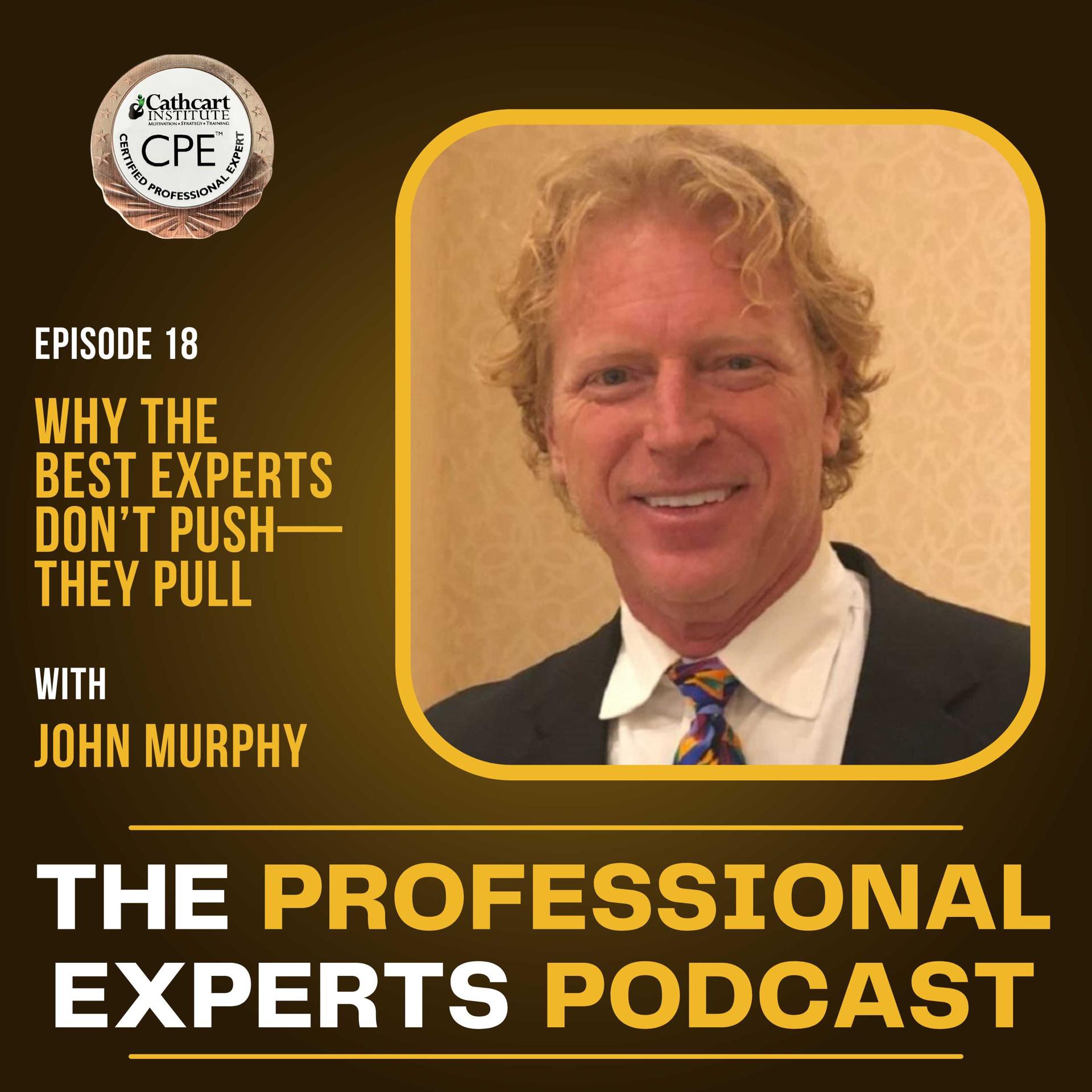
Why the Best Experts Don’t Push—They Pull with John Murphy
A conversation with John Murphy
About This Episode
What does it really take to become a trusted professional expert—and stay relevant for decades?
In this episode
of The Professional Experts Podcast , host Jim Cathcart sits down with John Murphy, a globally respected authority in culture change and organizational alignment, to unpack the mindset, methods, and moments that shaped his remarkable journey. From launching his consulting practice before he had it all figured out to leading rapid, measurable change inside major organizations, John shares why expertise is built through action, not perfection. You’ll discover how alignment beats authority, why simplicity outperforms complexity, and how creating real value naturally attracts the right clients—without chasing sales. This conversation is a masterclass for consultants, coaches, and leaders who want to build credibility that lasts.
About the Guest
John J. Murphy is Founder and CEO of Venture Management Consultants (1988). John is the author of 20 books, including the award-winning "Beyond Doubt: Four Steps to Inner Peace," Editor's Choice "Best Inspirational Book of 2010" (Allbooks Review, Toronto). His latest title, "Miracle Minded Manager" is quickly gaining international attention for integrating "A Course in Miracles" into business. His books "Zentrepreneur" and "Sage Leadership" also combine timeless spiritual principles with modern-day challenges. John has trained thousands of people from over 50 countries on topics such as inspiration, leadership, high performance teamwork, personal empowerment, culture change, and Lean Six Sigma methodologies. He is also a highly respected speaker and management coach, featured on over 500 radio and television shows.
Website
https://www.johnjmurphy.org/
About the Host
Jim Cathcart, CSP, CPAE is one of the top 5 most award-winning speakers in the world. His Top 1% TEDx video has over 2.8 million views, his 27 books are translated into multiple languages, including 3 International bestsellers. He is a Certified Virtual Presenter and past National President of the National Speakers Association. Jim’s PBS television programs, podcast appearances and radio shows have reached millions of Success Seekers and he is often retained to advise achievers and their companies. Even his colleagues, some of the top speakers in the world, have hired Jim to speak at their own events. Jim is an Executive MBA Professor at California Lutheran University School of Management and serves as their first Entrepreneur in Residence. He has been inducted into the Sales & Marketing Hall of Fame in London for his pioneering work with his concept of “Relationship Selling.” He is also in the Professional Speakers Hall of Fame and has received The Cavett Award and The Golden Gavel Award. Jim has written 27 books, hundreds of articles and he is always writing at least one new book. His most recent book is HI-REV for Small Business, The Faster Way to Profits . Audiences buy his books by the hundreds and he happily adds autograph sessions to his speeches. https://cathcart.com/ https://www.linkedin.com/in/cathcartinstitute/ https://www.facebook.com/jim.cathcart https://www.youtube.com/user/jimcathcart Tedx: https://www.youtube.com/watch?v=-ki9-oaPwHs
Full Transcript
Welcome to a thoughtful discussion of important ideas among people who are committed to succeeding in life. This is a gathering of leaders from a variety of industries, and our role here is to help you reach the top 1% of your field of choice. I'm Jim Cathcart. So come with me and let's discover how much more successful you could be. Hey, folks, this is Jim Cathcart. Welcome once again to the Professional Experts Podcast. Today's guest is a guy that amazes me. I mean, he's a successful man. He's a certified speaker, certified professional expert, as you know, because everyone that's a guest on this podcast is a certified professional expert. But let me tell you a little about John that kind of goes beyond the usual. First off, he is a former quarterback of the University of Notre Dame. Go Irish. He's a graduate there and also a graduate of the University of Michigan's Human Resource Executive Program. He served as a Human Resource executive. He served a while in Paris, France. So he's been all over creation. He's written a number of books, 20 so far. And among those, the titles are Sage Leadership, Agent of Change, Miracle Minded Manager, Half Full, the How of Wow. I mean, Habits Die Hard. A lot of really, really good titles in there. And he's spoken all over the world. He's been on the platform with many of the people that you and I have come to know, like our fellow CPE, Dennis Waitley and Zig Ziglar. Norman Schwarzkopf and Rocky Blier, Anthony Robbins. So John's been at this a long time, both from the corporate perspective and then on his own. He founded his own company in 1988, and it's. It's called Venture Management Consultants. And so I'm going to stop there because I could keep on gushing about John, but I want you to meet this guy. So. Ladies and gentlemen, please welcome John Murphy. John?
All right. Thank you, Jim. Love it, love it, love being here. Feeling very grateful as we've talked.
Outstanding. Well, John and I are fellow faculty members on the digital learning platform Fuel, which is my fuel. Fuel. Myfuel.IO so myfuel IO will lead you to John's courses, his mini lessons and, and mine, and a number of other people, many of whom are also CPEs. But, John, here's what I try to do with this show. I try to give the listener a way of understanding what. What it takes and what it means to be a professional, indicating paid expert who is selling their expertise as the nature or the essence of their business. So unlike a Person that sells home design services. This is a platform for people who are promoting their own name as an expert and building a career, much like an author, a consultant, a coach, a speaker, a celebrity in their particular niche. And one of the things I do when I'm training people going through this mentorship process is I asked them early on, I said, item one, what do you want? Once we get clear on that, I say, at what level? Your level of aspiration determines how hard and how big your homework is. So low aspiration. I want to be competent. I want to be able to sit with the big kids, but not necessarily be one. Right. Next, I want to be excellent. I want to occasionally have people say, wow, John, that was good. Right. Next level, I want to be an expert. Now, what's the difference between excellent and expert? An expert can be excellent on demand. And where is it? Person who's excellent is not always at that level. Right. The next level, leading authority. And that's what my mentor, Earl Nightingale, was and what I have aspired to be and beyond that is celebrity and then star or superstar. So I asked them to choose their level. Well, clearly you've reached the leading authority level, and I would imagine in some of your markets you're considered a star. Is that accurate?
It is, yeah.
And the people that you've worked with, whoa. I mean, you've got mainstream kind of engineering mindset, the lean Six Sigma black belts. You know, you got that. But then you got the CIA and you guys, I mean, Lord, you got the House of Representatives, you got. Which state was that? Michigan.
Michigan State. Sound. Yeah, yeah.
So give us sort of a flyover for how your career evolved from the point that you decided, okay, I'm done being an HR executive for somebody else. I'm going to launch my own initiative.
Yeah, that's. I mean, that's. I'll try to keep it reasonably short because that's. It's a long story over almost 40 years. But you remember the name Tom Peters, In Search of Excellence? Yep, sure, sure. Well, I went to see Tom Peters speak. I was the head of HR at this time, and I went to see him speak. You know, there's probably a thousand, fifteen hundred people there, and he's up there on stage with a coat hanger with the small hook on it saying, you know what. What's a hotel doing with these little things? Because they're. They're basically saying, we're going to steal the coat hangers. So he was, he was kind of. He was getting in people's face about you know, you know, poor customer service and distrust and playing games. And I just remember sitting there, Jim going, I want his job.
There you go.
I want to be up there. I want to be a global change agent. I want to be leading authority to use your levels. I was making major change in the company I was with, made the national newspapers in 1986. Young guy, didn't really know what I was doing. And that's been a theme, Jim, for the last 40 years. I still don't think like I know it all and I don't have everything figured out because when I started my practice in 1988, just to give you a little perspective, I started it with two other guys and they both left in six months. So. And I'd written a business plan that I then had to completely rewrite because I lost two thirds of our.
They both left within six months. And you were specializing on retention.
Yeah. Yeah.
Well, you know, they're always had to have some fun.
Yeah. I said I was going to start this company. They both worked for the same company. I left and said, whatever you do, we want to come with you. They're both older than me. They went. One had kids in college and I was 28 years old, so. But I had this idea that we were going to start a company where we would be contract executives to small businesses, bringing like a temp firm for. At, at a high level. Yeah. We had one guy.
Was this the fractional CFO or HR director, whatever.
Yeah. So. So one of the guys was a CPA controller, accountant, expert. The other one was a safety and health expert, and I was HR and labor relations. You know, why couldn't we put this together and offer it? And it just wasn't selling fast enough. So they left. I rewrite the business plan and I, I'll tell you one tip I have for people is pay attention to patterns and, and benchmark outside of your. Your industry.
Absolutely.
So I'm, I'm sitting there going, how do I get business? And I personally don't like knocking on doors. I, I don't like, you know, cold calls. And to fast forward, I haven't made a sales call, Jim, in 30 years, and I'll tell you why in a few minutes. But I have a philosophy of pull versus push. And I think of a lot of sales as push, push, push and cutting deals and things like that, which is fine. But I believe in pulling and attraction, and you do that with compelling value proposition. I think like that. But you also do it with creativity. So what I did is I borrowed from law firms, retailers, insurance companies who were offering free seminars, banks to people to come and learn something within the legal profession, a change in the law, you know, financial deals, things like that. And they were getting clients. So I thought, well, I'm going to. I'm going to create a workshop. Yeah, I'm going to hold a seminar and see if I can get anybody to show up. So I did, and it was called Pulling Together the Power of Teamwork, which later became my first book. And I got maybe 12 people there, something like that, a small number. And one of them was a woman that worked for the university that I rented a space at to hold this seminar. And I'd asked her ahead of time, will you. Would you attend and give me feedback? I've never done this before. And she said, sure, I'll be glad to, John. So here's the thing, Jim. At the end of it, I get evaluation forms. I get very good grades. I get two clients out of the deal. One's a bank willing to offer me money. The other went on to win Michigan Manufacturer of the Year, like four. Four years in a row because. And they brought me in to do executive training at the. At the high level for executive alignment and teamwork, and then throughout the organization to pull teams together, to make change. I run Kaizen events, change events now all over the world. And I didn't know what I was doing. And that's a key point here, is if people wait until they think they have it all figured out before they start building their castle, it's never going to work. So you got to be willing to get in the game and then improvise. And of course, I learned that as a quarterback, you go up the line of scrimmage and you got a play called. You got a game plan. It's part of a strategy. You've been practicing all week, and that's good. The truth is, right until the snap, and then on the snap, the ball snap, chaos, essentially, you don't know what's going to happen. So I'll say to people, when you get out of bed in the morning and you approach the metaphorical line of scrimmage, the day, how do you do it? Are you afraid? Are you nervous? Are you anxious? Because if you're a quarterback, you're not going to win. Your team isn't going to win because they're going to read that in a second and annihilate you. You go with poise and confidence, even though you don't have any idea what's actually going to happen. I mean, you could end up breaking
your neck in your heart that whatever comes up, you can handle it. And even if it defeats you, you can learn from it and leverage it. You know?
That's right.
You're not afraid of it. You're eager to get into it. It's like, give me the ball. Somebody say, you know, whatever.
That's right.
Get this, Pupp. Yeah. You know, that's, that's the thing. If people say, oh, you're afraid. No, no. Pregame jitters is. Let me add them.
Yeah.
Wait. I want to make contact with. With some kind of a barrier and get this thing rolling.
That's right. And that's what one of the things I teach in my, my mindfulness classes is that fear is an illusion. You're only afraid when you're looking into the future, projecting, assuming something's going to go wrong. You're afraid that something's going, I'm going to hurt myself. I'm going to do something stupid. I'm going to embarrass myself. People in the speaking field, you get up on stage and you're, you're, you're, you think you're going to do. You're going to fail, that causes fear. But when you look at it differently and you say, give me the ball, coach.
Yeah.
You're not. And I like to use the word inspiration to mean in spirit. And then when we're in spirit and inspired, we're fearless. When you think about a time when you were truly inspired by something, could it be a relationship, a date? It could be anything. You're fearless. Yeah. I go into my business that way. I go in knowing I don't know much and what do I do?
Which, by the way, puts you in the mode of eager to learn. You know, the, the people that go in with fear, they say, I don't know much. Therefore, I will back off or protect myself. Whereas the person with the growth mindset or the optimistic point of view goes in there saying, I don't know much. I'm going to pay attention. I wonder what you can teach me. She can teach me. This can teach me. Ouch. That hurt. I wonder what I can learn from that.
That's right. And I like to say, pay attention to who you pay attention to, because this world's full of people giving lousy advice. So one of these, Jim, I did is I surrounded myself with brilliant minds like yourself, you know, and reading their books, listening to audio tapes back in the day. This is before the Internet, you know, and before we have a.
Remember?
Well, yeah, so I, Yeah, so if I can be driving in my car and, you know, and listening to Earl Nightingale or you know what? I just, I'm going to do that and I'm going to continue to just learn everything I can. And then of course, you don't really know anything until you apply it. And then, you know, at a higher level, teach it. When you're teaching something because you've applied it, you have experience with it, it's a much richer teaching experience than if it's theoretical. Right. So I give this first seminar and I asked this, this, this lady who worked for the university, give me some feedback and I'll ever forget what she said. First she said, john, do you want the truth now? You know, of course, whatever comes next might sting a little bit, right? And she said, john, your content was great, but your delivery could use some improvement. Because, Jim, I was under the paradigm of professors teaching with lectures that truthfully were boring. In many cases, the content was good. And that was sort of my model at the time. I didn't, I didn't know any better.
Yeah.
And I remember saying, well, I could resist this advice. This is another important tip for people. I could resist this advice because I got two clients out of the deal. I got excellent performance reviews. I don't have money right now to spend on going to Chicago to the seminar that she recommends. Do you remember the name Bob Pike?
Sure. I knew him well. I was. Well, just before he passed.
Okay, right. So Bob Pike, Creative training techniques, I think was the name of it all on experiential learning and things like that. And I, I went, long story short, I went and I learned some fascinating delivery techniques, how to use simulations. I designed a simulation that's still used in the Navy. Okay. A lean Six Sigma simulation. Anyway, so that made me richer in terms of knowledge and delivery. And so I started pulling together, long story short, went from a local workshop, two day workshop, to do regional to national, eventually, eventually international. That's what the CIA was attending in the state senate and military units. And because they were coming to learn methods to align better. To me, in a word, it's all about alignment. First you have to have focus to line up, and then it's about alignment. Yeah. Basically drawing from a lot of my experience on the football field, if you're not aligned and focused and playing as a unit, it's like a symphony. Playing as a unit where timing is important, you're screwed. Right. And when you look behind the curtains now in the business at A company like Amazon, it's an orchestra for the most part. It really is. Yeah. And I remember when Bezos was starting Amazon, I was publishing my first couple of books, and they were, you know, a vendor to me. They were only in books to start, if you recall.
And.
And I.
Just upside down financially for the first several years. I mean, deep. That's upside down.
I know, I know, but I give a lot of credit. And the other thing about innovation is, can you imagine sitting around a strategy table with Bezos sometime and his team, and he's saying, you know, we gotta figure out a way to eliminate the book. You're like, wait a minute. That's our bread and butter right now. This was quite a while ago. What do you mean, eliminate the book? Well, it's a lot of paper, it's a lot of ink, it's a lot of glue. It's a lot of transportation. And what's really a value to people when they buy a book? It's what's in the book. It's the contents. Is there a better way for us to deliver that? Faster, better, lower cost? That's lean. The answer, of course, is, yeah, well, just beam it to them. Yeah, you want a book? You're sitting on an airplane, in a hotel lobby, whatever. Just you pick the one you want. And there it is, by the way. The author, you know, makes more money because there's less cost. The. The customer gets a better value. It's like, win, win, win. How do you compete? That's what I love about what I do, is I help companies go in and completely rethink what. How they're delivering their value proposition. And it's.
It's.
It's really transformational change. It's not just moving chairs on the Titanic, so to speak. It's. It's deep and gives me a profound feeling of. Of helpfulness. And I told you, I don't. I don't make sales calls. And the reason I don't is because of the pull approach I've used. They call me and how do they do that? A senior exec at one company will get a promotion to another company to be CEO or a chief person. And they'll. And they'll go in and they'll look at the. And they're like, oh, my God, we need to fix this place up. And I know a guy. Yeah, Yeah, I know a guy. And I mean, I get. I get big deals that way. They put me on retainer for a year or two. I go in and I train their people. To replace me. I essentially have a new job every year. Now, a lot of people would be.
That's an important element. You train people to replace you. Many people enter the field of being a professional expert thinking, I'm going to set up a bunch of annuities, I'm going to make myself indispensable and be employed for years with these clients. Well, that mentality is what leads to complacency on your part. And at the same time, it's unfair to your client. I think we all ought to make ourselves progressively less necessary so that we have graduates instead of dependence or us being dependent on there. Either way it goes. That's. That's a faulty thing. I started much as you did when I was in my late 20s, but I didn't start with as much depth as you did. I started by doing a seminar for about 12 people in a borrowed conference room and got a little bit of business or a few leads out of it, but not much more. But years later, I. I was looking at my goals list, and one of my goals that I wrote in 1974 was be hired by the White House. And Nancy Reagan hired me to train the just say no speakers.
Wow. I went, isn't that cool?
And I did the training. And it didn't occur to me until like two or three years later that I had achieved a goal that it was lost in those old gold notes from long ago. It's not like a linear goal that I was constantly keeping in front of me. It was one of those that if I reach the level of being that I want to achieve, then there will be a pull, like you say, of the kind of business I want. To me, it goes back to Earl Nightingale, who you referenced. He was my mentor, and his basic message was become the kind of person, meaning, acquire the qualities of the kind of person who would have the results you want. And those results will be your natural byproduct. Yeah, clearly that's what I hear coming from you. Now, structure in the professional experts. We've got a structure that we look at with every person, and I do the same with myself. What's your value message? And you pretty well articulated that already. You may want to say it in a succinct manner for the, for the listeners benefit, but what is. What do you have worth paying for? Give us the short paragraph you would use.
Well, I'm not around the world as an authority in culture change. Okay, so that's sort of a vague term. What does that mean? And I describe it this way. Culture is the way we do things around here. It's right.
That's a great definition.
And synonymous with the way we do things around here are your systems, your policies, your organizational structure and design. So the question, how do you change culture? How do you change the way we do things around here? The answer is, we change the way we do things around here.
There you go.
What?
Yeah.
So I go in, Jim. Yeah. I go in and we examine everything they're doing in terms of how they do things around here. Structurally, policy, procedure, or absence of. We don't have standardized procedures. We don't have clear policies.
Yeah.
We have bad policies or we don't have policies where we should have policies. It's chaos. So I come in and with facts and data, I will say this too. For all these years, I've been going in and leading some significant changes around the world. I have never had authority. I can't go in and make anybody do anything good. So it's all about influence. And so I am branded and known as a change master who comes in and leads change fast and measurable. So bottom line is, when they get results and they get them fast. So when I run a Kaizen event, just quickly, what that is, is I go in and out train. Kaizen means good change, essentially. It's a Japanese term.
Right.
Technically, Kai is to take apart and make new. And Zen is about, you know, balance and harmony and peace. So when you look at Kaizen, it's about we take a process that's bumpy and dysfunctional, and customers are unhappy they're not getting what they want, things like that, and within a week it's different, and we have evidence it's better in a week. And that blows their minds because they're like, we've been wrestling with this for six months, a year, and we're just. We're still tripping all over ourselves.
And.
And we have a meeting this week and then a meeting next week and a meeting next week and we hash things out. No, I want a team for five days straight. I'm going to train them 30 days in advance on data to collect the analysis tools we're going to use, and we will make change real time. So by the end of the week, on Friday, we have proven change already. We've taken a process that takes 12 hours and now we're doing it in 30 minutes because we've actually proven it by the end of the week. And it blows people's minds. They're like, how'd you do that? And how did I do it with knowledge, with a useful methodology, with tools that work with experience over the years. And that is what I call change mastery. And a lot of the people on these, to do that you had to
transcend their point of view. You know, that's the thing. It's the, a lot of companies operate like executives in the purchasing department. You know, is that a good quality deck chair for our Titanic? I don't know, maybe we should get a different finish on that. You know that, that kind of thinking, if you never transcend that mindset, then you never see the solutions that are obvious to you and me. And so my little structure starts with what's your value message? You've said that and you've answered the second one, which is what's your brand identity? That sets you apart. Because when people say like a consultant or the executive coach or somebody like that, a lot of times they'll say to me, well, you know, I, I teach people how to be more successful and, and I did it at night. Everything they say has been said by every other competitor they have. And I say, yeah, but what makes you unique? You don't understand. No, you don't understand. The bus are looking at you and you look like a commodity to me.
Yeah, well, that's right.
They matter. And then your ideal customer, it sounds like you are very comfortable with enterprise sized clients. Yeah, I'm good with them as long as I'm just in the boardroom. But I don't want big enterprise sized applications beyond what I'm doing currently because at this stage in my career I've gone from not from wanting mostly keynote speeches all over the world to not wanting to do those unless they're really going to get something done. So pick them like one recently in Malaysia or one coming up in Austin, Texas. But I'll do, you know, a couple a month compared to 120 a year when I was in the peak of that part of my career. So now people say, what do you do, John? I'm a mentor.
Yeah.
To professional experts. What's a professional expert then? Now we're having the conversation I want. So item three is who is your optimum or ideal type of client? And it sounds to me like your, your ideal client is a person with a C in front of their name.
Yeah. And the thing about that, Jim, is, is I am at a point of transition in my career. So for, for over three decades now. And I discovered this by giving my first workshops. I was just trying to make it right. And I got, I got deals with Companies coming out of those workshops to say, come in and help us. Right. And it was a lot more money and it was a lot simpler because now instead of running all over the place and doing, you know, one day or two day seminars or speeches and things like that, I had some stability. And the other thing is I like to think see results and I know sometimes you give a talk and you teach a class and then you never really see the, some of the results. Yeah, I loved going into companies and leading change events and seeing measurable results. And then because of the results, I didn't have to sell much because my clients were selling for me. They became advocates of. And you know as well as anybody that credibility is essential and trust in selling or in influencing change. Right. So guess what? I gained credibility by having credible people say, you got to bring this guy in. He's got to, he's got to really deliver. So I didn't even have to be credible after a while. I am and I. No, but because I had so many credible references. I mean I had black belts in my classes and Kaizen events who are now CEOs of some good sized companies. They've gone right up and I've coached them on the way because they didn't think they could do it. I go, you got every bit of potential for this and the skill set, you know, let me, let me help you out a little bit here. So yeah, I, but the transition right now, Jim, and this is partly with fuel, is I'm, I'm starting to shift from business to business work and these longer retainer retained situations, which I still accept as long as they're win win.
Yeah.
But business to consumer work, where I'm now like, through Fuel we can reach people all over the world in multiple languages. We've got chat bots, we've got online courses.
Yeah.
I'll say this real quickly. Covid changed a lot for me, probably
for everybody, our whole world, because that's when I made the transition from speaking engagements to seeking individual clients that I could help to grow.
Yeah, I mean There was one year, I was thinking around 2013 or 14, I was on the road 51 out of 52 weeks. I was all over the place doing live events, which I loved and it was very lucrative. But now I hardly travel.
Yeah. Yeah.
You know, got a, as you know, I got a couple courses out on, on through Fuel and then I've got a number of, of podcasts going on and things like that, webinars. So I, I like that. I'll be 66 this year and, and not slowing down at all as far as I can tell. But I tell you, because I've passed
that this several years ago, that you got a whole lot more prime ahead of you. I was at my peak fitness in my life in my late 60s and I was still running mountain trails at age 73 when we moved from California to Texas. The reason I say was is because Texas doesn't have mountains, we have hills. Paul and I live in the hill country here in Texas. But when I look at my own career in parallel to yours, I notice some strong similarities. My first full on client was the Tulsa agency of MassMutual Life Insurance Company. And they said, Joe Willard, the general agent said, I like the seminar you did for us, come move in with us. I said joe, I've got a job. He said yeah, I know, but you need a better place to do it. We have a penthouse and I'll give you a corner office, you can use our conference room, we've got a full time cook, we've got a full staff and all kinds of machines. You're welcome to leverage those. And I said, well, you know, I'm also getting a salary. And he said, because I was what was the senior program manager in charge of individual development programs at the national headquarters of the JC's Junior Chamber of Commerce. And they were huge at the time, 350,000 members. And so I was the guy in charge of leadership training for all that. And Joe brought me in to do a speech and the speech went so well, he said look, I'll pay you whatever they pay you. I said joe, I'm making fifteen hundred dollars a month. He said I think we can cover that, Jim. So I moved into his agency and I had to upgrade my thinking because everything around me was first class. And we took 19 agents and over the period of five years went from an agency they were threatening to close down to winning the president's trophy twice out of 125 agencies. And I got hired by 32 other MassMutual agencies and the home office. So it was just like your situation where the company said, come in and do one thing. Hey, we want to keep you. Kaboom. So now that we've hit value message, we've had brand identity, we've hit target client, Right, okay, yeah, this business model, and it sounds like your business model is in a transitory mode or transitionary mode right now. But describe what your business model has been up to now and what it's going to be next as you Understand it. And let me for the listener point of view. A business model could be selling personal coaching services. It could be author who also speaks or speaker who writes and sells material. It could be a person who does presentations to win consulting contracts. It could be any number of things there, you know, you could license other people to use your technology like Bob Pike's company did. And it goes on and on. So from a business model point of view, and let me add the fifth item to that, which is operating systems. Business model and operating systems, how do you approach those two?
Sure. But when we talk about revenue streams in the model, it's essentially in one word, lean, because I teach lean. And lean just basically means we attack waste in the process or the system and eliminate it. So I run a very lean model, meaning that and I use pull. So if I go into a great big company by myself, Jim, and I need external help, in other words, they don't have the resources internally that are quite competent enough yet or there yet. So, okay, we need to bring in some other experienced experts. I pull them in from universities, from other consulting firms. So my model is actually super lean. I have very low overhead and my, my primary income is coming from retainers from, from big corporations, which is going to be very lucrative. And then I have, you know, 20 books published. So I've got royalties coming in from, from book, book publications and then I do keynotes. Not nearly to the level that you do or have, but that's a migration I'm making. I, I want to do more of those. I want to partner with you and people in fuel and el. I get a big kick out of that. And I've had a lot of, I've got tons of stories now and examples to share with the world and I can see myself doing a lot more of that now. It's almost like come first full circle because it was a long time ago that I was on stage with Schwarzkopf and Tony Robbins and those guys, Zig Ziglar. But to come back around to that. And so in terms of revenue streams, essentially right now it's retained deals with clients, it's book royalties and it's keynote speeches. Operating systems. Again, one of the key words in Lean is simplicity. So I keep my business and I have a degree in finance and you know, a background in business management. So I, I run such a lean, simple business with very user friendly processes that I hardly need a whole lot of technology. I mean obviously, yeah, it's all virtual.
No, outsourced.
Yeah, yeah. I am a one for 38 years I've been a one person corporation. I'm a C corp and everything I've needed, I pull in. So I don't, I don't need a big tall building with my name Murphy on top of it and I don't, I don't need all the egos.
Someone did that, right?
Absolutely, absolutely. But for me it's not important. Okay, well, but for me, by the way, if I'm in my office, at least in days past, I felt like there's something wrong because before we went to virtual and all this online stuff, if I wasn't out with a client, I wasn't making any money.
There you go.
So I was like, I don't want Peters.
You know, Tom Peters and Bob Waterman in their book In Search of Excellence, introduced us to the MBWA business by walking around and he too said, if you're in your office and you're the leader, shame on you. Get the heck out of there and go connect with people. And Sam Walton practiced that throughout the Walmart system. I did some training for their executives and Bentonville once and they said, first you need to visit one of our stores and we'll take you to the non existent manager's office, which was basically shelf against the wall where the manager could keep some data. But most of their time was spent interacting with the people. Yeah.
Oh yeah. I was a big fan of Sam Walton's Made in America, I think was the title of at least one of his books, his autobiography. I was reading that as a young consultant and I just, I remember that book. He, he went to 300 stores a year, so essentially a store a day. Yeah. Practically flew his own little plane. And he had executives sharing rooms to save money. And he was the wealthiest guy in the world at the time. There's a replica of his office in Bentonville, which I've been in. And I've had Walmart people come to my, to my workshops as well. But the replica of his office was like a train depot. You know, drove a red pickup truck with a bird dog in the back. Yeah, yeah. Humble. That's another thing I value tremendously, Jim, is humility. Most people, when I go into a company, it's, I'm not a celebrity. I mean, they know me, but I don't show off, you know, I don't, I'm just not that way in terms of character. I'm quiet again. I, I'm, I'm a pull. Yeah. And so for example, you talked, we talked earlier about just good listening.
Yeah.
To me, that's pull you. You're pulling ideas in, you're pulling information in. And it's not even just audible listening. I think of reading a book as listening.
Sure.
Okay. I. I mean, I'm taking in. I'm. I'm. I'm hungry for information, for knowledge.
One of the keys to that is being open to the contradiction of everything you believe you know, to have what you think is true, challenged by what you're reading or who you're listening to or talking with. And to accept the possibility that you might be wrong instead of defending your position to make sure that they're wrong absolutely takes place is in accepting that possibility of being wrong and being willing to, you know, crash and burn for the moment and rebuild.
Yeah. There was a great book written by Fisher and Uri out of Harvard many years ago called Getting the. Yes. I don't know if you saw that, but it was a good. Yeah, yeah, it was a great book. I got a lot of information.
Two separate authors. Yes.
Yep, yep.
Getting the little Quick, quick read.
But one of the things I got away from, I got out of that book was, was know that. Know the difference between interest and positions. Like, a team could have a common interest. We want to make this process better. But their positions would be two different ways to do it. So they start arguing over option A and option B. And I'll come in and I'll say, let's look at the third right answer. They're like, what are you talking about? I go, well, let's just assume option A is right and option B is right. Let's forget about both of them and find C. And it breaks the duality and the conflict. Now we get aligned around. All right, we got to think of a third right answer. And guess what? We don't go with a B or C. Typically, by going through that process, we end up with D. And I learned this. I learned this, Jim, when I was back in human resources. My boss, Jean Pierre Sarah, is a French company, and we called him JP and jp he would say to me, when I come to him with. With a challenge or problem or something going on, he says, john, don't come to. With a problem without a solution. That's not what he said. That's what that. But that's what. That's what everybody's programmed to think, a solution. He'd say, no, don't come to me with a problem without three. Like, three. Well, but I got a great idea.
Let's. Can't we just do this? Nope.
I Wanted to see two more, I want to see two more ideas before we decide. He got me out of the box with something so simple.
You remember something?
Oh yeah, yeah, yeah.
In 1976, I had the privilege of going to the, to Washington D.C. for legal affairs seminar that the JC's national was holding. And we went to the White House and Dick Cheney was chief of staff for Gerald Ford. And he did briefing for us. And he said in the briefing something that just completely rattled my world at the time. He said, we never bring a problem to the President without bringing a menu of solutions. Menu chooses the one he likes or he creates a next, you know, another one and that's what we go with.
So yeah, it's the same idea menu I like. Yeah, yeah, I like that. And you know, the other thing is, is when we pull these guys and event teams together and we come up, we take apart a process, we use a model, by the way, dmaic, D, M, A, I C. And it's, it's a world best practice. And D stands for define. So we define the current state it is what it is. We measure with facts and data to prove it is the way it is. Right? So it's like go to the doctor and the problem. You know, you've got this symptom, your blood pressure is too high. And let's like, how high is high? Measure it. Let's get a baseline and then while we're in the measure phase, we identify what we call uds, undesirable effects. So now we've got customers mad at us and we've got proof. We got, you know, and, and then we've got long cycle times. We've got too much inventory sitting for too long. We've got like that, yeah, we got employee retention issues. They're all leaving. They're, they're whatever Those, those are UTIs and we can prove every one of them. And if we can't prove it, we dismiss it. It's gotta be factual because it's hard to argue with facts. Right? Then we, from the unis, we do analysis. DMA A is an analysis. We get down to root causes. Because I'll say to people, they say, well, the customer's upset and we're getting a lot of phone calls and that's the problem. And I'll say, no, that's not the problem. That's the symptoms of a deeper problem. So why are they calling us? Let's figure that out. That Apple Computer, Every phone call that comes in from a customer is considered a problem. The way Apple thinks is no one should ever have to call us for anything.
Right.
Why are they calling us? Meanwhile, other companies are building call centers and you know, in India and stuff to. Because the, the volumes are so high. That's not solving the problem. So I, I help them realize it's deeper than that. So they're calling because there's a flaw in the design or there's a flaw in the, in the delivery system and things like that. And then I is traditionally improved. Now let's improve at the root cause level. But in more recent years, I'm using I as innovate. As what? And not just improve. In other words, why would we improve something we can eliminate? But let's get innovative, right?
Yeah.
And then the C is control. And I. A lot of, in the old days, the, the masters would teach it linearly. So D, M, A, I C. Done.
Yeah.
And I said now another differentiator. I make sure it's circular so that when we finish an improvement, we're back to zero again. Because I'll say nobody wants a Six Sigma floppy disk anymore. So even when you think you got it right.
Good analogy.
You better think again. Right.
Pmoc, you know, plan or POMC or maybe plan, organize, Managing control. Yeah, Old engineering mentality.
Yeah, yeah. Demi had the PD plan, do check, act, pdca, different models. But here's the thing. If I go into an organization with no authority and I pull a team together and we pick a. We define a target area that we need to improve. We define who the team's going to be, we define the milestones, we define a charter. What's our mission? Let's define our mission. Let's be perfectly clear. Okay? And now we go to that target and we measure and we process, map and we figure out where the UDs are. And every yuty is factual. We have the senior execs come in and it's not pretty. And I also teach the black belts and such. I said, now you have to be aware of the ugly baby syndrome. Another little silly thing I named.
That's a great name.
And this is important because you know what happens if you call somebody ugly? I mean, they could be the ugliest, you know, Quasimodo or something. But you never say that. And so when we're presenting to an executive team about the state of health of a key value stream or process in the business and it's ugly, what I don't want black belt saying is, this is a mess. This is like, oh my God, this is, this is because Those are opinions,
I believe, on you for liking this. Right.
So, you know, we'll script this out and I'll say, here's what you might want to do. Reporting live from Austin, Texas, here are the facts. We take 120 days to do 10 hours of work across the value stream. Okay? We have facts and data the whole way. And by the end of our. Oh, by the way, we say to the executive team, we're going to. We're asking you for 20 minutes without interruption. And we're. We're not going to sit down. We're all on our feet. So already we're demonstrating a different culture. We're not going to come in and get comfortable and have somebody interrupt after one minute. Go. I don't agree with that. That's. That's ludicrous. Nope. And the other rule I impose when I come in there or I. I can't really impose it, but I ask for it, is that if you disagree with anything this team presents, you have to prove them wrong with fact, because they're giving you facts, by the way. I don't say a word. After that, the team takes over. We've scripted this thing out. They tell the story about the current state with measures and facts. And typically, at the end of that, the executives are sitting there going, we got to fix this. Yeah, right. What? Like, like, how are we going to fix this?
Immediate.
Oh, yeah. How much money we're wasting. We say, come back tomorrow because this is early in the week. So the DMAIC model I use is. We structure it right through the week. We define and measure current state that. We say, come back tomorrow. We'll get to root cause. And this is the area we need to focus on fixing root cause. So they come back. And here's in one word, it's all about alignment. I align the team. We don't present anything. If we can't prove it, that creates incredible credibility. Then to the executive team that has to support all of this and sponsor it. And by the end of the week, it's like, done. And there's no. No, there's no friction. And nobody's called anybody's baby ugly. We've just said, let the facts speak for themselves. And because we have a base, clear baseline with facts, we've got measures against that baseline. And that's powerful, Jim, because it's a.
It's a.
The lesson is you got to have a good methodology, okay? And if you don't, you just go in there and you wing it. That's. So that's another differentiate differentiator for me. I don't go in and wing it. And I go into industries I know nothing about in countries I don't know the language.
Yeah.
In many cases I've never met the people. And I go in fearless, if you will, because I trust the process and I trust the people I'm going to be working with.
And you said early on, notice patterns. And when one of the things I talk about is the essence of intelligence, I tell people, I've told an audience recently, I said, by the end of this presentation, you will be more intelligent on that subject. How do I know? Because I know what intelligence is. Intelligence is the ability to make distinctions by noticing patterns and the principles that drive the patterns. Once you know that, you can change the methods for infinity. And I think it was Peter Drucker. It may have been someone like Aristotle, but Peter Drucker articulated it. He said, if you learn only methods, you will be tied to your methods. But if you learn principles, you can devise new methods. And that's what I hear you saying. And boy, that needs to be heard today. And whatever is more on and start to understand the principles of, and see the patterns of, we become more intelligent about.
Yeah, that exactly. So it's, it's, it just helps me to have a good tool set. You know, if you're going to win a golf match or a tennis match, you better have a good set of tools, you know, along with the skill and the intelligence. Like, how do you actually use these tools, by the way? One more quick metaphor is, you know, I, there are dozens of tools in the Six Sigma toolkit, so to speak, and the Lean toolkit. And so I use the metaphor if you've got a leak at your, in your kitchen sink and you don't know how to fix it, so you call up an expert, a black belt, a plumber, and they drive up in a truck with 60 tools in it, 100 tools in it. How many do you want them to use?
Two.
Yeah. Or one even. I mean, and how long do you want them to be there and how much do you want them to charge you? So what I'm teaching, because black belts, there's great irony in the Lean Six Sigma model because Lean is all about simplify and lean out waste, and Six Sigma is about perfect, whatever's left. So when they integrated in the 90s, I was part of a consortium in Boston that pulled Lean. And so they used to compete with each other, pull them together companies. I get it. I get called in by Master Black belts that go, well, you come in and help because our executive team's not supporting us. And I go in and I find out it's because you're using 60 tools to solve a problem that requires two, you know, or 10. Yeah, they're over complicating, which is not lean, it's the opposite of lean. And they're over analyzing and inconsistently approaching, which is the opposite of six sigma. So they're trying to do something and they're doing it in exactly the opposite way. They're not walking the talk at all. So the differentiator is how do you actually use these tools intelligently, to use your word? So I can fix the leak in no time, charge very little to the customer and be on my way. So I use fewer tools than most to get a job done. And oh, by the way, off of dmaic, I call the tool belt. So there's multiple defined tools, multiple measure tools, analyze tools, things like that. I also teach it this way and I know we're running out of time just a little bit. One of the things I'll teach in my classes is like if we're going to learn a root cause analysis tool or we're going to learn a DMAIC tool, I'll tell the, I'll tell the students, go home and actually apply this tool to yourself tonight. We'll talk about that tomorrow. So, like one quick illustration is a tool called the IPO diagram. It's not initial public offering, it's input, process, output. This was a classic deming tool. Any process has inputs and outputs. For simplicity, think about like baking a pumpkin pie. So the inputs, Well, I need an oven. I need ingredients. All these ingredients. I need to set the oven at a certain temperature. I need to keep it in there for a certain amount of time. These are critical inputs to get a good output. Consistent output, right? Inputs, process outputs. Do that on your body, do that on your mind. What inputs are you bringing into your mind and what are the outputs? Are you stressed? Are you confused? You feel lost? Okay, what about emotions? Okay, what about your finances? Are you broke? You got a bunch of debt? Anything about you social? What do you write? Your relationships? You got in a lousy relationship. You're not in a relationship, you want to be in any. Those are UTIs, by the way. Those are undesirable effects. So on the outputs, we work backwards. We start with UTIs. Well, physically, you know, your blood sugar is too high and you're pre diabetic or something like that. On the social you're in a crappy relationship. That's no good financially. You know, let's just say you're okay physically. Well. Or emotionally, you're stressing out about life. Yep. So now we go and do the root cause analysis. So when I teach these tools to make it really personal, these aren't just business tools you use in corporations and enterprises. You take it home with you. And when you figure that out. I just had my internal age measured and guess how old I am internally.
54? 38.
38. Actually, the first time I had it, first time I had it tested was 33 and I had it retested recently. 38. So that's half my age. I'm younger than a couple of my kids.
Yeah.
And why is that? Is because I've spent several decades learning about inputs and outputs as it relates to me. So it's, it's everything from ice cold plunges to infrared saunas to a very nutritional diet to interval exercise. Not aerobic, but anaerobic. Little things people don't know. But when you put those things together, you still age. Yeah. You don't have to do it as fast as some. Yeah, right.
Well, so anyway, and all that is integrity, because alignment leads to integrity and when things are aligned, then it is one integral system and it, you can fend off anything with that. But when, when it's apart, clearly things can slip through. And I love the essence of this whole message. You, you're walking your talk. Your talk is fascinating and practical enough that I want to walk it too. So, you know, it's no wonder you're doing so well. And we've run out of time for
today, but yeah, glad you were the
guest for the day because our listeners are going to get a ton of value out of this.
Thanks, Jim. Yeah, definitely.
John, how do they reach you?
Well, I'm social media mostly as an author John J. Murphy. There's a lot of John and John J. Murphy, so author John J. Murphy. I'll also, I mentioned I have three podcasts now, the Change Mastery show, which is the second Wednesday of every month. The mindset matters with Fuel on Mondays. I'm every third Monday with Ali and Danielle. And now launching this week a new webinar called Fearless, Fearless, Fearless. And that launches this. Yep. And that's through fuel. By the way, I've got a couple hundred YouTube clips out on my YouTube channel, which is author John J. Murphy, so people can easily find me through social media. And I've been remembering the word authority.
Author Jones.
Yeah, yeah, yeah. Exactly.
Dynamite. Thank you, my friend.
Thank you, Jim. I love you. And we'll. We'll do this again sometime.
You bet. Back at you. And have an abundant 2026.
You too. Definitely.
Thank you for joining us today. If you are committed to making more success happen in your own life, go right now to my website, free.cathcart.com and download my free ebook and then watch the video. If you decide that you'd like my assistance in helping grow your success, then come with me and let's discover how much more successful you can be.
Nurture Your Nature.
Never Miss a Conversation
New episodes drop regularly. Subscribe on your favorite platform and never miss a conversation.