
Season 2, Episode 22
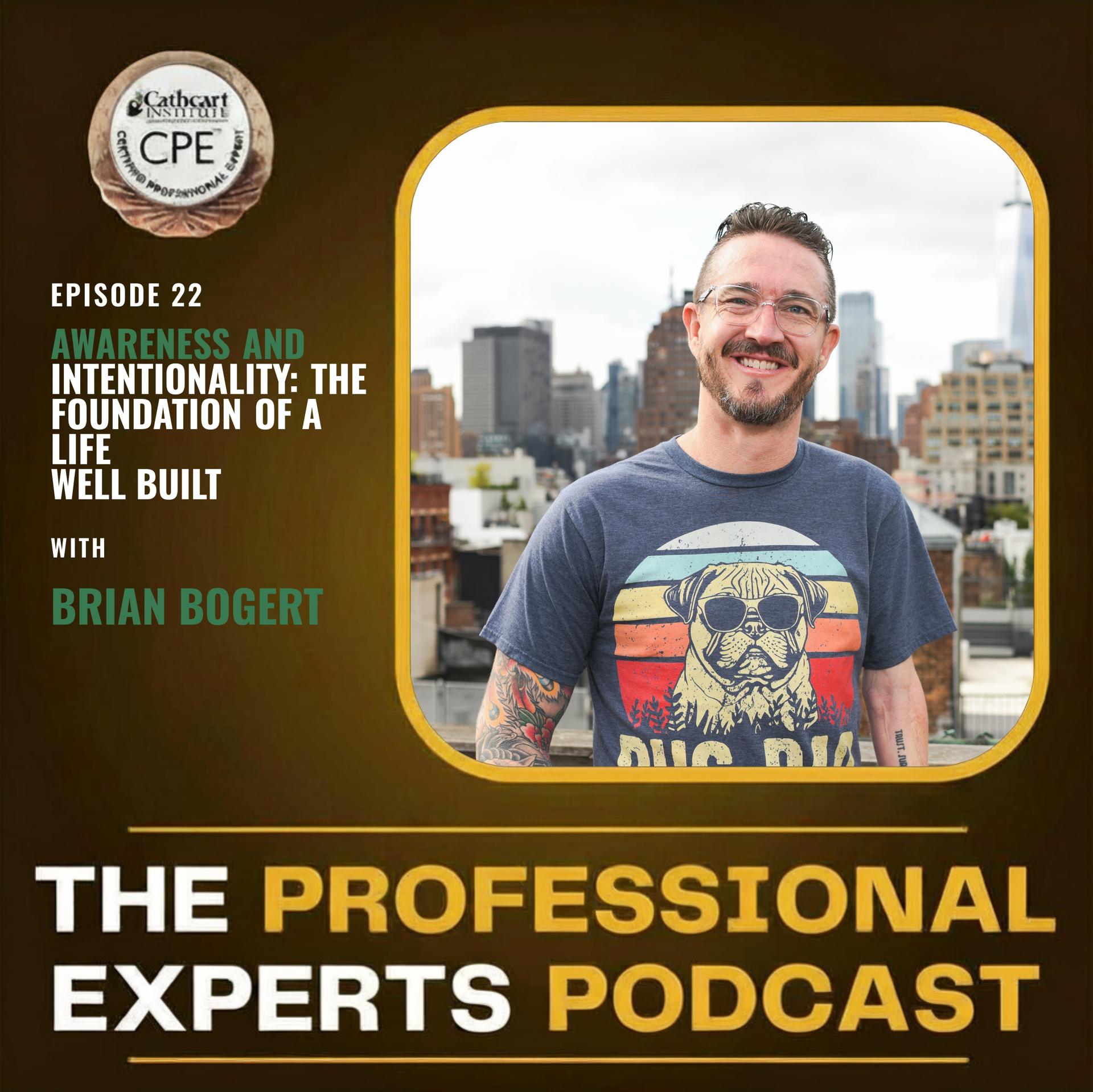
Awareness and Intentionality: The Foundation of a Life Well Built with Brian Bogert
A conversation with Brian Bogert
Watch This Episode
About This Episode
Brian Bogert joined me for one of the most honest, layered conversations I have had on this podcast. Brian is Certified Professional Expert number 40, and he earned that number by doing the work, not just talking about it. He has invested over $800,000 in coaches, mentors, and programs over 13 years. That is not a flex. That is a philosophy. And it shows in every word he speaks.
The Story That Grounds Everything
At age seven, Brian was run over by a runaway truck in a parking lot. His left arm was severed. Twenty-four surgeries followed. What stayed with me was not the physical ordeal but what happened after. People refused to believe his story. They wrote it for him instead. That experience planted a seed of performance-driven identity that took Brian decades to recognize and gently uproot. He did not become bitter. He became a student of his own life.
The Idea That Stopped Me Cold
Brian draws a clear line between pain and suffering. We can choose the pain of a hard conversation to avoid the suffering of a broken relationship. We can choose the pain of honest self-examination to avoid the suffering of a life that never quite fits. That reframe is simple, practical, and quietly profound. It is the kind of truth that sounds obvious until you realize you have been avoiding it for years.
What We Covered
We talked about the moment Brian's wife told him she wanted all of him, not just the performing version. We explored his protector-connector framework, the idea that every defense we build disconnects us from the very things we want most. We also discussed how awareness and intentionality, what Brian calls the real AI, shape everything from business decisions to the deepest relationships we carry.
How to Reach Brian
Visit brianbogert.com/connect for his full resource library, podcast, and Time Compression AI work. That is Bogert, like yogurt with an E.
In the spirit of growth.
About the Host: Jim Cathcart, CSP, CPAE is one of the top 5 most award-winning speakers in the world. His Top 1% TEDx video has over 2.8 million views, his 27 books are translated into multiple languages, including 3 International bestsellers. He is a Certified Virtual Presenter and past National President of the National Speakers Association. Jim’s PBS television programs, podcast appearances and radio shows have reached millions of Success Seekers and he is often retained to advise achievers and their companies.
Even his colleagues, some of the top speakers in the world, have hired Jim to speak at their own events. Jim is an Executive MBA Professor at California Lutheran University School of Management and serves as their first Entrepreneur in Residence. He has been inducted into the Sales & Marketing Hall of Fame in London for his pioneering work with his concept of “Relationship Selling.” He is also in the Professional Speakers Hall of Fame and has received The Cavett Award and The Golden Gavel Award.
Jim has written 27 books, hundreds of articles and he is always writing at least one new book. His most recent book is HI-REV for Small Business, The Faster Way to Profits. Audiences buy his books by the hundreds and he happily adds autograph sessions to his speeches.
https://www.linkedin.com/in/cathcartinstitute/
https://www.facebook.com/jim.cathcart
Chapters
- 0:00Welcome and introducing Brian Bogert
- 4:21Investing in yourself: the $800,000 decision
- 8:12The accident that shaped everything
- 13:27From performance to presence: the inner shift
- 23:45Armor, authenticity, and the protector-connector
- 31:21Embracing pain to avoid suffering
- 38:37Awareness and intentionality: the real AI
- 43:56How to connect with Brian Bogert
Notable Moments
“My existence, my reason for existence is to allow my truth to give others permission to live theirs.”
“The second you protect, you guarantee two things: you will disconnect from being seen and understood and connected at the deepest level, which are the two things you want most.”
“I'm not talking about artificial intelligence. I'm talking about awareness and intentionality. ”
“We end up driving around in an armored car thinking it's a sports car. Hey, look at me.”
“I decided that I was no longer going to allow myself to get stuck by the things that had happened to me, but instead get moved by what I could do with them.”
Full Transcript
Hey, folks, this is Jim Cathcart. Welcome to the Professional Experts Podcast, where today we're taking expertise to a much higher level. My guest is Brian Bogart, and Brian and I have been working together pretty intensely for the last couple of months, just taking the Cathcart.com website and the concept that's built upon and rethinking everything. I mean, he brings such a fresh perspective and a bigger, bigger mindset to the whole thing that the first thing he did was gently scold me. Jim, you're underselling, man. You're a much bigger product than that. Tell the world. And so I'd evidently been hiding my light under a bushel or something, metaphorically. And I'm not any longer. So if you haven't been to Cathcart.com lately, go there and see Brian's handiwork. Just scroll through, take 10, 15 minutes, and just click every link within it that you can think of and explore and watch videos and see, you know, articles, blog posts, podcasts, all that. And this one will also link there because this is part of the Professional Experts podcast, where every month I interview one of the certified professional experts. And the most recent among those is Brian Bogart. And Brian Bogart is number 40, and he's also age 40, so he's as old as every one of the certified professional experts. Brian's in the. In the Phoenix Basin, in the Valley of the Sun. Welcome aboard.
Brian Bogert, my friend, it is an honor to be here with you. It has been an honor to walk alongside you for these last couple of months and to also have your trust in helping show the world who I saw the first few times that we met. Right. And it's just been such an awesome project for me to be able to help bring together your 53 years of, like, documented impact and proof and to put it into a way that not only brings you into the current, but sets a foundation for the legacy that you're going to continue to leave behind, and you've already left behind as you continue to blaze this trail, because I know you're operating like you're 40 years old today. And so this is going to be a lot of fun today, my friend. But I'm grateful and I'm excited to have this conversation.
Thank you. Me, too. Well, one of the things that's unique about this podcast is the people I talk with, the guests are certified professional experts. I don't do the usual podcast thing where interesting people of different types come on board. I stick to our lane, which is independent experts and that's a person who's building his or her career around their special gifts or talents or abilities. And that would be speech speakers and coaches and consultants and authors and celebrities and influencers. People where they know they are the product, and they need to build a product with integrity and staying power, and they need to know how to rise to the top 1% or above in their own particular chosen niche. And you've clearly done that. I mean, man, I was reading your application for CPE. You've spent $800,000 on coaches, mentors, and training to sharpen your skills and take you to the edge. Wow. Tell me about that.
Well, that's probably one of the only numbers you'll ever hear me flex. You know, it's something I'm very, very proud of. You know, there are business metrics and numbers and revenue and things that'll be thrown around at different points. But why do I see that number as so important? Because beyond the actual investment, it's the time, it's the connections, it's the lessons. And those were the moments that at 27 years old, when I woke up one day and my bank account was full and I found myself empty, I realized that everything I'd been doing up until that moment was performative. I was operating with shame and anger in ways that were affecting my world that I wasn't even conscious to, and frankly, wasn't completely conscious to all of it for another seven or eight years. But that was the moment that I sought external help for the very first time. Right. Was 27 years old and the chance to say, okay, somebody else might have blazed the trail ahead of me, and what can I glean from their insights in my world? And in the last 13 years, there has not been a single moment that I haven't had at least one coach been enrolled in at least one program to elevate my expertise, my knowledge, the ways that I can show up in the world. And, you know, I do believe that life compounds on itself. Right? We genuinely can have all these unique, different interests that might seem completely disconnected in one period of our lives. And then by making investments like that in ourselves to be more clear, have a better understanding of who we are and how to position ourselves in the world and. And to frankly, just get the reps at really doing the work with people in a way that matters. I. I don't think I'll ever not have a coach, and I don't think that I'll ever have a day that I don't learn until the day that I die because that's what life's about. And we've got one run at this thing. Yeah, I learned that very early. So.
So, yeah, well, your age 27 when you started. My age 26. Earl Nightingale was my mentor. But Earl didn't know it because I was doing it through audio recordings on cassettes back in the day and I bought that big library of his recordings. And man, every day, fanatically, as I've told you, clinically fanatical, I listened to those. And because I knew that my worldview needed readjustment, I. The way I saw the world was through middle income person's view with a life that was likely to be quite unremarkable. But I didn't want to be unremarkable. I wanted to make a difference. I wanted to matter. And so I reached out that way and it was years before I ever hired someone on my own with a separate check to a live person, you know. So bravo and God bless you for that. Now, your own personal story has got to be shared here because it's such a, an amazingly profound story. Would you share with us the path from.
Absolutely.
After age six? Yep.
Yeah, absolutely. You know, there's many arcs to the story, as I'm sure you can imagine. So we'll hit the beginning part of it because it just kind of grounds the plane. But when I was 7, my mom, my brother and I went to our local Walmart to get a 1 inch paintbrush to complete a home improvement project around the house. And as we got back to the car, right. Like anybody who's known me for more than two minutes knows that I talk fast, I walk fast. I've had a vigor for life since the moment I was born. I mean, I had teachers even from early ages 5 and 6, being like, Man, Brian must have come out of the world like to take it over or something. He's just got this, this, this, this anchor.
So of course that's what I call high velocity.
Yes, you had told me that.
I mean, sincerely, that's a genuine measure that applies to people and you are clearly high velocity. Yep.
Thank you. Thank you. So I was the first one in the car and I was there waiting for my mom and brother to catch up and we could go home on with our way. But this was back in the days before there was key fobs. So my mom had to literally reach her hand in the purse, grab the keys, pull it, put it in the door, turn it before we could go on with our way. And the two, three feet behind me that she was. This all happened in a glimmer of a moment. A truck pulled up in front of the store. The driver in the middle, passenger got out. Passenger all the way to the right felt the truck moving backwards. So he did what any one of us would do, Jim. And scooted over to put his foot on the brake. But he instead had the gas. Combination of shock and force threw him up on the steering wheel, up on the dashboard. And before you know it, he's catapulting 40 miles an hour across the parking lot right at me. With no time to react. He goes up and over the median, up and over the tree in the median, hits our car, knocks me over, runs over me diagonally, tearing my spleen, leaving a tire track scar on my stomach. And then continuing on to sever my left arm completely.
Wow. Wow.
It was August 10, 1992. It was 115 degree day. The next thing my mom hears is my brother's voice who's 14 months older than me, saying, mom, Ryan's arm is over there. And as she looks up to see where he's pointing, she sees a string of muscle cooking like hamburger on the asphalt.
Yeah.
You know, I've said for years as well that I'm forever indebted to a woman other than my mom. I'm forever indebted to her also. But there was a nurse that walked out of the store right when that took place.
Place.
And she saw the literal life and limb scenario take place right in front of her. Right. And, and, and I, I've said I'm forever in, in great indebted to her and grateful. But that became even more powerful. Three years ago, I met her for the first time on the 30th anniversary of the accident.
Wow.
I learned that she had a friend with her that day who was also a nurse who had all the same sets of skills. And I want to be clear before I say this. There is no mal intent, no resentment, no frustration. But this other woman turned her head and went on with her way, which was well within her right to do. She owed me nothing. But why do I highlight the contrast in that? Because this woman's decision to come in and make a choice to help me, right, gave me options and opportunities that I wouldn't otherwise have. And she came over and stopped the bleeding on the main wound and she instructed some innocent bystanders to run inside and get my arm that was sitting cooking like burger on the on ice within minutes. So she not only saved my life, but she gave me A fighting chance to have my arm reattached. And as I'm sure you can imagine, there's a whole lot of other stuff to unpack, but 24 surgeries, years of, of, of adversity, and, you know, my whole shame and anger arc, a lot of it's rooted and connected into things that I didn't even realize were things that needed to be focused on earlier in life. And, and so a lot of the conditioning shaped me to believe things. But I always pause with this before we transition off the story. I, I, I always know how unique my story is. It's impossible for me to have told it for 35 years and not realize how unique it is. I find myself to be the only one in pretty much every room I walk into. But here's the piece that, that I learned a long time ago, right? It's, it doesn't necessarily matter my stories. It doesn't matter the extremities of any one of our stories. What I believe is that we all have the ability to tap into what I call the collective wisdom of each one of our stories. Right? How do you pause long enough to become aware of the lessons you can extract from your own stories so you can become intentional in how you apply those in your life moving forward? And with that, you have the compounding effort of actually constant improvement and tapping, frankly, into Earl Nightingale's whole concept of just continual improvement and reaching mastery in whichever path you decide.
First off, I'll give the listeners a chance to breathe. What a powerful story. And the miraculous fact that you've got a functioning arm today, Holy man. Thank you, Lord. Right? What a blessing. There's so many directions we could go with that. But rather than take the usual path and talk about dealing with adversity and all that sort of thing, let's look at how you were able to make that one pivotal decision, which was, I'm not going to be the victim of this. I'm going to get past this. And that's a enormous moment in a life, right? In our own personal evolution, I was looking at a simple issue. I was raised to be ordinary. Nice, honorable, but ordinary. Right? I love my parents and I respect my parents, and they didn't inspire me to go for big goals, but something inside me had that higher velocity and wanted to go for the bigger goals. And so it was until I was 26 years old that I got the insight that I needed to flip that switch. What, what was the point where you got beyond being the guy that got virtually destroyed to being the Guy who's building for an enormous future.
So there were many moments. I will tell you the first one I remember because it actually was in the first two weeks that I was in the hospital. I do remember at 7, feeling sorry for myself and wondering what my future was going to look like, what was I going to do? How was I going to in the world? And, you know, I was blessed to have really good people around me, but we were so overwhelmed with the amount of support that we got from the other families in the ICU and all the surrounding units coming up and saying, we're so sorry for what happened to you. We're so sorry for what happened to you. What can we do to help? And then we come to find out that their kid is laying in the hospital bed next to me with a terminal illness and doesn't know if they're going to live for another 30 days. Two. Yeah, my arm and whether or not it would be successfully reattached or what use or function I may gain out of it became secondary at that point, because I had my life, and I was no longer in direct jeopardy of my life. And I do believe that, you know, having a strong relationship with mortality and a healthy relationship with mortality creates a lot of freedom for us in this life. But that was the moment that I decided that I was no longer going to allow myself to get stuck by the things that had happened to me, but instead get moved by what I could do with them. And I do believe that moved people move people. Now, I also highlight and say this out the gate. I recognize and learn. And I've said this also very early. I learned to receive love, validation, and connection through performance, which meant it was always contingent upon what I did, not who I was. And this was not because of my parents. This was largely because of the dynamics of how the world viewed me through this. Because what happened, even after I made that decision, is I would. I came out of the hospital and I had a teddy bear in between my arms because my arm needed to heal at 90 degrees. Well, I was cute. I always had gravity to me. So people would always come up and say, what happened to you? And I'm deadpan in the eye and say, I was run over by a truck and my left arm was torn off. Now, mind you, this was only the 40 of people who had the courage to actually ask a question. Yeah, the 60 that stared at me were doing what? They were writing my story for me without giving me a chance to tell my own. Right then those 40 and you were A kid.
You were a child. That's kind of a big deal. It is a big factor. Yeah.
And they. And so then after I would tell them what happened, after most people would pick their job off the floor, they would pause immediately and they would turn to my parents for validation, which told me what? They didn't believe me.
Yeah.
They didn't believe my own story that I'm living and wearing and embodying. And now all of a sudden, I'm like, wait, most people are gonna write my story for me? And then most people are going to actually not even believe the story that I'm telling. Right. And then the last thing that almost all of them did was they would view me through their lens of what they'd be capable of in my situation, immediately limiting me and telling me all the things I was and wasn't going to do for the rest of my life.
Yeah.
And so this put me into a really strong performative arc, because if the world's not going to believe me. Right. I'm going to live in such a way that the world can't refuse who I am.
And. Exactly. That's the same thing.
Motivation. Yeah. There's motivation in that, but there's also toxicity in that. Right. That I didn't learn about for years later. And so it worked because I did everything I ever sought to accomplish, which I used to tell myself, was proving it to them. Truth of the matter was, I was trying to prove it for myself. And it took me a long time to really center in that. And so there's lots of layers to this arc that continue down decisions where I've only been able to be as aware as I am up until this given moment. But I may see something in five minutes that determines a path change in my life or a new choice. And that's how I've chosen to live my life is as presently as I can and within the confines of the things I can control and the choices that I can make and the questions that I can ask.
Man, that's. And that's a thing of beauty. So many things come up. You know, we talk about the I'll show you factor. There's a lot of. A lot of people that have done great things in an attempt to prove somebody that didn't matter to them was wrong in their judgment about them. Here's an example. Zig Ziglar, one of the most famous motivators of the last century, and man, who I had the privilege of being good friends with, he, when he was a child, was thrown out of the public swimming pool because he was a poor kid and he was probably dirty. And so they threw him out of the public swimming pool. Fast forward 30, 40 years, he's in Dallas, Texas. He's killing it in the marketplace. Marketplace. He's rich. And so he builds a swimming pool in his backyard shaped like an arrow for his theme, CU at the top. And he builds it one foot longer than the public pool he was thrown out of. In your face. Right. I'll show you. It is just amazing what we do to, to have that moment. But you're right, he wasn't showing them anything. He was showing the self doubt factor inside himself. Look, they were wrong. Forget everything else about it. Just know between me and me, they were wrong. And we're okay now. Right? That's a big breakthrough in the human psyche.
It is a big breakthrough. And you know, it's also interesting though, because on the same token, it's a big breakthrough, but often it doesn't land for most people, meaning they don't transfer this into a way that they no longer have to justify, protect, defend, perform. Right. And it's a consistent way of seeking that validation versus finding the ways to center in themselves.
Yeah.
Learning to celebrate what is right.
How did you do that? Because that's, that's even bigger.
Yeah.
The other one's more noticeable, but that's an. That's a bigger one inside.
That's been where a lot of my focus in the last 13 years has been. But I'll tell you the moment that's shifted that for me, there was two. The first is when I was 32, I had a moment with my daughter that brought me to tears. And I highlight this because I think men crying is a sign of strength. I wasn't raised in a generation where that was taught, but that's what I believe. But I conditioned tears out years ago. So when I'm crying with my 2 year old out of joy, it caused me to pause. Because what I realized is that everything else I'd ever experienced up until that moment was pale in comparison. And I started to realize that I really hadn't felt emotion at all. My wife used to joke that I'm more sympathetic, not empathetic, when inside I'm like, no, I feel everything right. But the truth of the matter, Jim, is that when I shut off physical pain because it exceeded my ability to cope, I shut off mental pain, emotional pain, and spiritual pain for 25 years and didn't realize it. So it was truly a performative, like do more Hustle, drive, mental toughness as the predominant narrative, when in reality, those highest performers are those that understand both their intellectual and their emotional narratives, and they can balance and regulate between the two because they will both try to tell you the truth and they will both lie to you. And so for me, that was a moment that started to shift. And then it was three years after that. My wife had challenged me in 2019 to basically look outside what I'd been doing in risk management, employee benefits consulting for a long time. She said, brian, I think you're dying a little bit inside. I don't think you're having the impact in the world that you want. I know you're scratching the surface of your potential. And she said something really bold to me. She said, what we need is 100% of you, and we don't have it. I don't care if we live in a cardboard box on the corner. We want you and all of you.
Yeah.
And I took that challenge to heart. Ten months later, I executed my buy sell in my business, and I went to do what I'm doing today full time. But why do I call that full circle? Because less than a year after I left, uncovered the most profound elements of the things that were blocking me, that shaped my whole waste to wealth philosophy, the whole concepts of take out your trash and the whole protector connector framework. Why? Because we're sitting on the back patio and Ashley and I, I would have told you, and this would have been true, that we were in the best place in our marriage we'd ever been. And that was true. But then she went on to tell me that there was things I'd done, ways I'd showed up, patterns of some of which still had existed, had caused her to basically contributed to her losing who she was while I'm trying to help everyone else get clear on who they are. And anger surfaced in a way that this is the most relevant example I give. My wife would say something as simple as this. Hey, honey, what do you want to do with the kids this weekend? But my shame and my anger filter caused me to hear it this way. Hey, honey, you've not done enough to be a good husband and father here recently. So what are you going to do to make up for it this weekend? Well, you better damn well believe I'm going to defend the shit out of that, because I am a great husband and a great father and you're challenging me, right? So then what do I do? I rattle off the 10 things I've done in the last few days. To show her I'm a good husband and father. That wasn't even what she asked. Yeah, but that's what brought me down to really understanding this communication piece. Because we all seek and desire four things. We all want to feel safe, we all want to feel protected. And those are not the same thing. We all want to feel seen and understood. And we all want to feel connected. Those are the two that we like the most. But the second, we don't feel seen, understood, connected, protected, or safe. What do we do? We protect ourselves. Right? I always say the 35 black. 35 gallon black trash bag. Pull it open right up in front of your face, it's this opaque. This is your armor. You're holding it in front of you. Then the question becomes, how could you properly expect anyone to see who you are, what you're willing to do, what you're not willing to do. Your heart, your intent, your soul, your desires, your boundaries, your values, your worth, delivered through this opaque force field. And that's assuming that they're not carrying their own. That's going to further dilute the message. See, most of the time in every interaction and communication, there's two layers of protection and disconnection. But this is what I teach and what I proved through this is that the second you protect, you guarantee two things you will disconnect from being seen and understood and connected at the deepest level, which are the two things you want most. And the second, you protect, you guarantee you will disconnect from who you are and what you want. And so I have learned and the ways that I teach this is how to become a protector and connector and then how to actually operate in a way that we can have what I call a strong spine and a soft front. That means we can be unwavering in any position. It means I don't need to justify, protect or defend who I am, my value, my worth, any of these things to anybody in the world. Because the second you have nothing to justify, protect or defend, you actually have freedom in everything you do.
Exactly.
This is something that's only landed for me in these last probably five or six years. And to close the story on my wife, just so that it doesn't stay open and pending. We've been together for 20 years. I like to say we hid from each other unconsciously for 14. But she's only felt completely emotionally safe with me for just about four years.
Wow.
And it's not a coincidence that we have the best relationship, the deepest intimacy. We reverse generational patterns in the home, we have the best business that we've ever had. And it took going to places that I didn't even know I had to go.
That's. I think that's universal, that everyone has needs that they're not aware of. You know, we've got blind spots, psychological blind spots, where something we think is so just ain't so, and we operate on the assumption that it is. And we build up the defenses to keep us from having the feelings that we don't want to have and that we end up driving around in a. In an armored car thinking it's a sports car. Hey, look at me.
Bingo. Yeah, but it's like perfectionism and control, they're just protection. They're just armor. Right?
Yeah.
There is armor. Resentment is armor. Like shame is armor. All of it. And. And yet it shows up in ways that people don't realize, the ripple effect in their lives because of what they're disconnecting from in the current moment. And you're right, we're conditioned this way. It's a survival tactic. Our nervous systems are on high alert all the time, especially in today's world with everything coming in every direction. But those aren't really things that are making us unsafe. It's just that our systems haven't caught up.
I just thought of an image, the armored car or tank, and then you paint on the side of it like a Corvette so that a person thinks they're driving around in a hot sports car, but they're going like nine miles an hour.
It's a great analogy.
Yeah. Yeah.
I feel like I need to go use some of my AI genius and, and create a couple of images around that. Now that. Now that we're talking about it. That's awesome.
Anything I suggest in this context, you're welcome too. Let's, let's. For the listeners point of view, the viewers, let's go to the evolution of your business side of brand. Right. How did you. How did you, I guess, choose each. Each phase and then choose to transition to the next and just overview on the early stages, get into more of the more recent ones.
Yep. I'll start by just saying, you know, I. I waste to wealth is something that I didn't realize is something that's existed for me always. When I was 12 years old, I went and I got a old bucket and I painted Brian's poop pail on it, and I started walking around the neighborhood to pick up poop, and I would literally pick up dog crap for cash. I would turn that into success. And like this was something that I was hardwired into early and I only connected the dots on like that resonance being the first way I monetized my business was utilizing waste to wealth back then and, and that I find really funny.
That is funny. For me, it was mowing lawns and things like that. Yeah, yeah.
And that's what mine turned into, was a yard cleaning business that, you know, was kind of second. And I loved it. It was a great way to get independence and establish myself early. My, my professional arc in the, in the broader context, I kind of fell into insurance. It was a relationship. I was looking for internships and I had some really early success in a one month internship where I was able to uncover about $3 million of uncaptured revenue for this company in a, in a software that I, I'm not a coder and I'm not a developer, but I now can use a lot of the, the skill sets. I worked with someone to design it and obviously as an unpaid intern to surface $3 million of revenue. They like did everything they could to keep me. And that kind of sucked me into that path for the next, you know, 15 years. Had a lot of early success, but I transitioned after I realized some of the greed that existed in the industry that didn't align with me. And I ended up becoming a partner in a firm that we built from basically Nothing to over 16 million by the time I left in the matter of a decade and had business partners helping do all that. I don't take all the credit, but it was a fun run and I learned a lot. But that was the phase of my life that I was also printing money for the purpose of impressing people that I didn't really even care about. And that was the arc because I also fell into that world. And instead of buying the 2500 sport code, I went for the $7000 sport code because why not? Why? I need to show what I'm doing. Right.
Plus, you want them to notice the mentality. Yeah. And hey, the label on my sports go. Yeah, yeah.
Exactly, exactly. And, and so that started to break down at 27. I had told you that was kind of the moment I realized that I hired my first coach. And within a month of working him, he said, brian, you need to be doing this. I said, what are you talking about? He said, brian, your personal story is insane. Your professional story is insane. He's like, what you do in the community. He's like, everybody's calling you all the time for advice and counsel and guidance. You Speak all the time. Why aren't you getting paid for it? And I was like, dude, that's not what I'm like, I'm not hiring you to talk to me about this. I literally was like, I'm paying you a lot of money not to tell me how great I am, but tell me, figure these things out. Now you want to add something to my plate, like, what are you doing? And sure enough, he was right. Right. He saw something that I couldn't see at the time. And nine months later, I jumped in. And so I ran my coaching and speaking business for five years, side by side with my risk management employee benefits consulting business with no intent ever of doing that full transition until my wife put that challenge in place. Basically, June 1st of 2020. Perfect timing with COVID as I'm sure.
No kidding.
Was. Was what launched this. And it was a real, like, learn by the seat of my pants type of a thing, because I had 20 live stages lined up, all evaporated overnight. I thought my business was launching really solid, and now all of a sudden, I have no revenue. But it forced me down a different path that caused me to learn digital marketing and exposure and, like, really looking at stage theory beyond just local geography, because that's all I'd done before, and it really allowed me to expand my reach, my brand, my relationships. And there was a lot of mistakes that took place in there. But long story to close this piece, all of this was for the sole purpose of being able to impact as many lives as we possibly can by reducing the level of suffering that exists on this planet, largely of which I believe exists internal. And it shows up in business and relationships and every other place.
Now, let's pause for a second, because you said that, you know, it just rolled off your tongue, but a whole lot of thought went into what you just said. And the way you word it specifically, it wasn't the original wording. I'm sure that, you know, it's gotten clearer and clearer, more concise in use. That's where a lot of professional experts in the early stages of their career have not spent enough time, and that is on their why, articulating their why in such a way that others say, tell me more about it, not just tell me more about it, but with enthusiasm. They want to know more. It's compelling because if it's compelling to you, it can be compelling to someone else. If it's not compelling to you, it cannot be compelling to someone else, except in a mechanical sense, you know, fill an existing hole. So elaborate on that a little bit. The refinement of that, that beautiful message.
The message did change a little bit. And I would say that the stated goal for the company and what I would say is my purpose in life kind of evolved simultaneously. So I had a pretty stated, clear purpose that I wrote down at 27 with my first coach, and that was the first time I'd ever written one down. And it served me really well for about 10 years. And. And it. It just became very, very clear just over three years ago now that it served its purpose, but it was no longer what I believed was guiding my entire life. So my existence, my reason for existence is to allow my truth to give others permission to live theirs.
Good.
Right. I. I believe we suffer in a variety of ways. It's. It's typically the things that are left unsaid, the things that we lack permission to feel or say, the things we lack the words to articulate or understand, or the things that are left undone. I've lived my life to unsurface all four of these in every category I possibly can. I don't want to leave a stone unturned if it's in an area that I care about, align with, and want to have an impact. And is that me?
I. Go ahead. Is that the concept of taking out the trash?
It's. It is the. It's the beginning phases of it. That's where this whole concept kind of started to develop. Because most of the areas that I was stuck or feeling down on myself or having blocks and layers of protection that I'd outlined before were in one of those four areas where I was suffering. It was something I wasn't clear enough on to articulate something I didn't have the courage to say, something I didn't have the permission to say or something that I just didn't do. Right. All of this comes down to choice. And so for me, those were the pieces that kind of drove it as I looked around at 27, remembering I'm not the only one that feels this way. This way. In fact, the majority of the people that I was running with that were making multiple 6, 7, 8 figures, in many cases, most of them were just as empty as I was.
Wow.
And. And. And yet they were chasing the same things that we were conditioned to believe are what matters in this world. And yet the further disconnected we get down this path, the more we suffer. So it all connects. My original framing and my original lesson and framework that I used to teach was the idea of embracing pain to avoid suffering. Suffering. It's the idea that we can embrace the pain of hitting the gym for 30 minutes a day to avoid the aches and pains and suffering of a sedentary lifestyle. You can embrace the pain of a difficult conversation with a loved one or spouse to avoid the suffering of a loveless marriage or being stuck in one when we really want out. We can embrace the pain of having our kids put down their mobile devices at the dinner table to miss out or avoid the suffering of years of lost meaningful conversation and connection that will never get back. Right. As salespeople, we can embrace the pain of firing our top salesperson to avoid the suffering of stagnation because they were the greatest cancer in our culture and all of our other talent leaves. This is all of where I had lived my life is through that lens. Now. There's a human component to it. Once a emotion came in, and that's where take out the trash comes from. The trash and the waste. The trash is always the emotional triggers, behavioral patterns and environmental conditions that have created a set of beliefs and a set of cellular memory that our lives only further validate until we break the pattern. And at the end of the day, it's about surfacing those beliefs and also understanding the alignment between what do I intellectually know and what do I embody? What do I actually feel and experience? Because that's the gap most people can't close. Yeah, they'll know something. They'll go to a coach and learn something. They know they can do this, and yet they keep repeating the same pattern. It's because they haven't actually gotten to the source of what's causing it in the first place.
This is going to be, this is going to be an episode that people have to re. Listen to because you're, you're giving us a fire hose of value, and I love that. And every time someone hears what we just heard in the last, excuse me, in the last, say, seven or eight minutes, they're going to get a different part of it in their awareness and they're going to go, oh, wait, pause. I need to think about that one. And I encourage you to do that if you're watching today. Well, let's, let's switch over to the business path. How did you structure, pardon me, the business side of Brian Bogart so that you could do all these things that you cared about and believed in and make them work financially and otherwise? Reaches most people. And by the way, I want it noted just for the record, that you are also very, very active as a philanthropist and a giver in, in supporting causes beyond your business itself. So bravo for that.
Thank you. Thank you. You know, I would say that it, the, the five years since 2020, six years since 2020, there's been a lot of learning curves that things from my prior world didn't apply. So the business structure has evolved a little bit and in the last three years it's really kind of stabilized and I will call out and call to attention. The biggest reason the first three years were a little bit of a train wreck and yet despite having good numbers, is because I still had trash in here that I hadn't dealt with. The truth of the matter is I started three separate companies because I didn't believe unconsciously that I was capable enough, talented enough to make it as a speaker and a coach alone. And that was the thought process and the framework that I built my layers of protection around that I just burned down about three, three and a half years ago. Since then, I've stepped fully into ownership of who I am and how I move through the world in the value stack. And I'm learning every day, right? I, every day I'm growing and learning still today I still need all the help I can get in the world. I'm looking and asking for counseling, guidance all the time because the more clear I can see my reflection, the more accurately I can actually step into who I am, you know? You know, so speaking is a big piece of it and that's a big area that I focus both on the private company side and on the conference side. I want to serve people, so I've had masterminds and communities and different things that we run underneath our umbrella where we're helping people from anything other than the emotional side and surfacing it all the way to actually developing full blown strategies, monetizing their efforts. The it, the, the range is broad, but it's also often about helping people see themselves clearly, right? And then where I've done a lot of one on one work that has continued to be fruitful, but I've also shifted a lot of my focus because I can't reach the billion lives doing one person at a time, it's going to be through collective impact. And that doesn't mean I need to work with thousands every minute. But if I impact a thousand, that will impact a thousand, that will impact a thousand. We're now at a billion lives. It's called collective impact. And it ripples through me and so I just have to make sure that I'm consistently paying attention. These last 18 months, it radically Shifted though, and yet it didn't shift at all. And what do I mean by that? AI?
Yeah.
I've been somebody who's been a, I was an opposer to AI for a long time and I've also been somebody that's putting a voice to grounded in human and real roi. But I often talk about AI being the greatest investment we can make and yet I often ground it and say I'm not talking about artificial intelligence, I'm talking about awareness and intentionality. And without it, you're artificial.
Let's pause and let that sink in. Awareness and intentionality. Awareness, you know, what you don't notice, you don't know and therefore you don't use it and it's wasted or ignored or its threat, if it's dangerous is not abated, you're going to get the full impact. So awareness number one and, and self awareness highest probably among those awarenesses and then second is intentionality. One of my favorite words on earth, live your life intentionally. Why'd you do that? Because I meant to do that. I thought about it, I looked at alternatives, I chose it and then I did it. I meant that. Wow. I mean that's just. Those are two things of beauty right there.
Thank you. And it's, it's the foundation to everything I've ever taught and yet it's nothing that I invented. It's universal truths. Right. That just happened to be packaged through the way I see the world and how I communicate it.
Well, and that's the thing. As, as professional experts, we, we're not unique in the world. We are the only us that's ever exhibited, I mean, existed. But, but what we do is a different combination or a different flavor, a different voice. Using your thinking of the same universal truths people say. Oh, you know all that self help steps in the Bible. Yeah. Have you followed it? Well, right? Some of it, yeah. Have you read the whole Bible? No. If you only read it once it. Was it interpreted or did you just go on what you think it means? You know, so there's, you just keep coming back to, to that. Of course truths are universal. However, the use, application and impact of the truths is individual. And that's where it's up to us. Yeah.
And, and, and, and those of us that have learned how to communicate it in a way that makes it accessible to others are the ones that can also transfer that wisdom in a way that helps others come along. And that's how I try to live. Where I was going with the AI piece is it's like you need awareness and intentionality to shape all of that. But why has that been a big introduction? Because it's not materially changed what I do. It's the same 20, 25 years of sales, marketing leadership, human behavior analysis, all of it. But I can distill a lot of my frameworks and philosophies into tools that now allow me to tangibilize results almost instantaneously in a way that I would never have been able to do before now. And, and to be able to do so in a way that's not just relying on my voice, which I know is a gift and I can communicate, but to be able to give tangible outcomes to people. Your website's a great example of it. Right. There's AI baked into the back end of it, but I used AI to help build it. And yet it's also deeply human, because that's what I believe. All of this has to be grounded in who we are and the humans using the tools.
Yeah, you. One of the things you did was you broke down the essence of Jim Cathcart. You know, my voice, the way I come at the world or think about things or appear in a relationship into a whole bunch of tiny little, you know, microscopic components that you surgically wove together into the website that now does express my voice and is consistent with my feelings and values and such. And that's. I mean, that doesn't show on the surface, but clearly it can be felt.
Thank you very much.
How do you do that? That's magical. How do you do that kind of thing?
So I wish I could tell you I don't know. And, and the reason I say that is because the way that I see people and the ways and the connections that surface for me and the questions that I think to ask often seem to think about things, see things, or ask things in a way that others don't consider it. I view myself as the most objective and non judgmental person probably that you'll ever meet. And part of the reason that I believe that that matters is because at the end of the day, all I am is a mirror.
Yeah.
Everything that you gave me is what allowed me to structure it that way, utilizing the tools that I have. But like that intersection and that weave and those pieces, AI didn't do that. That came through how I see Jim. And that's the human insert here that needs to exist. But I had to then use those abilities that I have to see and surface people with clarity and learn how to transfer those using the tools to make them into things like websites and marketing materials, copywriting. Because I would have done the same thing that I did on your website with you five years ago, but I would have just verbalized it all, and then you wouldn't have known what to do with it. I don't know if you.
Exactly.
But I speak fast, and that's why I record all my sessions. Because my clients will often go down and slow it down and watch again. Because you point. I cram wisdom and knowledge into a window not to overload, but because if I know we can leverage today's technology, people can consume it at the speed they need to and they get the whole story piece of it.
Exactly. Well, how. We've got to wrap it up, because both of us have another call that we've got to go to. And I want people to know how to reach you and how to explore who Brian is. I mean, one way, they can go to Cathcart.com and see your masterwork. But I want them to get more directly in touch with you. How do they reach you?
You can go to Brian bogert.com backslash connect. Through there, you'll get everything.
And that's Bogart.
Like yogurt spelled with an E, not a U. Yes.
Right, Brian.
With an I and B, O, G, ERT backslash connect. And that'll get you to our Time Compression AI website. That'll get you to the Brian Bogart website and a whole bunch of other social and podcasts and YouTube stuff so you can get a really good feel. It's a lot of free information. That's how the ripple effect works. Because I'm just trying to move as many people as I can.
Man, I love it. And I'm so proud that you are CPE certified professional expert number 40. That's. That's awesome. Welcome aboard. Thank you for honoring me, and thanks for sharing this time with our guests.
Thank you, my friend, very much.
You
Nurture Your Nature.
Never Miss a Conversation
New episodes drop regularly. Subscribe on your favorite platform and never miss a conversation.