
Season 2, Episode 21
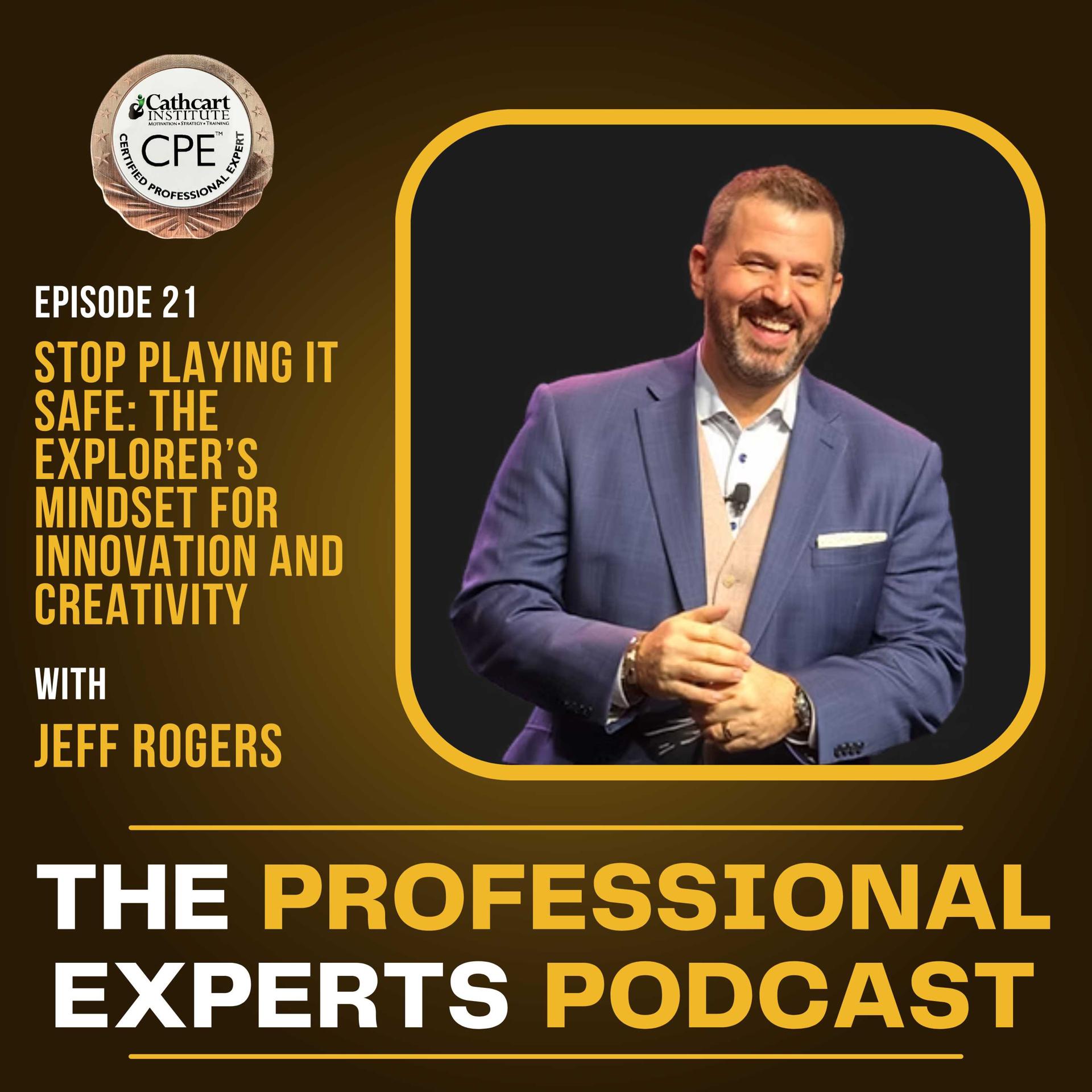
Stop Playing It Safe: The Explorer’s Mindset for Innovation and Creativity with Jeff Rogers
A conversation with Jeff Rogers
About This Episode
What if the key to innovation and stronger teams isn’t more structure—but more creativity? In this episode, Jeff Rogers shares how his background in improv comedy and work with Second City shaped his approach to leadership, storytelling, and corporate transformation.
From building trust within teams to shifting mindsets from risk-avoidance to exploration, Jeff breaks down how organizations can unlock creativity and take meaningful action. You’ll also hear powerful insights on why people fear judgment—not public speaking, how small perspective shifts can change outcomes, and why embracing an “explorer’s mindset” is essential in today’s fast-changing world.
About the Guest
Jeff Rogers is an award-winning keynote speaker, professional emcee, and creativity expert with over 25 years of experience engaging corporate audiences. Known for his high-energy, interactive style, he blends improvisation, storytelling, and innovation to help organizations think differently, collaborate effectively, and take meaningful action.
Jeff began his career as an award-winning stand-up comedian before being discovered by Amy Sedaris and encouraged to train at Second City. He went on to perform alongside renowned comedians such as Steve Carell, Stephen Colbert, Tina Fey, and Amy Poehler, honing the improvisational techniques that now define his work with business leaders.
Today, Jeff is a nationally recognized speaker and storytelling champion, delivering keynotes, workshops, and hosted events that drive innovation, strengthen culture, and inspire teams to move from uncertainty to unstoppable momentum. He is also an international best-selling author and creator of the PLAYMaker Mindset, a framework that combines creativity, collaboration, and the science of play to unlock breakthrough thinking and performance.
Beyond the stage, Jeff has worked as a TV host, screenwriter, and creative director—including leading the inaugural Chicago Ideas Week—and has appeared in commercials and television shows for major brands. His work focuses on helping organizations align purpose, ignite creativity, and build cultures that thrive in times of change.
Website
https://www.jeffrogersunlimited.com/
About the Host
Jim Cathcart, CSP, CPAE is one of the top 5 most award-winning speakers in the world. His Top 1% TEDx video has over 2.8 million views, his 27 books are translated into multiple languages, including 3 International bestsellers. He is a Certified Virtual Presenter and past National President of the National Speakers Association. Jim’s PBS television programs, podcast appearances and radio shows have reached millions of Success Seekers and he is often retained to advise achievers and their companies.
Even his colleagues, some of the top speakers in the world, have hired Jim to speak at their own events. Jim is an Executive MBA Professor at California Lutheran University School of Management and serves as their first Entrepreneur in Residence. He has been inducted into the Sales & Marketing Hall of Fame in London for his pioneering work with his concept of “Relationship Selling.” He is also in the Professional Speakers Hall of Fame and has received The Cavett Award and The Golden Gavel Award.
Jim has written 27 books, hundreds of articles and he is always writing at least one new book. His most recent book is HI-REV for Small Business, The Faster Way to Profits . Audiences buy his books by the hundreds and he happily adds autograph sessions to his speeches.
https://cathcart.com/
https://www.linkedin.com/in/cathcartinstitute/
https://www.facebook.com/jim.cathcart
https://www.youtube.com/user/jimcathcart
Tedx: https://www.youtube.com/watch?v=-ki9-oaPwHs
Full Transcript
Welcome to a thoughtful discussion of important ideas among people who are committed to succeeding in life. This is a gathering of leaders from a variety of industries, and our role here is to help you reach the top 1% of your field of choice. I'm Jim Cathcart. So come with me and let's discover how much more successful you could be.
Hello, folks, this is Jim Cathcart. Welcome to the Professional Experts podcast. Today our guest is Jeff Rogers. And Jeff Rogers comes from a different world than a lot of the other folks who had come through the Experts podcast in that he includes in his background comedy work with Second City, among other things. So, Jeff, give us a little bit of an overview of what your path has been and. And then bring us up to date on what do you do now? Mostly.
Absolutely, yeah. Thanks for having me on the podcast. I'm excited to be here.
It's an honor to have you. Your CPE certified professional expert number 39. And I'm proud, proud, proud to have you in the group.
Well, I'll tell you, that's one of the reasons my background is one of the reasons that I actually was so excited about getting that designation. So I started, you know, as I started as a stand up comedian, honestly, when I was 18 years old, and I literally had to have a fake ID to sneak into bars to do stand up comedy.
That's it.
That's not typically why people sneak into bars, but I was on a mission. And so, you know, from doing that and performing with that, I actually, Amy Sedaris, who's fantastic comedic actress and she has had her own television shows and been in films and TV and all of this, she saw me doing stand up and she came up to me afterwards and said, listen, you're not doing standup. That's not what you do. You do improv, but you don't do it real well, so you need to go take classes.
Whoa.
So I did. I ended up going to a place called the Players Workshop of Second City, which is the oldest school of improvisation in the country. Many years later, I ended up buying that school.
But wow.
And then I got hired at Second City. Now, for those people who don't know, the Second City is an improvisational theater based in Chicago. Folks like Bill Murray, Alan Alda, Ed Asner, John Belushi, Dan Aykroyd, Gilda Radner, Catherine o', Hara, John Candy, Chris Burley, Mike Myers, Steve Carell, Stephen Colbert, Tina Fey, Amy Paul, all of these people came through this little theater in Chicago because of its special techniques that it Taught, which was improvisation. So I actually got to work with Stephen Colbert and Steve Carell and Tina Fey and Amy Poehler, and wow. Oh, it was fantastic. It was absolutely amazing. So while I was at Second City, though, I started helping them build their Second City Communications. And what that was was the business application of the tenants of Improv. And the idea there is that improvisation has so many great lessons and tools for interacting, supporting creative thinking, that businesses would come by and do a workshop and say, I need you to come and work with us because my team isn't creative enough, or they're not a. They're not a strong enough team or they don't trust each other enough. And so we would work with them, teach them our exercises, but in the way of a. Of an organization or a company. And it was a great time to build that. And so that really built my interest in working with corporate organizations and associations and sharing this way of being in a very non creative space. And that led me to working with just, I mean, a significant amount of the Fortune 500, everything in every vertical. And so then I got interested in innovation because the creativity was great. But then I would leave those workshops and there was no action step. There was no thing they did next, how to apply that. So I got involved with design thinking and I took a lot of certifications. I got certified in design thinking from Stanford, from Harvard, from mit. To really bring together and coalesce the creative part of it and then the action part of it. And that's. I. I play into this day. Yeah, I do that, you know, through keynotes and workshops and longer, Longer engagements with clients to teach them storytelling and to get them to be able to think creatively and innovatively, to be able to act creatively and innovatively and then to be able to share the story of why.
Exactly. And by the way, let me interrupt for a second.
Sure.
Just so our listeners will know, Jeff Rogers a couple of years ago entered the National Speakers Association Storytelling Contest. Well, this is kind of like a tank coming into a fistfight, you know, it's just unfair advantage from the start. But I was. I had the. And not. But I had the privilege of being assigned as his mentor, senior speaker. Right. Like I'm gonna help you with storytelling. Anyway, I gave him a little bit of feedback and of course, he nailed it and came in number one in the nation in the National Speakers Association. So, yeah, no, you. And when you talk about storytelling, you got the chops. That's.
Well, you help more than a little. That was a great. I Mentioned that every time people talk to me about that competition and that insight that you had, that it just. It really did turn the whole story into something of a much higher level. It was. And you were so gentle about giving the notes as well. It was like, jeff, I've got. I could. I know exactly what you said, Jeff. I got no notes. You do a great job telling the story. I got no notes. I just wonder if. And you just had this perfect little note that everything in the story shifted and it fell into place, which. It was remarkable. It was.
It was a wonderful, beautiful, beautiful. Well, that's. You know, when it comes to storytelling, human communication is natural storytelling. You know, hey, how was the trip to Disneyland? Oh, my God. You know, and they tell the story, and they don't think of themselves as storytellers or public speakers. I wrote a book called what to do when you're the speaker for people like us, you know, professional speakers. In that book, I lead with this. I say, nobody's afraid of public speaking. You don't know me. I'm afraid of public speaking. I get dry mouth.
I get.
You know, I've frozen. It's. It's. It's. I need treatment. You're not afraid of public speaking. Yes, I am. No, because you speak in public all the time. When you say, hey, guys, they're open. Come on, let's go. In the theater, that's public speaking. When you say, excuse me, could we get a waiter over here for second round? That's public speaking. You're afraid of judgment.
That's great.
That's the only thing people are afraid of.
That's a perfect example of a Jim Cathcart little nugget that shifts everything you're thinking and makes it fall into place. That's exactly what you do. Which. And you're absolutely right, that's it. I mean, and storytelling is such a native part of our DNA, right? In the cave drawings, they weren't, you know, doing an Excel spreadsheet. It's the story of the hunt. So, yeah, it's part of who we are.
And it's what. It's what a culture lives in. You know, I'm speaking at a conference coming up this summer, and the theme of it is, is building a strong culture. And so my whole message is going to be storytelling about groups of people with whom I was connected and how just by changing the story or emphasizing the story that maybe was ignored or not noticed, everything changed. Like, when I was president of NSA, they had been. It was the 16th year, sweet 16 and we were in Dallas, about 2,000 members showed up for the convention, all professional speakers and authors and people like that. And every year prior to that, we had been behaving like a big business club, not like a professional society. And so our conventions would be a meeting room with a raised platform and a banner and sometimes a head table if there was a meal back in the old days. Right, Head tables.
Yep. Like a wedding.
Yeah. Those of us on the board said, wait a minute. This is a bygone era. We need to lose the head table. Just put a lectern up there and put our table. Yeah, but what about the dignitaries? Give them reserved seating down front, but don't put their eating skills on display. Right. And, oh, man, you should see Jeff eat. That guy with something. He wasn't the speaker, but he was up there, and he would, you know, and he was just beautiful. No, so what. Put in front of us what you want in front of us. So my theme for the year, because we could have a presidential theme, I came in and I said, the theme for this year is share the vision of what could be.
That's great.
And the opening of the convention, we're at the Anatole Hotel in Dallas. Big, elaborate meeting room. And I had a stage built, contracted, obviously, with a black background with little pin lights like stars. A small orchestra. Oh, not a band, an orchestra. Live in the room. A big screen up above the stage at the back. In the days when nobody had screens.
Right, Right.
No video was shown anywhere. This was 1989. And then the stage itself. So the people come in the room, and the room is dark, but with enough light to get to your seats. So it's like a theater on Broadway.
Right?
And they come in and they find their seats, and the orchestra is playing, and it starts playing. 2001 A Space Odyssey. Boom, boom, boom, boom, boom, boom, boom. Right.
Okay, that's awesome.
Builds and builds, and there's nothing on stage. So the room's black, and this is building. And all of a sudden it goes. Orchestra goes silent. Scream comes alive. The people go. And it's a clip from Back to the Future when the car comes out of the. Out of time and it leaves the trail of flames, right? And there's smoke all over the place. And the car door opens, and the screen goes black, and the stage lights up and it's filled with smoke. And I walk out.
That's outstanding.
And I said, I have just returned from your future, and you're gonna love it. Just yesterday, I was at the fifth annual White House Conference on Professional Speaking and President of the US And I named one of our members, said to me, you know, and so the whole thing became just a big, like a beginning of a one act play. After that, everything in NSA changed because they all started thinking of themselves as professionals. And this is a professional society. And upscaling everything we did. And it's collaborating with groups like, like Second City, you know, talking to people in the comedy field. We worked with the Hollywood Improv on, doing a special lab on humor out in the West. We worked with the American Booksellers association on an authors conference. You know, I mean, we went to the Jonesboro, Tennessee Storytellers Festival.
Okay.
Yeah. I mean, so everything changed, like you said, by just shifting the story. Same group, same reason, same same topic, different twist.
It's amazing what that different lens will lend itself to. Right? Same position. And I'm sure, like you say, same
people, you could go on for weeks giving examples of how you did that and how you saw others do it with you. Yeah, just pick a couple of pearls for us.
Well, I tell you, the one I use so often right now is that, that I think everybody gets. Because it was such a big film, the Titanic.
Yeah.
Right. And so, so let me do it the way I tend to ask people, well, Jim, why did the Titanic sink?
Because it had a hole in the side.
It had a hole in the side. Right. And most people say that exact thing. They say, well, it hit an iceberg. Well, the reality is that's not why the Titanic sank. The Titanic was literally built to hit icebergs.
Wow.
If it had gone straight into the iceberg, it would have dented and lost the first two compartments. Absolutely. But it was made to withstand that impact at almost full speed.
Wow. That's why they called it unsinkable.
Exactly. They thought they had figured it out. The problem was the ship's captain, who was well known and incredibly well regarded as one of the best sea captains because he literally, a month before, 60 days before, had narrowly evaded hitting another ship that had gone off course. And he had saved both ships. So he was known far and wide as the. He would turn the ship on a dime and be able to evade things. But because of the new technology, that was the exact wrong thing to do. He had old thinking put into new technology. Let me stop for a second. Does that sound like anything that's going on today? Yeah.
AI, no.
But that's exactly what happened. So his instinct was to turn the ship and what happened was the iceberg instead of just hitting the first two compartments and smashing those, which would have been fine, would have completely limped on for the rest of its journey. He turned to try and avoid it, and that scraped that hole into the first four compartments. And if it had only gone into three of those compartments, it still would have been okay. But because he tried to avoid and evade, which up to that point, with old technology would have been exactly the thing to do. That's why the Titanic sink. And so it's that minor shift, right? That shift from a minor key to a major key, that small shift that makes all the difference. Just like the lens that you're talking about, how we view ourselves, how we view each other and how we view what we're supposed to do, what we think we're supposed to do. The entire difference of the trajectory of your journey.
So how do you work with people today? What if, when, when people find out about you, what are the ways that you work with them?
So it. It's really in three different areas. And so it's awareness, integration, and transformation. And so I think about it that way because awareness is a keynote or a workshop. So they might hire me to come in and talk about thinking differently, how we're going to approach things a little bit differently. And I try and couch that in the idea of. It's necessary now to think like a startup.
Yeah. By the way, quick interruption. When I was in the Army, I went to Officers Candidate School, and after OCS graduation, they sent me to a. I Advanced Individual Training.
Okay.
Or advanced, in my case, advanced Infantry Training. But that ait, you know, Advanced Individual Training or Advanced Individualized Training or Advanced Innovation Trial. I mean, you can have fun with this. Right?
That's a lot. That's so. It's so perfect. I mean, that, that's really what it is. I mean, it really does sort of engage on that level. Right. It evolves as I keep working with organizations. So like I say, awareness is like a keynote or a workshop. And I'll. I'll show people this is what it means to think a little bit differently. And I, I use the three ifs, which is what if? As if, if, then.
Cool.
And so that gets them, okay, here's what if. What if we think differently? What if, you know, gets them thinking a little bit creatively? And then I talk about as if. And all the work that's been done and the science behind the idea of acting differently actually leads to being differently and behaving differently, believing differently, and then, well, okay, if that's possible, then what else is popping? What else can we achieve? Right. And so we take them sort of gently through this process of change.
That's a good model. I like that. Yeah.
Because people get very uptight around change as you. As. You know. Right. I mean, with all the organizations and teams you've worked with.
You know, what's interesting is the way people position change and you hear so many of our colleagues say, well, people hate change. People love change. People seek, people demand change. When I go to the movie theater, if it's the same movie, you got a problem. Not me.
Right, Right.
I'm coming after you. Right. When I go to the restaurant, I might order the same dish I had before because it's a favorite. But if I don't know the restaurant, I want options, you know, give me variety, give me something I haven't experienced before, and it might be a customer for life after that. So people love change. What they don't like is discomfort or confusion or embarrassment. Right. Yeah.
Yeah, that. That's exactly it. And that. That feeds into that unknown, and we will fill that unknown with the worst possible things that we can imagine before we actually go and experience it. Oh. Oh, well, I actually have everything I need to get through this part of it. I. I don't. I'm. I have the experience and the knowledge and combine them in different ways in order to form these new ideas to,
you know,
really move through this different. This different thing, this unknown area.
Yeah. I was talking to someone the other day and they said. They says, what. What if. I've forgotten what they said. But, like, okay, we're going to church today. What if it rains? I just look at them, you know? What do you mean? Well, what if it rains? Will answer your own question.
Yeah.
We'll step indoors. We'll wear a raincoat. We'll get an umbrella.
We'll.
Yeah, okay. Anymore. What if we get stuck in traffic? I have a cell phone to you. I mean, answer your stinking question. Don't just ask it, answer it.
I think I feed, but I think that we've been conditioned over the last couple of decades to catastrophize everything. And I. That's why I. So I'm enthralled by this, to take a little bit of a side trip for a moment. This new moon launch that just happened. The Artemis 2. Right. Yeah. I mean, that ties us back to a time when we were explorers, where we.
Yes.
We were exploring. We didn't know anything that would happen. We had no idea. But we thought, we're going to do, do it anyway. That level of exploration and discovery, the thrill of this discovery drove us as opposed to this constant catastrophizing of what if this goes on? What if this goes wrong? Figure it out. We have all of this knowledge and experience. We have everything we need to achieve the goals we want to achieve. And if something unfigurable gets in our way, you know what we're going to do.
Figure it out. Yeah, absolutely. Oh man, I love that. I got a note from my former roommate, a guy that I went to high school with who a few years after high school we got an apartment together and he said, hey, he said, they just launched Artemis for, for the moon. He said, I vividly remember you and me standing on the deck outside our apartment and looking at the moon while our TV was showing the astronauts walking on the moon for the first time live.
Wow, that's outstanding. I love that. I mean I just. On my laptop I have a little sticker that. A little NASA sticker. And it's not because I'm a bit of a space fan, but just the idea of it that we're going to go exploring on a level that's never been done before and we're going to do it by our sheer will, wits and intelligence and it creates stuff and that. I just did a LinkedIn post that said the four greatest improvisers on the planet are currently off the planet. Four astronauts are going to improvise around whatever needs to happen. They're going to have their systems, right? They got to have their systems. Yeah, but if something comes up, they're going to improvise and they're going to
make it pass like the first day when they, when they had their problem with the. In. In flight bathroom.
Right, right.
You know, and it's interesting, I. There's a place in Westlake Village, California, Four Seasons Hotel that is was built by David Murdoch who owned Dole Corporation, a food company. And he owned for a while the island of Lanai island. And, and he owned two Four Seasons hotels that he had built on the island. So mega wealthy billionaire. I had a chance to briefly know him and my son was the HR director for that Four Seasons Hotel for many, many years. And attached to the hotel was a TV studio that was state of the art. I mean, had a mission control, had broadcast studio, had a radio booth, had, you know, all these things, like four or five stories, there's several theaters and technology out the kazoo. So it was built in 2000 something. And when I saw it, it was about six years old. And they said all of this technology here is now obsolete. And so we're going to have to replace all of it. But keep this in mind. All the technology that was used for the moon mission in the Apollo program was less than is in this phone.
Yeah.
What, What?
I know, I know. It's. It's. It's mind blowing when you think about it. Yeah, absolutely. Mind blowing.
What?
You know what? I want to go back to one thing. So what were you thinking? When you're standing out there looking at the moon and on the TV in the other room is a guy walking on it, what's going through your head?
I don't think anything was going through our heads as much as through our hearts. You know, we were just standing there going, oh, my God.
Yeah,
wow.
You know, that's outstanding.
Where rational thought had no place to go.
Yeah. Right.
So you just kind of snuggle into the emotion and live there for a moment or two.
Yeah, that's outstanding.
It was amazing.
I absolutely love that. I think that that's that spirit, that sort of. I. And I mean, if you go back further, the, The Westward Hoe and the, the exploration of. Of. And go back further in Columbus and, you know.
Yeah.
Galileo going back, and you keep on finding these explorers who are saying, wait, what, what else is there? What else can we do? And. And as a. As individuals and as groups, as cultures, what else can. Are we capable of? And yeah, I feel like when we touch on that as an individual and as a team, you become unstoppable.
Exactly. And there's two things that. Two things that impede that. One is self doubt. The other one is. It's kind of. It's a permission thing. You know, if your leaders empower you to make mistakes, you'll try things. If you make a mistake, you're toast. You won't try anything. Right. So you got to have a culture of openness to accidents and failures and occasional waste, but not recklessness. You know, that's the difference, people. Ten years ago, it was really popular for speakers like us to be brought in to talk about, sell people on taking risks. Risk taking was a corporately desired skill. Well, shame on you for wanting risk taking. Don't want risk taking. Want exploration and know that there are reasonable risks to be assumed within it. But yeah, taking as the thing you seek. Hey, let's see how bad this could be. You know, we could lose our legs. Let's give it a shot.
We could really mess this up.
Yeah, and lend me that bath Towel, I'll put it around my shoulders and fly off the garage. I'm Superman.
Right, right, right, exactly. Yeah, that really is that. You know, I trace that back a little bit. That idea of fail fast. Right. And a lot of that originated in Silicon Valley because their whole idea was to get to a minimal viable product as quickly as possible and get that out into the market. And then they would update and upgrade. Right. The problem with that becomes coding is such a narrow focus band to begin with that it doesn't have. You don't have to worry about X, Y and Z coming out of that. It really is like this. When you say take risks as opposed to develop an explorer mindset or an.
Yeah.
You haven't put any parameters on it to make sure that you're, you're focused on the right target. Right. Or the zone, the landing zone. Right. And now I feel like there has been such a withdrawal of that. It's almost like the, when a tsunami comes in, the water is sucked all the way out and then it comes in. Yeah, right. I feel like that idea of. And the idea of taking a risk has been sucked out of a lot of organizations. And it's the pendulum swing. You can't be totally one side or the other side. You've got to that ability to swing in the middle and if you're really good at it, to be able to do it in a targeted way, to time it to trend spot so that you know when to take them in a few and when.
By the way, I've got some, I've got some observations for you. This is for you, to market you.
Okay, I'll take them.
So you're talking to the marketplace and you say, they say, well, so Jeff, you know, we've had a lot of speakers over the years. What should we expect if we bring you in for our annual expo and say, well, I'll do. The main thing I do is I stimulate an explorer's mindset. Oh, I love that explorer's mindset. What is that? Well, one of the biggest problems that people run into in their careers is they get so used to the routines and the rules that they assume that's the fixed world that we've got to live when live in forever. And what they're allowing to go to waste is the explorer's mindset. The, the kind of mindset that startups have. The kind of mindset that people in the early days of the industrial era or the information era had where they're, they're saying, let's try that and next thing you know, you've got Apple Corporation or Microsoft or whatever, all of which came out of somebody's garage, you know.
Right, right.
Because of the explorer's mindset. Now, if everybody in the organization has an explorer's mindset, you got chaos, and you're at risk. But the people who can explore ought to be encouraged to explore. Like, we've got four astronauts in space right now. But the ground crew is not just thinking that.
Yeah, right, exactly. You've got ground control.
Yeah. And ground control has fixed systems and rules and technology and, you know, all that. And you present them a problem, they will go through formulaic approaches to solving those problems.
Right.
Now, the people in space, they figure, hey, you got a. You got a Kleenex. I got to plug a hole. You know, whatever. Gabby, get. Are you using the eraser on that pencil? Yeah, because I need that as a. As a stopper for this. Right. You know, I mean, innovation happens because that's the only option. But when I was a kid, we didn't have to be sold on recycling. We recycled everything. Hey, well, don't. Don't throw. Throw it out. You know that in a scrap box, we might be able to use that.
Right.
But it's just a piece of bent metal. Yeah, but it could be a brace. It could be. I could drill all. You know. You could. And ideas start coming. So when I wanted a Davy Crockett jacket with the fringe and everything.
Sure. Absolutely.
And we didn't have any extra money, mom said, I know. I'll make you one. And she got a pair of my dad's khaki pants, took it apart at the seams and cut a pattern out and made fringe for it and sewed it back together for little Jimmy. And I had my Davy Crockett. And I couldn't afford to go to the store and buy a Davy Crockett coonskin cap.
Coonskin cap, Right.
So dad brought home a coon. Oh, he was a hunter. I had a coonskin cap.
Maybe in the real deal. Yeah.
Wow. Mom put a silk lining inside it so I could wear it.
That's hysterical. That's awesome. That's absolutely outstanding of them. Are you kidding? That's fantastic.
But that's the thing, you know. I wouldn't want my wife to have to be explorer, but I wouldn't want to never be permitted to explore. As my greatest joy. When I ride my motorcycle, my greatest joy comes from what I call riding free. And that's when Paula says, where are you going? I Say, wrong question. When will you be back? Would be more accurate.
Exactly.
Because I don't know where I'm going until I get close to something interesting.
So that's so fascinating because they literally nowadays are building parks that are unsafe for kids because they have to learn everything has been so mitigated. Right. With risk mitigation. Kids don't know how to jump a bike off a ramp of a, you know, a piece of plant and non.
Die.
Exactly. And not die. It's like, no, no, they need that. In fact, talking about NASA, one of the things that NASA did Is during the 90s, they had to bring back a bunch of the old guard from the 1960s to work with the new crews. Right. Because they didn't know how to. How to innovate and to take care of issues that they were facing. Because as kids they were taking apart radios and putting them back together.
Exactly.
Now.
And they didn't realize that the two. Two best tools in the history of mankind. Or a Barlow knife or Boy Scout knife, maybe.
Yeah.
And duct tape. There you go.
I was just going to say, you know that there's duct tape on that. You know, there's duct tape on that spaceship right now.
Oh, there's got to be. There's totally got to be. Not love that. So this corporate executive comes to you and says, jeff, look, we're kind of stagnant. We've leveled off and I need to kick in the profit engine again. Well, let me teach your people how to develop an explorer's mindset and how to cultivate a culture internally that encourages innovation while respecting the rules and respecting what works. Because the last thing you want to do is. Is start new bleeding when you haven't stopped the existing bleed.
Right, Right.
So first thing I'll do is I'll have some fun with them, get them to where they like learning with me, and then I'll show them how to be innovative and I'll get them involved, get them engaged so that everybody feels included, but nobody feels like they're put on the spot and highly at risk. I know how to do this so that everybody feels happy and involved, but not embarrassed or, you know, whatever.
That's exactly it. Yeah.
And the second thing I'll do is I'll work with your executive team to look at your existing principles and practices, the rules you live by today that are your culture, and we'll come up with a new set of guidelines that allow more room for creativity and innovation, and we'll set to set limits on how big of A failure we're willing to risk. But at the same time, we will move the markers out a little further to allow for some accidents, waste and, and mistakes that we can learn from. And at the end of it all, you will have a team of people that'll have a common story that everybody can tell that will make anyone want to do business with your company. So my name is Jeff Rogers and here's how you reach me.
I'm just going to use that clip as my, as my sales tool. I'm just going to send the entire time. Yeah, that really is it. I mean, that really does. And I love how you rec. But of course you recognize it. But the, the idea that by allowing that, by creating that playground. Right. That science lab of being able to explore and just discover these happy mistakes. Right. These happy accidents that may lead to. And maybe they don't, but they lead to learning. But what you're also doing in the background is creating that tapestry of the culture, the rent that you're pulling through all of this work and all of these interactions that now becomes a bonding agent as opposed to everybody in their silos just doing their thing. And every, every study of corporate culture and, and military culture is that you don't fight for the flag, you don't fight for the pledge. You fight for the guy or the person in the foxhole with you.
Yeah.
The reason people don't leave the company that they're with, if they don't leave it is because of the people that they're working for.
You know, people don't leave companies, they leave bosses.
Yeah, that's exactly.
Yeah. Yeah.
It's true that the science all shows that. And if you can reinforce that bond and really bring them together strongly around something that they identify with and that value aligns with their values, then they become, you know, more than just an employee. Now they're a brand ambassador, right?
Yeah, yeah, they're a brand ambassador. And their business family, you know, organizational family. Right. One of the things I talk about, everything in my business is about acorns and the whole nature metaphor that relates to that. And I talk about organizations using a tree structure rather than org chart.
Right.
The tree structure has a root system seeking resources and, and a growth system seeking opportunity. And every cell from the tallest leaf to the deepest root has the exact same DNA.
That's excellent.
And the way I talk about that in day to day business dealings is when someone comes to interview with your company, the resume shouldn't matter much. What you want to know is like my son when he was hiring all these thousands of people at Four Seasons, he said, dad, I didn't care if they graduated with honors from the Cornell Hotel School. I wanted to know, are they a four seasoned person? Do they have our DNA? Will they fit in this culture and have the people who are here already say, man, I'm glad you came aboard.
Yep. Yep.
Because it's not what you know that counts. It's not who you know that counts, is not who knows you that counts. It's not who they know that counts. It's who's glad they know you.
That's a great way of putting it.
There you go. And thinking, coming back. We need to wrap up. Of course. But. But coming back to your story, I recommend that when you're talking with clients and potential clients, that you follow this. This mantra, solve a bigger problem. So when they come to you and they say, we got problem with our people not being engaged, Solve a bigger problem. Like reinvent their culture. Or they come to you because profitability's been off for three quarters in a row. Solve a bigger problem. Profitability is a symptom, you know, find out what it's symptomatic of. Bigger paycheck.
You can't even help just dropping these acorns of debt right now. You can't even help it. If you're watching this or paying attention, I hope you're taking notes. I literally was just taking notes from this interview. That's fantastic. I love that. And it's absolutely true. It goes to the heart of the. Of the issue. Right. And yeah, that's what. So I. When I teach a storytelling, when I'm working with them on their stories, that idea of, we do this, we solve this problem, and it's like, yeah, right. What's the bigger problem you're solving? That you're going.
Absolutely.
Pivot their thinking. Because if you.
Yeah, don't give me cough drops.
Right.
Give me something that'll kill the COVID Yep, Exactly. Right. Absolutely.
Yeah.
That's good.
It's been great. Thanks so much, Jim. I really appreciate it.
Oh, you bet. Well, hey, you know, I was thinking, here's a line you can use. It just popped into my head. You're sitting talking with some people, and they've. They're telling you all these serious issues. You know, we've got, you know, we're blending two companies together, two different corporate cultures, and they're coming together at different pay structures, and we've got to redo all that. And we've got that. And so we need someone like you to make them feel like a team again. Say, excuse me, but first thing you need is a happiness injection. You get a bunch of people that see this as hard work, and so do you. And this has got to be fun again. So let's think like a startup and let's. Let's embrace an explorer's mentality and look at this from a whole different point of view. How do we make the blending of these two companies, the creation of a startup instead, using the assets of two organizations.
That's great. That's. I love. I love that pivot. I love those pivots. The pivot in the conversation when you make them think that different thought. It cures their issue. Right. It takes care of their issue. But that's not the issue. Like you say, that's the symptom. Yeah, let's take care of the actual issue. Let's diagnose that and take care of that. The symptoms will go away if we cure the actual problem. Yeah.
52 years ago in Chicago, I was in the audience. 1974, I was in the audience. Peter Drucker was speaking to the American Society for Training and Development, now called ATD association for Talent Development. And there were about a thousand of us in the room. Peter Drucker, the father of American management, Big, big deal guru of the day. Kind of the Elon Musk of intellect of the day. Right. And he said. Or someone asked him a question, and he said, that's not the question you should be asking. And I thought, you can do that. You. You could. You can tell someone that that's not the question they would. I like this guy. Right. But wasn't that beautiful?
That's outstanding. That's so fantastic. First off, I love that he did that. Second half, I love your reaction to that. Wait, that's allowed. Yep. That's such a great moment. That's that. And that's what you hear your audience, right. You want them to have that moment of, oh, that's exactly what I want to do. Or I never thought of it like that. And if you.
Exactly.
Oh.
Someone asked me one time, what's your favorite audience response? Standing ovation? I said, no. I said, not even ovation, necessarily. Because some presentations ought to be met with solemn introspection. Ooh, he's right. You know, we. We have to do something. So my favorite response is this one. People walking out of the meeting going, you know, I never thought about it like that. That makes perfect sense. We can do that.
Yeah.
That perfect audience response. So what's the perfect way for people to reach Jeff Rogers.
Absolutely. Come. Come to my website, jeffrogersunlimited.com and literally, I named the company Jeff Rogers Unlimited because I don't believe in limitations. There's always a way. There's always something that can be done. So it's always.
It may not be a good idea, but it's always there.
I didn't guarantee a good idea. That's not what I said.
That's right.
But come to the website. Email me at jeff@jeffrogersunlimited.com I post on LinkedIn and I have a newsletter on there every other day. So literally, I always. I try and put out as much thinking to try and get people to stimulate different ways of approaching what they're doing. And, yeah, a lot of fun with it.
And I think folks ought to follow you on YouTube, but just to see how you do storytelling. You know, the way you. You. I told you this when I critiqued you for that storytelling competition. You've got a natural feel for timing, for. For the turn of a phrase or the emphasis in a word. You know, it's. It may be natural now, it might not have been when you started your path, but it's refined at a professional level over an extended period of time and proven to work. So people ought to be learning from you, if nothing else, just by example.
Well, I'll tell you, I. I grew up in a family of 11 kids and.
Get out of here.
Oh, yeah.
Imagine if that had been your own family.
Yeah. No, I can't. But I will tell you that if you couldn't hold the. And literally. So that's an audience, right? That is not just public speaking was a daily requirement.
That was it. Yeah.
And if you wanted to eat, you better be able to hold the audience and. And get a laugh. So it was absolutely something I was born with.
That's good. And there's a good line for you in the future. I grew up in a family or I was raised in a family of 11 kids. It was the Johnson family, not the Rogers. But. But they had 11 kids.
But they had 11 kids.
Yeah, exactly. Yeah. That's great. Well, Jeff, thanks so much. I'm so proud that you're a certified professional expert and that you join with me and Nito Cobain and Patricia Fripp and Brian Tracy and Les Brown and Tony Alessandra and all those others in carrying this brand forward. So stay engaged. And folks, look this guy up and follow him all the time. Your life will be better. And you'll have a smile injection.
Thanks so much, Joe. I appreciate it. It's truly been an honor to be included in those ranks. And it's something I want to live up to every single day. So thank you.
Take care. Bye bye.
Bye, bye.
Thank you for joining us today. If you are committed to making more success happen in your own life, go right now to my website, free.cathcart.com and download my free ebook and then watch the video. If you decide that you'd like my assistance in helping grow your success, then come with me and let's discover how much more successful you can be.
Nurture Your Nature.
Never Miss a Conversation
New episodes drop regularly. Subscribe on your favorite platform and never miss a conversation.