
Season 2, Episode 20
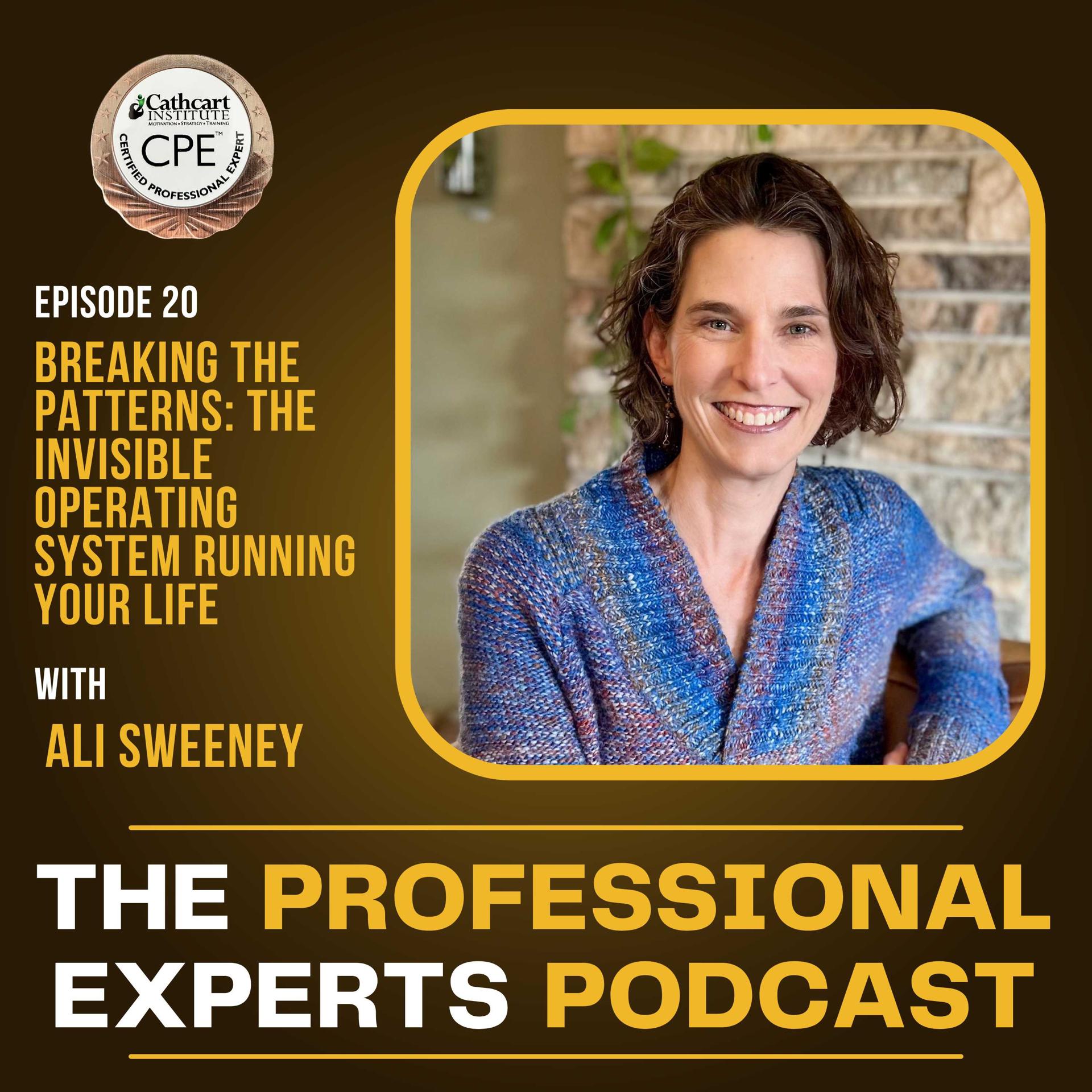
Breaking the Patterns: The Invisible Operating System Running Your Life with Ali Sweeney
A conversation with Ali Sweeney
About This Episode
Most people are being guided by beliefs they didn’t consciously choose. In this thought-provoking conversation, Ali Sweeney shares how unconscious beliefs act like an invisible operating system that shapes our decisions, behaviors, and leadership without us even realizing it. Through her work as an intuitive guide, she helps high performers uncover hidden patterns formed earlier in life and interrupt the cycles that keep them stuck. This episode explores the powerful intersection of intuition, leadership, and self-awareness—revealing how leaders can move beyond fear, reprogram limiting beliefs, and align their actions with who they truly are.
About the Guest
Ali Sweeney is the founder of A Light Insight, where she works as an intuitive guide, energy healer, and meditation teacher helping individuals uncover limiting beliefs and reconnect with their inner wisdom. Her path has evolved over three decades—from environmental engineer to nonprofit leader, and eventually to spiritual teacher and psychic practitioner. Through her work, Ali supports people in recognizing hidden patterns, releasing emotional blocks, and aligning with a more authentic and purposeful life. She offers clairvoyant readings, meditation classes, and group experiences designed to help clients gain clarity, confidence, and a deeper connection to themselves. Ali holds a degree in Civil and Environmental Engineering from Cornell University and a master’s degree in leadership from the University of Denver, blending analytical thinking with intuitive insight in her work.
Website
https://www.alightinsight.com/
About the Host
Jim Cathcart, CSP, CPAE is one of the top 5 most award-winning speakers in the world. His Top 1% TEDx video has over 2.8 million views, his 27 books are translated into multiple languages, including 3 International bestsellers. He is a Certified Virtual Presenter and past National President of the National Speakers Association. Jim’s PBS television programs, podcast appearances and radio shows have reached millions of Success Seekers and he is often retained to advise achievers and their companies. Even his colleagues, some of the top speakers in the world, have hired Jim to speak at their own events. Jim is an Executive MBA Professor at California Lutheran University School of Management and serves as their first Entrepreneur in Residence. He has been inducted into the Sales & Marketing Hall of Fame in London for his pioneering work with his concept of “Relationship Selling.” He is also in the Professional Speakers Hall of Fame and has received The Cavett Award and The Golden Gavel Award. Jim has written 27 books, hundreds of articles and he is always writing at least one new book. His most recent book is HI-REV for Small Business, The Faster Way to Profits . Audiences buy his books by the hundreds and he happily adds autograph sessions to his speeches. https://cathcart.com/ https://www.linkedin.com/in/cathcartinstitute/ https://www.facebook.com/jim.cathcart https://www.youtube.com/user/jimcathcart Tedx: https://www.youtube.com/watch?v=-ki9-oaPwHs
Full Transcript
Welcome to a thoughtful discussion of important ideas among people who are committed to succeeding in life. This is a gathering of leaders from a variety of industries, and our role here is to help you reach the top 1% of your field of choice. I'm Jim Cathcart. So come with me, and let's discover how much more successful you could be. Welcome, everyone, to the Professional Experts Podcast. This was originally called Wisdom Parlor because I get together with other people who I consider brilliant, and I try to pick their brains and gain some wisdom that you and I can all learn from. Well, today my guest is Ali Sweeney, and I'm going to let Ally tell you who she is and what's unique about her. But she is, among all the experts in the. In the certified professional expert category, which are currently 39 people, she stands alone, is the only one in her unique niche. So like all the rest of them, she is highly accomplished in her field, very well recognized, has a great body of work, intellectual property, and a great deal of experience to bring to the table. But the area she has chosen to focus on and the way in which she approaches it is truly unique. And you and I can learn from that and follow her business model to the extent that it transfers. You know, they say wisdom transfers. Technique does not. So technique may be specific, but wisdom transfers. And who was it? Somebody like Ralph Waldo Emerson said, if you learn only methods, you'll be tied to your methods. If you learn principles, you can make up your own methods. Well, we're going to make up our own methods after we learn from Ali Sweeney. Welcome.
Oh, Jim, thank you. What a beautiful introduction. I'm proud to be one of your professional experts and bring what I do to this realm. I'm really excited about it. Thanks for having me.
Oh, you bet. Well, give. Give us a little hint. What is a light inside? What? Do that. And you use the word psychic, which usually, you know, people go, what? Really? You know, they're afraid to strike up a conversation for fear you're reading their auras or something really, that has happened. So walk us down that path.
Yeah, well, you know, in the realm of when you're talking about principles and methods. Right. My principles are basically that we all operate with these unconscious beliefs that are running as a background operating system. And until we start to look for them, they can influence our decisions, our behaviors, what we do in our lives without us even realizing. Yeah. And so what I learned how to do in being a psychic and being an intuitive guide is help people see those patterns, those beliefs with clarity. Because when you see them, then you can change them.
Yes.
And so the principle I think we can all agree on. Right. Is that everybody has this experience of, gosh, maybe feeling like they've made a decision over and over again, or they're stuck in some pattern in their life that just keeps repeating. I'm sure we've all had those experiences. And my method might be slightly unique, but it's really powerful. So it's different from working with a coach that might help you with your skills or your behaviors or your frameworks. Right. What I do is I take people deeper into that invisible operating system that's underneath all of that. Yeah, yeah.
How do I get in? I want to listen to in the Looking Glass, you know, down the Rabbit Hole. I want. I want to end. I want to see what it's like in there. So.
Yeah, well. And Jim, like the people who are on your podcast, they're ideal clients because they're such high performers. Right. You've had this incredibly successful life, and so many leaders have. But what happens when you work with me is like, it's a felt difference that comes in your body, so it becomes something that isn't just about performance and more aligns with who you are. So it impacts all areas of your life, not just your professional life, but also your personal life. And, you know, a lot of times we can be scared to look deeper. So, you know, I'm actually honored that you would say, like, let's open it up. Right. Because it can be scary to be the one who's in charge and to be the one who's the rational, logical decision maker. Right. Responsible for all these people or all of the profit. Right. Whatever people's responsibilities are. And yet, often these operating systems, they were created in our childhoods.
Right, Exactly.
Created so long ago, and they've become as if they are us, but they're not. They're not actually the truth. It's just we've lived so long with them that we think they are.
Years ago, I was talking with someone that I've been in the field of personal development since the 1970s, so I've had lots of fascinating conversations.
Oh, I can.
Pretty substantial people like yourself. I was talking with someone, and they said, well, that's work. I said, what do you mean? Say, well, you know, you got your business life and your personal life, and your personal life shouldn't interfere in your business life and vice versa. That's impossible. You're the same person. Yeah, but, you know, when you get to. No, excuse me, but the fears from your childhood, the hang ups that you have about your personal abilities, the doubts that you have, the argument you had with your spouse this morning, all that comes to work. You don't mention it, but I guarantee you it flavors each conversation and, and each task that you're working on. Got a personal problem of a broken leg. Let's go through a work day and see if you didn't bring your personal life to work.
Right, exactly.
Yeah.
And that's the thing. Like a broken leg is so obvious. Yeah, Right.
But physically, you know, we're comfortable acknowledging those things. But when it comes to psychically, and they go spooky, spooky, you know, astrology stuff, don't. Wait a minute. We all have a psyche. We know that the field of psychology is the study of that psyche. So don't go all weird on me just because I used that term. Everybody knows it's there and everybody talks about it and everybody deals with it. So let's put it on the table.
Right. And. Right. I think more and more in business today, leaders do use the word intuition. Yeah, right. They, they know something, they feel something. And so that's very similar to what psychic would be. What you have to be careful of is that sometimes this conditioning, these operating systems can mimic intuition. They can, they can feel the same because they happen quickly. They're like, feel like an instinct. And so that's why it's so important to create some, some awareness. Right. Where you're actually making the decision from. Because until you practice in intuition, you might be actually just operating out of, you know, something like scarcity. If you were raised in a home that was. Didn't have enough.
Well, yeah. My wife grew up in a family where every penny was essential. She was one of five kids. Her dad worked in a factory. Her dad and mom took in furniture for repairs on weekends, you know, and her mom took in ironing. And so everybody struggled to get by. I was raised in a little bit higher middle class family. My dad was a telephone repairman. Mom didn't work outside the home and we had enough money to, to not worry about money much. But then my grandfather had a stroke and we took him in and he couldn't. He was a vegetative state. Wow. Patient for the rest of his life. Seven years in our front bedroom. Never got up out of bed, never, never spoke. Poor guy. I mean, yeah, I can't imagine the misery that must have been. But anyway, my mom and my grandmother took care of him and tried to raise me and my little sister. So our World changed a little bit. But I grew up with a growth. I think I grew up with a growth mentality. I certainly did once I was exposed to the field of self development and spent hundreds of hours listening to recordings and reading the motivational books and all that. My wife grew up with a scarcity mindset, but a happy, loving scarcity as opposed to a fearful, angry why may scarcity? So she's just a delight to be around. And she always thinks other people's needs are more important than hers or mine because we should always put ourselves second, even if we're starving and won't be able to help them an hour from now. We should put ourselves second because there are other people and other people are by definition higher food chain. So. And she married a guy who's a motivational speaker. Hello. You know, goal setter, dreamer, paradigm exploder. And here I've. We've gone all over the world. I've delivered 3500 speeches literally around the world.
Yeah.
25 major cities in China, all over Europe, South America, Australia and so forth. Now, I'm not saying that to say, look at Jim.
Wow.
Wow. I'm saying my mindset and her mindset both came into a lifestyle neither of us had even had a sample taste up. And we've lived this wonderful abundance and love it. And We've been married 55 years and are still in love and still flirt with each other today. And we have arguments and all that, but still, of course, we're in love. You know, that's how important what you do is, is helping people honor their own psyche, their own essence, their spirit, you know, because they got a soul in there that's trying to get out and live fully, but our belief systems inhibited all the time. I'm going to stop talking and let you run with this.
No, you're doing great.
Thank you.
Exactly what it is. It's exactly what it is. All of these programs and conditioning, they, it, they happen, right? And they get formed out of what happens to us, right. What happens in our lives. And again, it's the way that you were able to keep that opening happen, right? To be able to say, okay, yes, that is what happened, but this is who I am in this world. Right. Is really the gift of your life story. Right. Is that you are able to know that through this. And I would offer that in today's leaders, and it's in today's world, in the generations that exist now, people have lost that sense of who they are in a lot of ways to, to the conditioning that has. Has happened.
And I was just talking with a client this morning. I did a seminar today for an electrical company in Texas, and we were talking about how the COVID era changed their collective psyche to make us afraid of other humans and reluctant to. To step out. And even students in, you know, teachers tell me, I was doing a coaching session a moment ago, and my client is a science professor, and she said, my students are afraid. You know, they don't speak up. They. They doubt their own ability. And that's not innate. You know, our spirit wants out. We. We just keep the door shut and keep holding it back and.
Right.
Wow. How do.
Yeah. And that's how powerful fear is. Right. And once you are in that feedback loop, it can become difficult to see that there's anything outside of that loop. Right. Once you're in the fear zone, then you start to see everything that's scary. And so that's where. That's where working with someone like me can be really helpful to just go like, wait a second. Actually, that fear happened to you before, but it's not happening now. So let's decide how we want to interrupt that pattern and move out. So that's what I mean, I'm sure you experience this all the time, Jim, is when you can be with someone as they interrupt that pattern and start to live their life again. Oh, it is the most incredible feeling.
It's like seeing a little. Little kitten come out of a. Out of a playpen, you know, while they wriggle all over you. Right? Yeah, it is. It is a truly joyful thing. And I can see you sitting in a boardroom listening to a group of business owners, executives, C suite people, and noticing the patterns in what they're saying and saying. I'd like to make an observation. There's a pattern here of skepticism about these things. What's that about? Let's explore that. Okay. Because as long as you're cynical, skeptical about these things, instead of exploring that to a point of certainty, then you're not going to take decisive action. And everything you do, everything you invest in is going to be a little. Okay, here's a dollar. See if that works. You know, your approach to business each day will be like this.
Right. You know, and don't hurt me.
And nobody ever grew by increasing their defenses. Nobody ever succeeded by protecting themselves more fully. Right. So there's a point where we've got to be willing to let our spirit free and take the risk of a few lumps and bruises for the joy of making A humongous difference in this world.
So come right. I. That's the line I always use. It's like a short term pain, like coming out of that comfort zone where you've always been in for the like long term gain of a life you love.
Caterpillar out of the, out of the cocoon, you know.
Right.
Without the struggle. It doesn't become a beautiful caterpillar. It's just dusty looking, kind of ugly thing. If you set it free prematurely.
Right.
And doesn't live as long. Yeah, yeah.
And it's actually far more painful to live in the pattern rather than who you really are.
Yeah. So when I talk with business people about becoming a professional expert, which means you put yourself at the center of your business as the product, what you do directly, personally for people, that's the product. That's a professional expert. So a professional expert, be a coach, a speaker, a consultant, an author, you know, specialist. And clearly you and I are the that in our own businesses. The first thing I talk about is what is your value message? What do you, how do you articulate that to the world? And we've been talking a little bit about that. I want to further. Second thing I talk about is what is, what is your brand identity? How if there's a room full of people that do what you do, how do you stand out as noticeable and memorable among people who do what you do or claim to do what you do? The thing is, who's the client you're going after? They said, well, I want to help the people with the greatest need. Well then be Mother Teresa. Because people with the greatest need don't have any money to pay for it. Right?
Right.
Yeah. Well, I mean, the people with greatest need, they have them. No, no, we need to be more intentional and more intelligent about that and that what's your business model like? Business model used to be keynote speaker. So it was all about what was the fee for that talk? And then it was information marketer, selling books and learning products and so forth. So there's different models. And then the final thing is what are the systems or standards you use to sustain the business? So let's start with your first one. How do you currently articulate your value message?
So it is a lot of what we've been talking about, Right. It is the depth and the speed at which I can identify what is happening on that under layer. Right. So it isn't that even you have to tell me your whole life story. Right. It's just that intuitively I get a sense of what's happening? It's just as you described. Sitting in a boardroom, I can just clearly see the pattern. I wish I could explain how that happens. I can't. It just is what it is, you know, and something unique that I bring is that I wasn't always a psychic intuitive. I have an engineering degree. I've worked in the corporate world, and I actually went to school to develop these abilities. So I bring a groundedness to this that I don't know is available in the woo woo world in the same way. Right. There's a practical element to what I bring that I think helps the message become. It's like, easier to communicate the message.
Do you remember Dennis Waitley? Dennis Whaley? The psychology of winning is what he's famous for.
Okay.
He was a dear friend and a colleague, and we worked together back long ago. He passed away recently. But what Dennis did is he brought his training in psychology to competition and combat. He trained returning veterans from Vietnam. He trained Olympic athletes who were competing, and he trained astronauts in mindset. And it's psychology. So he brought the. The technical skill to the more physical context. Whereas I see a parallel. Your engineering degree and experience coupled with your psychic insight, you know, that's a really, really powerful combination. And I can see where your value message could be something like a psychology of winning statement, which would be, you know, the. I don't know that. The psyche of. Or whatever. The something. You know, but work on that. I think you. You've got a hook. A statement that people go, oh, well, never thought of that before. For example, emotional intelligence. Daniel Goleman wrote the first exactly by that title, and it hit a chord with people. They said, I get it. I. I know what intelligence is, and I know what is. And most people don't think critically about emotion, but if you did, you would be more emotionally. Anyone. Anyone intelligent? Bueller. Right. Anyway, that. That book took off not because he was brilliant, because the statement brought together two things they intuitively knew.
Mm.
In a way that made sense of it like never before. So that's where I see you.
Yeah.
Yeah.
And I often I will say. The words I will say was like, I take your chaos and bring clarity.
Yeah.
But what is. What is really unique about it, again, is that it's not me like, creating the clarity. It's that I give you the clarity, Then you see it. It's your wisdom. It's your life.
Here's a. Yeah, use the word patterns.
Yeah.
Say I'm a pattern interrupter. Okay. Now people get it. What A pattern interruption is, you know.
Yeah.
Any pattern not interrupted will sustain itself, you know, will continue.
Yeah.
So.
Right.
You know, if. If something's falling and you don't catch it, it will continue to fall. Fine. Okay. I'm a pattern interrupter. Really? What's a pattern interrupt? Well, I'm trained in engineering, and I'm also trained in psychology and in looking beyond the obvious. So I look for patterns, both physical and psychological, that keep people from living the abundant life that they're capable of.
Yeah.
I look for.
Beautiful, Jim. Thanks.
In operations and in concepts and strategies that inhibit the growth of an organization. And I help people transcend those. Were you available next Tuesday?
Exactly. Thank you. Perfect.
Yeah. Cool. So we've looked at value message. Now let's go to brand identity. Is there a particular way you articulate that now that. That seems to work really well for you.
Really? It's talking about those kind of invisible operating systems.
I like that, by the way.
Yeah.
If you're not using that term a lot, I suggest you do seriously. Invisible operating system.
But I think it gives people this idea of, like, that patterning and the conditioning that can happen. Right. And so that's where I think it's really where what sets me apart. Right. Is that most people who are in coaching or who are in the professional development zone are really looking for those skills. Right. They're looking to have there. Here's a habit you can change or a behavior you can create in your teams, or this is how we create better communication.
Yeah.
And I'm just a layer underneath that so that whatever is preventing the communication from really happening is really at the core. And so we might be able to band aid it a little bit. But I'm getting to the. To the source.
I got a call years ago. Clients said, can you teach my people to be better listeners? And I said, yes. The first question do you want to schedule a seminar on listening? And he said, yeah, that's why I called. And I said, how many people in your organization have a listening problem? He said, well, frankly, one. We have one guy. And I said, now wait a minute. I want you to hear yourself. You're about to schedule the whole company to sit down and go through a training program because one guy's got a listening problem. I said, I submit that you don't need a seminar and that that guy doesn't have a listening problem. The problem is he doesn't want to hear.
Oh, nice.
I said, if I were to say to him, I have $100,000 for you what do you bet he wouldn't miss a word I said in the next paragraph? He knows how to listen. What he needs is to understand how important it is for him to keep the aperture open for information to come in and to be more attentive and supportive and interactive with other people. He said, yeah. I said, okay, that's a coaching session, not a seminar. Yeah. Right. And that's. That's you. How many times have we, as an organization had a problem that was not a physical problem? We didn't need to interrupt any patterns of a physical nature. Our policies, our systems, our strategies, all of that worked. It was a point of view, a mindset problem that grew out of something that wasn't even connected to work. That's what I specialize in. I can identify that pattern and help remove that blockage.
Yeah, that's it. Again, you're selling this perfectly. Thanks.
Oh, good, good. I think we make a good team. Oh, yeah.
Appreciate you.
For sure. You got to believe in your product, and I believe in you.
So I believe in you. Thank you.
Thank you. So we've looked at, you know, value, message, and brand identity. Let's look at who's your client, who. Who ought to be hiring you.
Yeah.
And for what activities. Yeah.
Okay. So we're really looking at the people who are making the high stakes decisions. Right. The people who are under that pressure or feel that pressure and helping them move from that place of pressure to a place of presence. Right. So that they have a felt change as they're making these decisions. It doesn't feel like such so much a responsibility as it feels like an opening.
Yeah.
When they're making those decisions. And it's also the people who are ready to change, the people who are ready to go to that deep level. Right. Some people, they don't want a life that's expansive or they don't. They don't want to move past their comfort zone. That's not who I'm looking for. And I'm looking for the gym cath cards who are ready to take life and live it. So it's the people who are looking for that deeper connection and maybe have some internal friction. They're really sure what it's about, or maybe they do, but that's where I can help bring in that clarity. And it can be. It doesn't have to be individuals. It could certainly be teams, and it can be even from different organizations who are people who are trying to work together. So it doesn't have to be specifically.
Yeah. It could be a Partnership. Like, they would bring you in, kind of like couples counseling. Bring you in to just listen and observe and make suggestions. I come to think of it, I used to do that. There's a woman named Pamela Stambaugh in San Diego who's a brilliant consultant. Came from the Ken Blanchard organization and some others. But I hired Pamela on a retainer, annual retainer, kind of a basis for I don't know how many years, maybe as many as 10. And she would come by and sit in every month or two on my business meetings with my team. And I had a small team, you know, like five.
Yeah.
Seven people. And she would come and just sit in on the meetings and then make observations. So have you guys noticed that all of these fall into that category? Huh? No, I hadn't. You know, it seems, Jim, whenever Carolyn asks you, you know, challenges your decision, that you approach it from a. Whatever. Point of view, defensive point of view, let's collaborate point of view. Yeah, whatever. But that's. You know. And she was my special business friend who, after the staff meeting, the staff would go back to their roles and she would sit with me and say, you were kind of a jerk in there. What? What? I was not. Yeah.
Everybody needs a friend like that.
Because you remember when. When Janie Lou said so and so, and you. You came back with this. That kind of implies that you don't value her input. Well, I do that. You know, stop defending. Listen, here's what you need to hear, and here's a better way. It's easy for you. Okay. And I got better every time we did that.
Yeah. How powerful?
I truly value people that do what you do.
Yeah. And exactly. When the situation that you're describing is one of those programs, is one of those patterns, that you're not making the decision to consciously talk to that person that way. Right. You would. You're even surprised that that's even how it's perceived. Right. You have no idea that this is what's happening. But once you see it, you can change it.
That's right.
And once you change it, then your whole life changes. Your whole business changes. Yeah.
That's the coolest thing of all, is that you make an alteration in the operating system, which is maladjusted. Yeah. Then problems look like opportunities. You know, issues go away. Some of them entirely, because, well, if I'm. If we're not competing, then go ahead. I don't care anymore. I thought we were competing and I was going to lose. So if we're not competing, knock yourself out. Can I help, you know, so. Yeah, it's Things just magically dissolve how. And.
And it can feel like magic. It can happen that fast. It's true.
Totally.
Yeah. So the way I do this is individual sessions. A lot like you're talking about with your, with your business friend. Right. We can come in and see the situation or talk to people individually and see what's happening in their lives. And what I think is really important about that is that it's a small situation. So when we're going so deep, it can be very vulnerable. And so. Right. It is. That isn't necessarily a situation where it's a. It's a large group. Right. So it's often a small group or an individual session where we're taking it to those depths.
Mostly. Pardon the interruption. Is that mostly your business model, doing groups and individual counseling?
Well, that's a huge chunk of it.
Okay.
And part that I'm trying to develop, you've already completely succeeded in. But the part that I'm trying to develop is in motivational speaking.
Yeah.
Because my journey in this life has been one of quite a transformation. And so I think that it's a story that people can see themselves in. And, and I also see it as a way to introduce myself and these services to a group of people who otherwise would think, oh, that's not for me.
Yeah.
So that's another element of it. And then I have something in the middle that is a 10 week course that does teach some of the skills. So it takes these intuitions and says, okay, how do we help you decide remember who you are and what you want and why you want it. And so that 10 week course takes people very specifically through that process.
What do you call that course?
The brain game.
The brain game. That's good. I like that.
Yeah. And because it really is a game that you can start to play with yourself. And so it's kind of being able to see through those patterns and it teach you, it teaches you very specifically how to interrupt them and create new ones. And the reason I think it's so powerful is it because it also gives you a discipline to then continue to do that in your life. So it's one thing to have an individual session and have an insight and you know, have something new awareness come. It's another thing to then break the habits that were built on that.
Here's a thought I love that you could, you could present in a dialogue with somebody about the brain game. You could say, this is, I guide you through an operator's manual. On your brain. No, I. Yeah, you gotta. How to operate your own thoughts and feelings and beliefs and, and patterns in a way that feels just as natural as scratching your ear or.
Right, scratch.
Smiling at something that makes you happy. Because that's the way we were created. And we need to stop getting in the way of our creator and start cooperating so that life can emerge more successfully through us.
Yeah, right, exactly. So much of the time we're in our own way, we don't even realize it.
Yeah, yeah, yeah. What's the, what's the biggest thing between you and success? You. You could even open a speech that way. Good morning. Glad all of you are here. What's the biggest thing between you and you being very, very successful. What do you think? Correct. You. You are the biggest obstacle to yourself and I'm the biggest obstacle to me. We, as we're growing up, how to remove that resistance. So that's what we're here for today. Yeah. Come with me and let's discover how much more successful you can be.
Right. And what I love about that is it brings in the personal responsibility.
Yeah.
Because so many people believe that what happens in their life is happening to them. Right. They become the victim of circumstance and it's really. Life is happening for you. And so that's what I really like about what you just said is just bringing that personal responsibility forward.
It's.
You get to create this life. It's nobody else's to do. You're the only one who can, by the way.
And you not only get to, you do. And whatever you create is what you end up having to live with.
Yeah, right, exactly.
Friend of mine, John Mitchell, he read the book Think and grow rich 20 times trying to figure out what the missing secret was. Because it tells you there's a secret, but it doesn't specify what the secret is. And he finally found it and he started practicing daily with a little 12 minute routine he designed for himself, transformed himself, his life. He used to make about 200, 300,000 a year. He started making 5 million a year. 5 million a year.
Wow.
And his whole world changed. And he wrote, wrote the book called the Missing Secret. And he says, look, life's hard enough without you piling on.
Right.
Don't doubt yourself, don't discourage yourself. Don't limit yourself with, with, you know, restrictive language. Oh, I can't. I'm not very good at that. I'm not, I'm not one of those who, you know, easy for you, but not for people like me. You know, life's hard enough without you piling on. And I love that. That's. That's a great.
I call that vital worth. It's this idea that we are intrinsically born with value. And sometimes the things that happen in our lives make us forget that, but it's always there, ready to be remembered, ready to be rediscovered. And as soon as you tap into is everything. Yeah. The world opens.
Yeah. Wow. Yeah. I believe we were intentionally created. Whatever the nature of our creator is perceived to be. There's a creator, there's a source, there's something.
Yeah.
We're something as someone. Yet that created life. Okay. And life needs outlets like a tree or a puppy or a person. And if that person restricts the expression of life, it's not just harmful to them. It denies everyone else in the world the contributions they could potentially have made. Wow. So thank you for being someone who interrupts patterns and sets people free.
That's my honor. It is my pleasure. It is. I can't believe that this is what I get to do in this life. It is so much fun.
Hey, everyone. I hope you heard that, because that's. That's a big message. It really is. It's not I have to go to work. It's. I get to do this for a living. Yep. Getting away with it. Don't tell.
Right. Yeah, no, I'm telling everybody.
Yeah. So how do you. What kind of operating systems are processes or how do you approach growing your business as a professional expert?
Well, I try. I've tried to create different. So. Right. A diversity of products. Right. So whether it's the brain game course or being able to have this motivational speaker aspect or the individual sessions and creating, like, repeatable frameworks in those options. For me, I would say another huge part of this is emotional safety and confidentiality. So I take that very seriously. Right. To be able to sit with people in the depths of their pain and the depths of their experience, to uncover these pieces, that's a huge part of how we can kind of open some of those doors and. And heal. And then, you know, it's. It's not the engineer in me, I guess it's the mom in me. But there's a compassionate part that is essential in our world today. I just. There's so many people who are like you were saying, they're so hard on themselves that really. Creating a space for compassion. I've seen it move people in ways that I didn't even know was possible. And, Tim, you can bring that energy in. So I feel like for me. Right. I just make sure that I have clear standards, clear boundaries. Right. I'm not, I'm not open for business for friends. Yeah, yeah, right. It's a, it's a different. I guess it is. It. It is a business.
And that, that's the key to this whole thing is a professional expert fits the five criteria of a professional. A professional is someone highly educated for their mode of business. Their education never ends. It's lifelong, constantly relearning. Right. It's done for pay, is done as a service to other people. So it's done as a way of helping for pay. And it's done according to a set of ethical standards. That's professionalism. And clearly you are in your specific chosen niche, a professional. And that. That's what I encourage all of us to be. I wanted to share a couple of things with you. Here's a thought in. These are just terms to use in your marketing if you're not already. Executive confidant.
Oh wow, what a great word.
I used to do that. I filled that role for.
Write this down.
One of my first clients and. But I never articulated it with that term. Yeah, Executive confidant. When he was struggling with something, he'd say, jim, got a minute? And I'd come into his office and I was in the office complex with this insurance agency. And so he would call me and I'd come around the corner and he'd just say and vent. And I would hear non judgmentally, just like you do, you know, I accept the person and, and focus on the struggle and try and interrupt that pattern so that the person can get past the struggle. And so executive confidant would be a great way to market your services. Another would be board. As in board of directors. Yeah, board mentor. Let me be Gandalf. Let me be Merlin. Let me be Yoda to your board of directors. I don't want to interfere. I just want to observe and point out the patterns and occasionally suggest alternatives.
Yeah, that's perfect. I love it.
The other thing I wanted to share and that is years ago I was hired. Well, I went to a luthiers festival, you know, where they make guitars. So all these, these wonderful artists that make these elaborate sometimes 20, $30,000 guitars and others making less expensive but still beautiful works of art, they all get together and that there's. There was a California Luthiers festival, lute being a name for a guitar in the early days in Healdsburg. H E A L D S berg, California and I went on my motorcycle and Hung out with all those people, and I play guitar and sing. So I. I was in my element, Loving, loving, loving it. And that one went out of business. The people that were running it retired. And a guy in Santa Barbara picked up the torch and said, I'm going to do it. My son and I went to it. My son's a grown man and a good guitarist. Very good. And so we went to it, and it was wonderful, but it was awkwardly run. And so there were lots of things they could have done better, but it didn't occur to them they were luthiers. They weren't event.
Right.
So I went to the guy that organized it, and I said, hi, I'm Jim Cathcart, professional speaker. I love this. He said, thank you. I said, and I know some ways, it can be a lot better for the attendees and a lot less burden on you next year, really. He said, well, could I buy you a cup of coffee someday? Yeah. So he came to where I lived and we met, and he said, I would like to have. These are great ideas. I'd like to have you involved in our next Luthiers Festival. Well, okay. So the next year, I go back to the Luthiers Festival, and it's much better. And he says, could I have you involved in the next one? In what way? Well, you know, the. The luthiers, the artists like you, and everybody else works with you. Well, I wonder, you know, if instead of just being there as an advisor and an enthusiast, if maybe you would do some training. And I said, okay, I will do a training program for the people who make the guitars on the day before the festival to teach them how to be an exhibitor in an expo. I'll teach them what a friend of mine calls boothmanship.
Yeah, that's great.
And he said, okay. And I said, here's the title of my seminar. It'll be just one hour, and it'll be the day before, so it's easy to attend. But here's the title. The Art of Business. And the Business of Art.
That's perfect.
Yeah. And that. I'm handing that over to you.
I feel just like you're.
You can play off that same model for yourself.
Yeah, I know there's something in there, for sure. It's funny, at this point, I feel a lot like the ludier. Like, you know, I. I know how to be a confidant. I know how to be a mentor. I know how to be an intuitive guide. I know how to lead people through these depths. And the business aspect of it is still something that I am growing in.
Yeah. Well, I would take, take the engineering approach and, and build on you, you know, capitalize on your credentials and engineering because that appeals to the logical mind.
Sure, absolutely.
And on the, on the psychic side of things, instead of presenting it with the word psychic early, let that come later, but use it intuitive or intuition. So engineering and intuition or everybody recognizes both of those are valuable, right? Yeah. They think engineering is more substantive, but it's not. It's just more visible intuition. Everybody gets it that there is such a thing. Almost nobody understands how it works or out of even poke it to see if it's there. And you do. So engineering and intuition, you know, business and art, whatever, but look for that yin yang and put it in your marketing. And I think you're going to find even quicker adoption where someone says, tell me about executive mentor or executive confidant.
Right.
Or business mentor or whatever.
Wow, I love that. And I would offer, Jim, that your career has been so successful, you might not have called it this, but your career has been so successful, your life is so successful because you are connected to your intuition.
Thank you. Thank you very much. Well, you've certainly blessed us today. I mean this is, this is one that's going to get a lot of replays and I, I thank you a lot. I'm looking forward to more because I it. You obviously made me come alive. So I want to do this again and again. And I thank you for joining us on the Professional experts Wisdom Parlor.
It was my honor, Jim. Thank you.
How do people reach you?
Oh, yes.
Yeah.
My business name is Alight Insight and so you can find me on the web. Anyway, A L I g h t insight and s I g-t.com and Jim, if there's a way to put it out, I have a special offer for your audience and that is a 20 minute complimentary clarity conversation.
Oh.
So if there's something that they're thinking on and they're not sure which way to go and they want me to take a quick look and have a conversation about it. Just one, you know, one. One loop that they're happening. One. One program, one pattern, then I'd be honored to share that.
So how do they send you an email?
Yeah, they can send me an email. I've got a. I've got a link too that I can give you, however this gets shared.
Okay. And let's say what the link is.
Oh, okay.
So that it gets audio.
Audio. All right, here it is. It's a bitly link. So it's bit dot l, y slash four C x vis in Victor U04.
Okay. Say it, say it the way it sounds out.
Yeah.
L. Yeah.
And then four C X, V, U.
Okay, cool. Thank you. Or go to alight insight.com.
yes.
Much easier. Hey, I heard you on the Jim Cathcart thing. I want to do the, the, the quick chat.
I thought I'd be able to like put it, put it as a words
somewhere and, and I encourage everybody to play the brain game as well.
Absolutely.
We're going to see those breakthroughs happen. Thank you again, my friend.
Appreciate you.
Take care.
Bye bye.
Thank you for joining us today. If you are committed to making more success happen in your own life, go right now to my website, free.cathco and download my free ebook and then watch the video. If you decide that you'd like my assistance in helping grow your success, then come with me and let's discover how much more successful you can be.
Nurture Your Nature.
Never Miss a Conversation
New episodes drop regularly. Subscribe on your favorite platform and never miss a conversation.