
Season 2, Episode 16
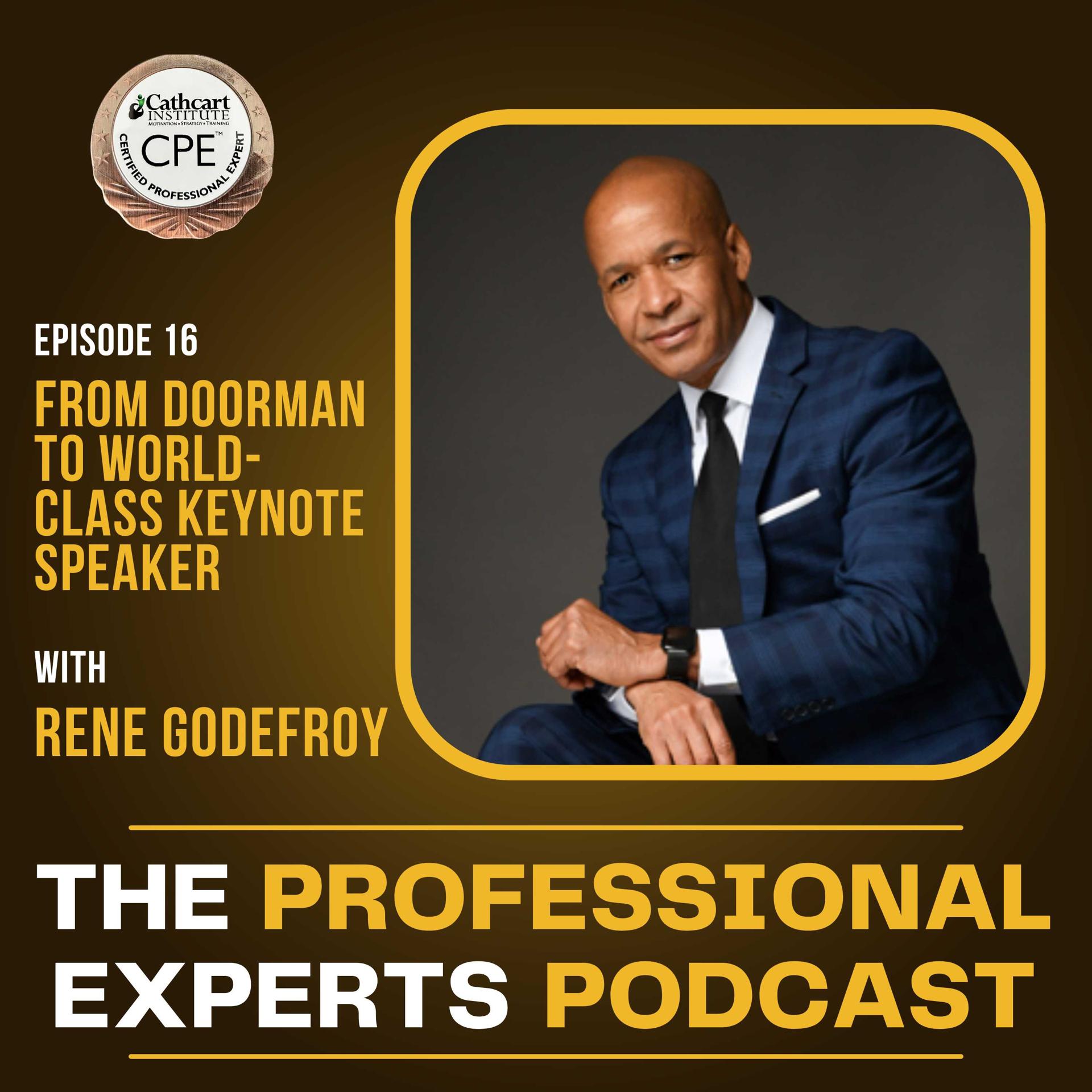
From Doorman to World-Class Keynote Speaker: The Remarkable Story of Rene Godefroy
About This Episode
What does it take to transform adversity into achievement?
In this episode
, host Jim Cathcart welcomes Rene Godefroy, a Haitian-born motivational speaker whose life story embodies resilience, service, and the power of belief. From his early years growing up in poverty to working as a doorman after arriving in America, Rene’s journey is a testament to what’s possible when consistency, integrity, and a commitment to others guide your path. Rene opens up about the principles that helped him rise from humble beginnings to international stages, sharing lessons on building relationships, leveraging digital assets, and staying true to one’s purpose. He also discusses his current business model in keynote speaking and coaching, his upcoming documentary, and how he continues to use his story to inspire transformation worldwide.
About the Host
Jim Cathcart, CSP, CPAE is one of the top 5 most award-winning speakers in the world. His Top 1% TEDx video has over 2.8 million views, his 27 books are translated into multiple languages, including 3 International bestsellers. He is a Certified Virtual Presenter and past National President of the National Speakers Association. Jim’s PBS television programs, podcast appearances and radio shows have reached millions of Success Seekers and he is often retained to advise achievers and their companies. Even his colleagues, some of the top speakers in the world, have hired Jim to speak at their own events. Jim is an Executive MBA Professor at California Lutheran University School of Management and serves as their first Entrepreneur in Residence. He has been inducted into the Sales & Marketing Hall of Fame in London for his pioneering work with his concept of “Relationship Selling.” He is also in the Professional Speakers Hall of Fame and has received The Cavett Award and The Golden Gavel Award. Jim has written 27 books, hundreds of articles and he is always writing at least one new book. His most recent book is HI-REV for Small Business, The Faster Way to Profits . Audiences buy his books by the hundreds and he happily adds autograph sessions to his speeches. https://cathcart.com/ https://www.linkedin.com/in/cathcartinstitute/ https://www.facebook.com/jim.cathcart https://www.youtube.com/user/jimcathcart Tedx: https://www.youtube.com/watch?v=-ki9-oaPwHs
Full Transcript
Welcome to a thoughtful discussion of important ideas among people who are committed to succeeding in life. This is a gathering of leaders from a variety of industries, and our role here is to help you reach the top 1% of your field of choice. I'm Jim Cathcart, so come with me and let's discover how much more successful you could be. Hey, folks, welcome to the Professional Experts podcast. This is a place where people who are making a living out of being an expert talk about how they do what they do and how you can as well. Their professional expert, unlike most business people, is their own product. He or she is what they're selling. They're selling their ability to, to solve problems, bring a special experience, or share ideas that are unique to them. And that kind of a business is not grown in the same way that you would grow a Subway franchise or Chevrolet dealership or something like that. And so when we're talking about professional experts, we're talking about people who are business coaches, life coaches, people who are consultants, certified consultants, trainers, human resource specialists, people who are trying to build a bit like an author or a speaker would do. They're trying to build a business by becoming known as a leading authority in their particular niche and building demand for their involvement. So that could be through speeches or consulting or coaching. It could be through contributing articles, any number of things. But I've been in that field all my life and career, all my career that's going on 50 years soon. And I've worked as a consultant, a coach, a keynote speaker. I've seen all the various versions of it and written 27 books. As you probably know, if you're tuning into this, you've seen my bio. Well, today I have a very, very unique guest. Rene Goddafroy. He was born in Haiti and the story of how he got from there to the main stages of conventions and meetings all across the world is compelling. Now, before I introduce Rene and we get into exploring his story, I want you to take the point of view. I'm not like this guy, but I am very much like this guy when it comes to pursuing the business. As a professional expert, you may not have his life experience, and he and I both hope you don't have to go through what he did to get here, but you can certainly learn from how he structured his business, built his career, and runs his, his day to day operations today. Rene, welcome aboard. Oh, great.
Thank you for having me. Jim.
Renee, you are one of the most recent inductees into the certified professional expert category, CPE and you're joining names like Todd Duncan and Brian Tracy and Les Brown and Patricia Fripp. You know, a lot of big names. Dr. Dennis Waitley, Don Hudson and so forth. I am really proud to have you on that list, and I look forward very much to working with you more closely. Would you share with us how you chose this particular path because you started from a place where anything that paid money and had a little bit of safety would have been desirable. What caused you to choose this path and then share your story, Please.
So, Jim, like they always say, I don't think I chose it. I think it chose me because I was minding my business. I was a doorman at a hotel and carrying bags for people and I was discovering books on the backseat of the cars that I was parking. And one of them is a book by Dottie Walters Speaking Grow Rich, I believe is the title.
I served on a board with her.
Yeah. And then so she undiscovered that you can actually run your mouth for money in America. And I said, you know what? I've been doing it for free all my life. So, you know, if I can get paid for it. There you go. And I just had the audacity and said, I'm going to be a motivational speaker. And, you know, because I did everything else in America, I was a janitor at 163rd Mall, mopping the floor there. When I first came, a new immigrant, I didn't speak English. I did a lot of menial labor. And then until I landed the job as a doorman and found a book. So if you look at the journey, it's almost like it's kind of like pursuits, pursuing me, seeking me out. Until, you know, I found this book and say, I'm going to be a motivational speaker. And that's the journey for me. That's how I actually started in the speaking business.
That's remarkable. Well, it's quite a leap from being a doorman to being a speaker. What were the steps in that transition?
Yeah. So the first thing that I did, I started inquiring. I found out about Toastmasters International. There was a concierge lady, Cindy, and she told me and then she gave me a little book for GSA Georgia Speakers Association. She used to be a meeting planner. So I joined Toastmasters International and I started find finding out who are the speakers, the top speakers like yourself back then. And I started studying all these people. And when they were coming to the hotel, I would make sure that they scheduled to me and then I would be the doorman I'd say, hi, sir, this is Rene Godfrey. I'm your doorman, but I'm gonna be a motivational speaker just like you one day, sir. Many of them didn't really take me serious, but a lot of them did. Jeffrey Gittermer, Dan Barris. We're still friends to this day. And I saved all my tips money, went to the National Speakers Association Conference for the first time. And I'm seeing people like. That was. Let me see. It has to be 98, 1998 or 1997. My first conference, I think, was in California.
San Diego.
It was. No, no. San Bernardino. Is that. It's close to the Disney.
Disney.
Disneyland, yeah.
Yeah. So that's.
That was my first conference there.
Yeah, it was in Orange County. Newport beach, that. That area.
I've been to Newport beach, but it's not Newport Beach. I've been to that one there, but that one was. I think it's called San Bernardino. It's a Marriott there in California, but it's not far from Disneyland. Can't remember exactly, but it has to be San Bernardino or something.
Yeah, there is a San Bernardino. Yep.
Yeah, it was my first conference.
Who'd you see there?
Everybody. I saw yourself. I saw Tony, Alexandra at Nito Cuban, all the big names up there. And I'm sitting there. I couldn't even afford to stay at the main hotel. But every day I would just put my suit on and then I would go to the conference. And I was. But there's something I did in the opening. The opening. The first night, the opening. I remember when everybody, when they were working out, they were all gone. The speaker spoke. I don't remember who spoke, but as they were leaving and I went to the stage, I stood on that stage and I looked at it. I said, one day I'm going to speak on the NSA stage. And I created that vision for myself.
Exact same thing. When I went to my first NSA conference, I couldn't.
Really.
Couldn't afford the luncheon. And so I bought a hot dog and stood in the hallway and listened through the door. So I had a partial registration, but not the full event. So I was just like you, you know, And I. And I went into the empty room and I stood on that stage and kind of soaked it in. So I. Man, I'm with you 100% in this
story, but here's the point. The point is, when you showed up, most people are in business. It's like they're working for the Secret Service. Nobody knows they are there. They don't go anywhere. You don't network with people, especially if they are a local business.
Yeah.
So we showed up and I showed up consistently every year. I was showing up, I was showing up. And some of the pros, like Willie Jolly, remember he told me, yeah. The first year you come, we see you. The second year we see you, but we waiting to see if you are really serious before we start pouring into you. And so the second, third year, when they see you, okay, so this guy is serious.
Yeah.
And that's when, you know, they open up. But yeah, that was, that was my, my first conference and I was so excited. But when I got there, a lot of people, they had a. They were complaining about a problems that they had. They were doing too many dates, too many dates on the calendar.
I'd like bring me that.
I want to have your problem.
Yeah.
How many dates were you doing back then? Those, those days here. Yeah, that's a lot, right? And I want to have your problem. I'm like, dates. I mean like, yeah, give me dates on my calendar. Because I didn't have any debt at all. I just showed up. And it was from that I think I did men's stage. It was about like two years later in Washington D.C. that's a big, big,
you know, that one starting out as a, you know, a person aspiring to be a speaker and just barely making ends meet and then being on the main stage, that's an enormous jump. And you made that in two year period. That's remarkable. Of course it justified, you know, you're, you're that powerful.
Yeah, I think it's the consistency. The consistency if you're consistent, if you show up. But you don't just show up, you get involved. Because that was very involved in the local chapter. I was volunteering to pick up the speakers when they come in to speak. I mean I was like whatever they needed me to do, I was there. I just wanted to serve, you see. And when I went to nsa, it was the same thing. I every meet the pro. Everything. I was just like soaking up everything. And of course I went to Jeffrey Gittermer and all these people and reconnected with them from the door and they remembered to me. And from there I remember picking up Tony Alexandra as a doorman. He might not remember that, but in the limousine at the hotel because I wanted to make sure that I pick up all those people so I can get to speak when they were.
Tony and I were business partners for five years and we're still best friend, you know, executor of each other's will. I mean, seriously bonded as brothers.
Yeah, that is awesome. Yeah. But, yeah, that's. That's the journey. To me, it's the consistency. Most people I was this morning, believe it or not, I meditated on one word, focus, because I realized if we can only focus either spiritually or physically, whatever the power that we have, or just creating, just to focus, to create. Like, how many books have you written, Jim?
27.
Talking about focus. I mean, the discipline that it takes to research and to write a book. 27 books. That's power. And that comes from that one word, focus. Today, it's just like so many. We have the shiny object syndrome. So many SOs, Shiny Object Syndrome. But so many things that look good, social media, LinkedIn and all these things. We are so distracted. We just can't focus anymore like we used to in the past.
Well, let's share with the listeners your backstory because it's such a compelling story and what you. What we've been describing in this last few minutes is something I found in common between you and me and Tony Alessandra and Patricia Fripp and Don Hudson. And I name, you know, a dozen more who were doing the same thing, scraping together enough money to register, going to the meeting, volunteering to do anything. I'll move chairs, I'll put up signs, I'll take registrations. You know, I'll go pick up the guy and bring him or her to and from the airport. That's exactly where we started. But your backstory, oh, my word is so unique. So share a little with us about that.
It started in. On a dirt floor in a tiny village in Haiti. That's where I was as a kid. Hopeless, isolated, powerless, condemned, abandoned by my father. My mom left me in the village when I was only nine months old, and she went to Port au Prince. She wanted to find a better way to provide for me. And so I stood in the village with a neighbor who didn't really care. She kept me because of the benefits, hoping my mom would send something from the city. So I had to really do everything on my own. Since I was a child, when I was like, when I became aware of my surrounding, I was already climbing coconut trees and mango trees. And for survival, I had a string at a bent hook that I would go to the ocean and try to catch whatever I could. So that's. That's what it was for me. And after my mother left, many deadly diseases pounded me. They vowed to really end my existence. And many of the people in the village, they used to tease me. They would call me a Creole word, kokobe, which means crippled, because they didn't really believe that I was going to survive to make it. So there was only one person in the village who cared. It was Great Grandma Stefan. But it was a very short amount of time that I had to spend with her because she was in her late 90s and bedridden. But every morning, I would go and tell her, good morning, Grandma. And then she would give me a piece of bread. When they give her her bread, she would break it and save a piece for me. Or when the people would tease me, I would run to her. She didn't talk much, but she would always pat me on the shoulder to pacify me because I was so upset as a kid. And then one morning, I went to say good morning to her. She didn't respond. And I said, good morning, and she didn't respond. And the lady came and said she passed away in the middle of the night. That was the moment I realized I don't want to be in this village anymore. Like they told me, my mother left because she wanted to find a better way. I didn't want to accept that. I was really mad. So every Wednesday, we had that old battered truck that came to the village, wasifan, they called it, to drop people off and to pick people up from the village. And that one truck. And so I would always run to Mrs. Adrian's and tapping on the truck and is my mama on this truck? My mom, they would tell me, no, she's not on this truck. Well, tell her, I am feeling miserable. Life is too hard for me. I can't take it to come for me. And eventually my mom sent for me and I left the village and went to Port au Prince. But I was thinking life was going to be so rosy in Port au Prince, because when I got there, I was so confused. I saw so many cars. I used to see one car. That's why I jammed. When I get stuck in traffic today, I see people losing their cool, upset, and road rage. Oh, no, no, no. I'm full of gratitude. I'm like God, I prayed for one car, and now I have all those cars.
Yeah. Wow. Wow.
But in Port au Prince, the confusion was so many cars and streets merchants, mangoes, avocados and motorcycles weaving to the crowd and trucks blowing the hornet. I was just that confused. But somehow I thought my mama was doing great in Port au Prints. But when I got there, my mom lived in a little shack infested with rats and roaches. We slept on the floor, the rats and the roaches crossing over us all night. There were mornings they would nibble the bottom of my feet. So life was not that good in Port au Prince. It was. It was really unbearable. Really tough to describe, actually, at that
level, would either give up or give in to the temptations of just living a life of crime and scraping by and, you know, doing whatever they could do. Man, you turned out different.
So that is why. That is why it's my mission today, to inspire people so they can look at change, challenges as an opportunity for growth.
Yes.
Because the challenges don't define us, they refine us. And so it's my mission because you are right, I could have given up. And if I did, everyone would have forgiven me. Right? Yeah.
It would be totally understandable.
Yeah. But I didn't. And I'm here. I'm here to share the story of. With the world so that they can see. I mean, we all have challenges, we all go through things in life, but for some reason, we didn't get the memo. That's what life is about. We thought it was going to be pie in the sky, so rosy and beautiful, but that's not what it is.
A lot of people ask me, so how do I get better? And as they seek resistance, do not look for comfort. Look for something that's, you know, like Rory Vaden, our colleague, says, take the stairs, Right?
Yeah.
Take the elevator, take the stairs. Difficulty, not just because it's difficult, but because, you know, that difficulty will make the muscle stronger. Difficulty will make you better at problem solving.
Yeah. It's like going to the gym.
Yeah.
I mean, like, you. You have to challenge the muscle. You have to really push the muscles so that you can build muscles. That's the same way for life, for success, and for, like, a lot of people could have made it big in life or in the workplace. They could have achieved a lot. But they reach a certain level where it's like boot camp, which is the way it is for everything in life. And so they quit. They don't want to go through the boot camp. And they think it's only happening to me. No, it's happening to everybody. If we are here to testify is because we've been through the rough times, we've been through it, and we're telling them that's what it takes to succeed in this life. When that's the message.
When I heard your. I went to your website and it's just. Renegottifroy.com. so he's easy to find. Folks. Go there and watch the videos, go there and explore the entire website to see the various things that he does and has done and what you can learn from that. Because this is a man that is easy to admire, but he's been through some times that we would consider our worst nightmares. And yet he endured. So, Renee, I mean, you were under a truck, hanging on for dear life, choking on. On the dust and everything from the road. What makes a person do that? Why did you not succumb to the. The griping, complaining, and seeking an easier path?
Survival.
Yeah, but there's survival and their survival. You survived and thrived. A lot of people survive, and that's as far as they get.
So the United States of America was for me, the promised land. I always knew if I ever make it to America, America will give me a chance to be all that I could be. And there are opportunities in America. So I knew that. And whatever it took for me to come to this country, I tell people all the time. That was 42 years ago. That was before. You didn't have to worry about me coming to this country or do any harm to anybody back then, but you had to worry about me coming here to eat your rice and chickens. Because I was gonna. I mean, like, rice and chickens were a luxury for me in Haiti. I mean, like, I'm going to eat some rice and chickens when I get to America. But the trip was from Montreal. I was playing theater drama with a group in Haiti, 21 years old and went to Montreal, and I tried to get a visa to come to the United States. I got denied. But whatever it took, I was going to come to this country. So I paid a truck driver to smuggle me here. I arrived wedged between the re tires of the 18 wheeler in a push up position, not in the box. Under the box. They have a little platform that they build for. I think it was an FCC thing for when small cars crash into, they don't go all the way through. So that metal bar, that's where I was hanging. To come to the United States, covered with ashes, dust and smoke. But I made a prayer. I said, God, I promise you, if you help me make it to America, I will do something with my life. I will not waste my life. And I kept that promised. So many temptations. I was 21. I could have gone any other direction.
Yeah.
But you know, I chose to do the right thing, to live. Like. Like I tell people, since I've been in America, I've Never been in trouble. In fact, my driving record is, like, clean, like, nothing. Nothing. I don't. I go by the law, everything. I'm just like, no trouble. Right. I've never been to the unemployment line to get money because I don't lose my job. If I had a job, I'm going to be there because I have the discipline. I go to work. I go to work. I'll work on Christmas, I'll work on Thanksgiving. I work on any time. Just let me know the hotel. I was a companion for a Jewish man, Mr. Horowitz. I took care of him very young, until he passed away. Right in my head, me and him, two o' clock in the morning. We ended up in the hospital. His family actually helped me get a job at a law firm that they owned the biggest law firm in Atlanta. Then they got me a job at the hotel. Right. All because of. Because of my discipline. Because of going the extra mile. Right. Doing more than. What is it?
I was like to note here is your humility. You did not put yourself out. As you know, this is about me. This was. I'm willing to do what I need to do.
Correct.
Make this work.
Going the extra mile. Yeah, that. Like the story of taking care of Mr. Horowitz. I could. I could write a book about that. The things that I had to do for him. Like, in my 20s, I don't know anybody who would do that. Like, this man was on morphine. And like, I was the only person in the world. Like, even his wife had to go through me to get to him.
Wow.
In his last days. Because I was the only person who truly understood him, who truly could take care of him. And, like, my first standing ovation was they sent me home to. For a weekend because I was there 24 7. And then I was. It was north side Hospital. When I got back in the elevator, he was a very wealthy man with a lot of visitors. And soon as I. The elevator door opened, the people just stood up. They start clapping. And I'm like, what's going on? They say, well, Mr. Arvis doesn't want to see anybody. We were waiting for you because we have all these visitors. They can't go in. And I went in in less than 10 minutes. I did everything I knew. Shaving, lotion, massage, talk. And then bam. I say, can your friends come, Mr. Arnovitz? Yes, they can. And they all went in to see him. Yeah, I can write a book, taking care of Mr. Arnovitz. Maybe that's the title.
Maybe so. And it's yeah. The generosity, the compassion, the commitment to serve man. That's got a lot of dimensions to it. Yeah. I could foster the writing of that book right now, today.
And the key.
You should write that.
The key is, I mean, you've read, you've written so many book, 27 books, relationships, customer service and all. For me, the key, I've got the God of our dominant principles. Right. For me, the key is anticipation, is to anticipate. Like when the guests come, what will they need? What questions do I need to ask them to understand about them so I can create a list of restaurants for them while they're going to be there. Like seafood, steak, what kind of. So I'm always anticipating their needs. So that's what made me such a great doorman or so good with service.
And that's what makes you so good to work with as a speaker. Because looking at your website, you tell the people, here's what you need to do if you want to have a great meeting. And when I get there, you know, I'm going to first, like I tell people in a little service commitment that I send them, I say, I'm going to tell you the truth 100% of the time. Everything I say, you can rely on it. I'm going to show up early, I'm going to wait my turn. I'm going to listen to other people. I'm going to fix a problem if it comes up instead of complaining about it. You know, I'm going to stay out of the way when it's not my moment. And I'm going to do whatever is reasonable and expected because you've hired me to be your speaker. I love that and I like. I enjoyed your article about icebreakers, talking about the importance of getting people reacquainted with each other on a new level so that they work together as a team.
Yes, yes, I preach that wherever I go. All managers, all supervisors, all leaders, whenever you start a meeting, always start with an icebreaker. And of course, I used to give him the icebreakers, but I said, no, just go to ChatGPT, describe your team, and then ask them, I need 20 icebreakers for my meetings, and it'll give you 20 icebreakers.
One of our colleagues, Ed Scannell, is past president of NSA and past executive director. He ran nsa, the office at the headquarters for a while when we lost one of our execs. So Ed's an amazing man, but he made his career on two books that he wrote. Maybe more than that, but all his books were on the same Subject and it was games trainers play.
Oh yeah.
Icebreakers and involvement and problem solving and, you know, all kinds of games and, and just a quick little formula. So I would imagine ChatGPT has probably discovered a bunch of his work and uses that as source material.
Yeah, definitely. Yep. Definitely. Yep.
So for you, what are you working on now
in terms of what the speaking?
The next. Yeah, the next goals or the next stage?
The next goal is a documentary. I, I want to create. I want to take the whole side, the whole thing, and do a documentary. I'm putting it out there for Netflix, whoever wants to come on board. We can't travel right now to my village. We can, but it's, you know, the whole city is under the grip of the gangs. They, you know, United nations now just agreed to send 5,000 troops there. So hopefully that will help the situation. But because, you know, if they're going to shoot a documentary, they have to go to my village and certain places and stuff to do it. But that's a, that's a big thing for me. I really want to do that one.
I think it would be life changing for the people who watched it. Yeah. Your story is so compelling and you've got so much wisdom that you've acquired along the path. What's your business model today? Are you primarily a keynote speaker, a consultant, coach, what? How do you operate?
I'm primarily a keynote speaker and I do some coaching as well. One on one coaching, but majority of it, 80% of the business is actually keynoting conferences for nonprofits, corporations, or, you know, wherever they need a keynote speaker.
Yeah. And you got a big list of clients. Everything from the US army to Coca Cola and yes, lineup of clients. Do you have a staff or do you outsource? How do you do that?
I used to. Before COVID I had two people. And then when Covid came, I had to let go of all those people. Now that things are getting back, I signed up with a management company and so they managed everything on the side in Dallas, Texas. And so this, Yeah, I feel like, yeah, this is the way to go. Instead of having employees right now, I pretty much, I want to do it like I've always wanted to do it. Like Joe Calloway. Right. He was always the one man. Right. He didn't know, you know, he was like, just handle everything. And I can do that. Except that there's. There are times that you so busy, it's hard to return. And you know, now in this business, you, you have to return to the prospects really quick.
Like, by the way, Joe Calloway has some secret sauce that he doesn't tell about. He married a speaker's bureau owner.
Oh, really?
Yes.
Ah, which bureau is that?
I've forgotten what she called her bureau, but she owned a speaker's bureau when they got married.
Okay. I know Vince Passante did that. Yeah, with International Speakers View or something. I didn't know that. Oh, Ellie.
Yeah. And Michelle and Vince are good friends and I, I worked with Vince recently. We do a PBS show at as co hosts. Occasionally I've stayed in their home and, you know, spent some quality time with them. But yeah, years ago, Tony, Alessandra and I developed our own model for, for how to process bookings and all that. And we had a staff of five people full time and five more outsourced part time people. We were in La Jolla, San Diego and then that we decided that we had accomplished all the goals we agreed on and we went back to being separate businesses because we were pursuing different paths after that. And one of the people that worked for us was a young college student, Holly Catchpole. Holly, her name was Olson. At the time she was, she started out as a gopher. You know, go for coffee, go for taking things to the mailbox, go for bank deposits or whatever. And then she graduated to higher levels of responsibility. When we split back to separate businesses, she stayed with Tony and ultimately became his office manager. Years later, my grandson was born in Santa Barbara and my wife and I decided to leave La Jolla, San Diego and move to nearer Santa Barbara to get LA out of the way because it was in between us and the boy we wanted to see. So I said to Tony, I don't know what to do. He said, well, why don't you have Holly, our former employee who's running Tony's business now, why don't you have her handle your bookings? I said, well, that would make me sort of working for you. He said, yeah, that wouldn't work, would it? He said, here's an idea. Why don't I sell my administrative business to Holly and you and I become her first clients. Oh, so she employs my employees. He only had two or three at the time. And she takes over all my files and handles everything and gets a percentage of each booking from Tony and also for me. And we were both very busy speakers at the time.
Yeah.
And I said, okay. So we met with Hollywood and she was following methods that he and I had developed so all of the office systems were 100% compatible between him and me. And she said, okay, well, today I'm no longer represented by her, but Holly owns a company that has made her a multimillionaire called Speaker's Office. And she manages Brene Brown and Tasha Urich and a whole bunch of well known.
Yeah, yeah, I remember Speaker's Office.
Yeah, yeah. And she managed. We brought Nito in and. And he signed up with her, and she managed Nito Cabela.
Keith Harold was with them, too.
Yep.
Yeah, Keith Harold told me about it.
Yeah, we had a Speaker's Office meeting in Rancho Santa Fe, and Keith Harrell was there. I remember sitting by the pool, talking with him about his business. And Peter Vidmar, the Olympic gold medal gymnast, he was. He was part of the team. So what you're doing with Krista Haverstadt is. Is very similar to what I did and what Tony did with Holly. Okay. Neither of us wanted to be running that part of our business all the time.
Yes.
So good on you, and good for her because she got a good speaker on her roster.
Yeah, she does. Wow, that's. That's. That's amazing. I didn't. I didn't realize that. I remember Speaker's Office. Now, for the people listening, they aspire to be speakers. You're big on relationship. Can you talk about. Because today it's. I'm told it's a relationship business. That's what's called speaking.
Yes. And not yes. But any business like this, where you are the product, the relationship, is going to be absolutely essential at various levels and maybe all levels. Another way to think about us is think about us as if we were Hollywood stars early in our career. We'll take any gig. We'll do a laxative advertisement if we have to. You know, anything I'll go do, I'll be the emcee for a local playhouse. I'll. I'll be the weatherman on tv. Anything. Just get me a gig. Right. And so we're building awareness of ourselves and demand for our services, and we're trying to create the uniqueness of us in such a way that we stand out from a Zig Ziglar or whoever else they might have been thinking about at the time. If your talent is so phenomenal that you are a star even before the world knows you, relationships aren't that important. They are important, but they aren't vitally important. Because your talent makes you so amazing, people will beat down doors to get to see you. You know, Elvis Presley, he didn't have relationships at first. Colonel Tom Parker did all that. And if you didn't make the colonel happy, you didn't get to have Elvis on your program or in your movie. Right. So that was a hybrid situation. But for those of us that are a little closer to being normal humans, relationships are everything. Because word gets out quickly, more quickly now than ever in history because of social media. It gets. If you're hard to work with, if you are different off stage than you are on stage and they can't trust you to be the same person, then you'll lose business. And so what we do in social media matters, who we connect with and who we're seen with and spend time with matters in a relationship. Here's a way to define it. It's a direct connection between people because you can't have relationships with things. Direct connection between living beings in which value is exchanged. We have to give value, we have to receive value. And usually it's imbalanced. So we should be always giving more value than we're getting. Always betting on the come, always paying it forward. And it's clear you've done that in your career. So how have relationships been a key factor from your point of view?
So, yeah, I agree with you completely. In this business, you gotta be so ridiculously good. That keynote has to be so flawless, so good that they can't ignore you. Like the book, the title of the book suggests. Right? It is true. But I've got like repeat business clients that it was a huge mistake. I didn't really form a relationship. I didn't really stay in touch with them. And quite frankly, a lot of them are retired now because I've been in the business for so long. Right. But when looking back, if you ask me, that's one of the mistakes that I made. Right. I just didn't master the art of relationship. I didn't really take your book and study it and apply everything in it. Right. Relate your relationship Selling. That's the title, right? Exactly.
The reason I chose that title is treating relationships as if they are assets. Because they are.
Yeah.
You think of a relationship as a. Excuse me, as a thing. And you manage it from simple acquaintance through life partner. There are stages that you can nurture each relationship along the way. And there are some people or organizations where at a certain stage, that's as much as you should reasonably give to that relationship. Others where you want to invest lots of energy and lots of love and taking care of it.
Yeah. But those clients that I built a relationship with, I could. So. So the thing is, this is. This is the thing. We cannot reverse engine if we can reverse engineer what is working. I think they say, what is the 80, 20 world? Is it 20% of the activities, what we do in the business, that's going to bring 80% of the income according to Vilfredo Pareto. Right?
Yep.
But it's taking the time to step back to say what is working for me so we can double down on it. That's what I didn't do. I had some relationships that working for me. I got some repeat business, but it never really occurred to me, wow, this is what's working best for me, that I should double down on it. And I made a mistake. And quite frankly, I was right there with Nito. He was teaching me all of that. I mean I spoke for him in High Point, I spoke for him in his Rotary Club, been to his house party and stuff. And some of the strategies is so high level that he is teaching, you know, how the mind say, well, that works for you. But me, where I am, it wouldn't work for me. Which is not true. Right.
When I met nito, it was 1977 in Atlanta at the Dunfrey's Royal Coach Inn, which probably doesn't even exist anymore.
Probably.
But it was a conference, a Speaker's Bureau. Dr. Dupree Jordan held a big event called Success Leaders Speaker Services. And he would bring in speakers like us at various stages of our careers and have a showcase that went on for two days and meeting professionals, meeting planners would pay to be in the audience so they could preview all these speakers and hire them for their conference. And he had Edgar Mitchell, the astronaut, and he had movie actors and he had, you know, big, big names. And then he had people like you and me early in our career and later, well, the year I went, 1977, Nito and I were both newbies. We were about 30, 30 something year old kids, you know, hoping to get another, yet another speaking engagement. And Nino and I hit it off and became close friends and, and I ended up. He's further along than me on the developmental path.
Yes.
Younger than me by two years. So I bought a day of his time and flew from. At the time I lived in Oklahoma, I flew from Oklahoma to High Point, North Carolina, stayed at his home and he taught me everything he could in a two day period. And that was a real turning point for my career.
Yeah.
So his influence has been huge. But like you, you know, I, I've been at those stages where I just needed to stand out and I was willing to do whatever the situation required to get it done as long as it was ethical.
Yeah. And I heard Bill Gove when he was 5 in an interview.
He was my early mentor.
Really? Yeah, yeah, yeah. I had a chance to meet him and talk to him, but they were asking him about the biggest mistakes he made in his speaking career. He said he was just too focused on speaking and playing golf. He should have created a lot more digital assets. Yeah. To make money. That's his number one mistake. And I think it's the same thing for me, too. I wasn't thinking about the digital assets. The. I didn't like. You created probably a gazillion cassette programs, right? Yeah, yeah. So you.
Cassettes and then DVDs and CDs and. And now, you know, lots and lots of videos. I've got, I don't know, 300 video lessons.
Yeah, that's a big profit center right there for the business. But, you know, I was like, you know, the skin of the stage. You can get into that fever. And you forgot it's not the speaking. It's just like a tool. It's just like one of the legs. Right. But speaking itself is not a business. And when I got into it, I was thinking, speaking is the business.
Yeah, so did I. It was. It's a gig business. You know, it's. It's kind of like being a performer playing the guitar and singing on the street corner for tips. That's the lowest their entry level of it. And then you get on up to where you're Taylor Swift. But that's a gig business. Unless you do it Taylor's way.
Yeah.
Do a Taylor's way and you can make gazillions. If she never did a live tour anymore, she would still have a rabid follower throng of people seeking her out and buying whatever she's produced most recently.
Did you read the article? I think it was just released.
She has the most life of a showgirl.
Yeah, yeah. But 59 million. No. Nobody in history has ever done that much money in a short time releasing an album.
She is phenomenal. By the way, I was talking with Dan Burris. Daniel Burris is a futuristic.
Yeah, yeah. He is a friend. Yeah.
And he's. I've known him forever, it seems. We were talking years ago and he said, Jim, I've. I don't know if he'd say this today, but back then he said, I've figured it out. I've done a calculation. And 84 speaking engagements a year is the tipping point where you reach critical mass. And you've got from those 84 engagements enough inquiries coming that you don't have to do much marketing, he said, but you got to market like crazy to get those 84 engagements. And I don't know if it's 60 engagements or 30 or if it's online presence or YouTube appearances or, you know, likes on the TEDx talk. But today there is just like back then, there's a need for us to be in person out there, appearing in people's eyes and ears. And so that it drives demand for the other things we do.
Yeah, it's like the Woody Allen quote. 99% of success is showing up.
That's right.
We have to show up. Last night I went to a Georgia, NSA, Georgia event for CPAEs and CSPs. They were recognizing them and somebody was asking this question, how do you get speaking engagements? And I was like, you can't be in the Secret Service. You have to go meet people, talk to people, go to all these events in Atlanta. I was doing every event. I was doing so many free speaking engagements for all the civic clubs, Rotaries and Kiwanis and Optimist International Season, all of them everywhere. They wouldn't pay you, but you get a free meal. I'm like, what a countryman. I can put a sign, speak for free.
400 JC meetings. First two years as a speaker for free. 400 meetings in two years, no pay.
Wow.
The state of Arkansas. And then I ended up on the national headquarters staff of the JC is in charge of leadership training for 350,000 members. And that's where I got the Earl Nightingale tapes and was able to launch my career as a speaker.
So for those listening to this, that's the lesson here. You have to speak for free. I mean, there's a whole strategy now. You do a lot of breakout session. When I do a breakout session, I do. Keith Harold taught me that. Actually, I do a mini keynote and I got them to. And I even tell them, you know, how would you like to have me as your keynote speaker? And then they all would just applause and because a breakout session is usually slow pace. And usually I ended up being better than the main keynote speaker up there who was like, you see? And Keith Harold taught me that. And he said, make them make a lot of noise in the room and
rename them in your head. It's not a breakout session, it's a breakout audition.
Breakout audition. Okay, got it, got it. Yeah, yeah. You are literally audition. But actually, even when you're on the men's stage, it's an audition. Everything in life, whenever you are delivering your service. When I was in Miami struggling, didn't speak English, so I couldn't get a job anywhere. And I started washing cars in the parking lot of a bank. Total bank. But I kept asking all these people, I kept asking them to wash their car. Wash their car. In my broken English, no, no, no. But one guy, a green Saab, you remember this car?
Saab.
Yeah, that's right. And he said, yes. And I said, in my mind, this is my ticket. I'm going to clean this car when this guy comes out. And it turns out he was the son of one of the senior executives at the bank. Wow. And when he asked me how much, I said, two dollars, sir. Two dollars. He gave me five dollars. And then he said, are you going to be. Are you going to be here for the next 30 minutes? I said, oh, yes. Yes, sir. Five minutes later, this guy come. Are you ready? I say, yeah. You watch car?
Yeah, Yeah, I watch car.
My friend say, you did a spectacular job giving the kids. And he said, how much? Now I know how much to charge, right? I said, $5. $5.
You've got 150% raise.
Yeah, I know.
Within an hour.
Within an hour. So that said everybody, if you go to a wedding, I watched a kid or the photographer, they don't understand you are auditioning. Like you just said, you are auditioning. That's your moment in time to impress everybody at the tables so that they're going to say, wow, I want this company to do my wedding or for my daughter's wedding or my son's wedding. But it's just a mindset.
By the way, you don't have to give me credit that you're welcome to use that auditioning.
Yeah.
Because it sounds like you've been talking about it for years just by putting that word in your mind.
Yeah.
For you. Good for you. Well, is there any. Anything you would like to leave with our aspiring experts who are going to be watching this, who want to build a career as an expert, Anything we haven't covered that you think they ought to hear?
Yeah. So when it comes to the law of expertise, like the cpe, Right. The certified professional experts that you offer, and the way you raised the bar, I think the number one thing is integrity. And that's the key. Because people will, when you mess up, you know, it will go around. People will know about it. Right? And we've seen that in life. We've seen people who got to a certain level, but because of their integrity, that one word. So that's what I would. That means a lot to me, that one word. I would protect it with everything that I have in me, coming from my background, because it really means that's all I have for me. That's all. If this is gone, my integrity is gone. I have nothing else. I can't knock on any door, I can't ask people for their business because, you know, I don't have integrity. We've seen one person, when they mess up the entire community, they know about it. So that's one word, integrity. When it comes to the cpe, the certified professional expert, by the way. Thank you so much. It's an honor. Yeah. This is it. This is it. This is it. This is the thing. The medallion. That's what you call it? Yep. It's like big games. You. You just. That's it first.
And you'll get. You'll get your certificate.
The certificate and the medallion. And the medallion. Right. And that proves that you've paid your dues, you've have the integrity, the character, morale to whatever line of business you are in. And you don't have to be a speaker. Anybody can get it. Right, Jim?
Right?
Yeah, yeah.
We've got people who are all kinds of different experts, you know, in fields that don't involve much speaking at all. You know, it's just that their expertise is what they're selling. And then people say, well, you certified people to be experts. I said, I certify people to be professional as an expert. I don't teach them how to be a landscape expert or an interior design expert, but I certify the fact that they are professional about it. They're highly educated for what they do. Their education never ends. Constantly renewed. It's done for pay, is done as a service to other people, and it's done according to a set of ethical standards. They have integrity.
Yeah.
Proud to have you on that list. Well, we've reached top of the hour and we need to wrap this together for folks. How do they contact you and what would. Why would they. Why do you want them to contact you? What do you want them to come to you for?
Speaking is the number one thing coaching. But people can find me anywhere on social media. If you go to TikTok, you'll find me. You go to Instagram, you'll find me. Now, you know, I'm spending more time on LinkedIn now. I blew up on TikTok, did millions of views, like, I think I have 164,000 followers or something on TikTok. And then so I left TikTok. Now I think LinkedIn is the place to be when it comes to professionals like cpes and type of level of people. So that's why I am now. So yeah, you'll find me on LinkedIn or you just go to my website. My name dot com. Renee Garafari.
G O D E. Thank you.
Yeah, yeah, it's r e n e 1 e r e n E. Right. G O E D E F like in Frank R O y. Rene Godo. Ferrari.com. yeah, got it.
Wonderful. Well, thank you my friend. It's great getting to know you better and I look forward to spending some quality time with you soon, so.
And thank you. I'm. I'm honored you accepted me in the program to have my cpe.
You raised the bar for the rest of us and you and I are both faculty members in the MyFuel IE network. Doing that with Todd Duncan and gad concision was what I was focusing on and so that's, that's where I messed up. What's his first name?
Oh, Todd Duncan. No, who? Brian? Byron. Alex.
Oh, Alex. Yeah, the brain burp. Sorry, Alex. I apologize for that, but I got the last name right. Anyway, ifuel IO is where you'll find Todd Duncan and Alex Conceician. Thank you.
I mean like, by the way, what a platform. I mean this is an incredible platform you can get. I mean I'm like a student. I'm an instructor, but I'm a student also because the courses like the course you created or the courses you created, it's just like bite sized information that can transform a life just like that. It's. Yeah. My fuel that I o is is the website and it's dirt cheap. Really? Like it's nothing expensive. Yep, yep.
Super. What? Make it a great day, my friend. You've improved my day for sure.
All right, thank you, Jim. Have a good one. Bye.
Thank you for joining us today. If you are committed to making more success happen in your own life, go right now to my website, free.cathcart.com and download my free ebook and then watch the video. If you decide that you'd like my assistance in helping grow your success, then come with me and let's discover how much more successful you can be.
Nurture Your Nature.
Never Miss a Conversation
New episodes drop regularly. Subscribe on your favorite platform and never miss a conversation.