
Season 2, Episode 28
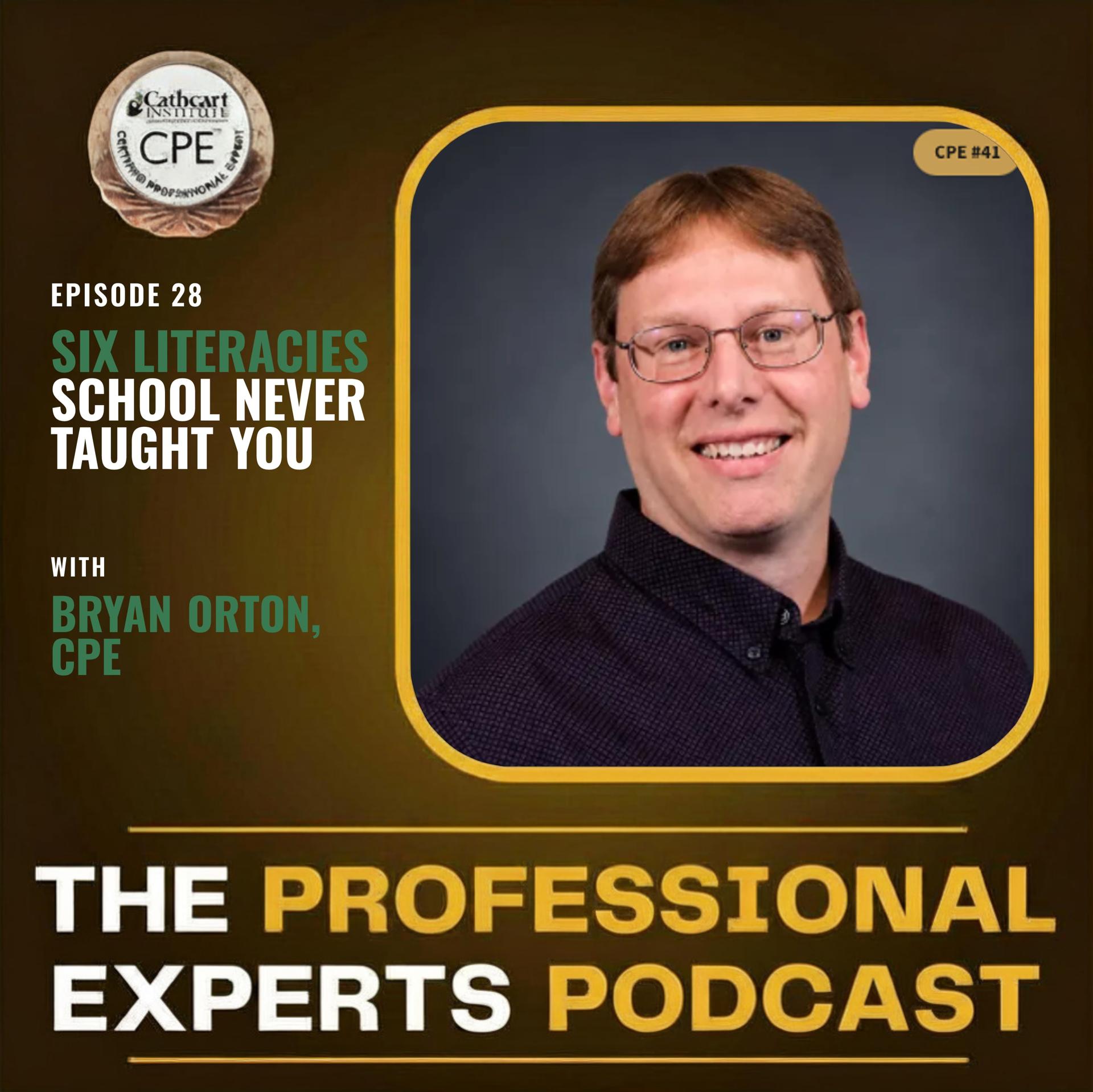
Six Literacies School Never Taught You with Bryan Orton, CPE
A conversation with Bryan Orton, CPE
Watch This Episode
About This Episode
I sat down with Bryan Orton, CPE, a thirty-year classroom teacher, author, and Certified Professional Expert, to explore six literacies that school rarely touches but life demands every single day. Bryan's book, The Wrong Lane, grew from decades of watching bright people struggle not because they lacked intelligence, but because nobody ever taught them how to make decisions, assign meaning, manage money, build relationships, understand identity, or contribute in a way that matters.
The Six Literacies That Change Everything
Bryan walks us through each literacy with the warmth of a teacher who has sat in the remedial row himself. Identity comes first, because every other skill rests on how you see yourself. Then meaning, the quiet art of choosing what a setback actually tells you. Decisions follow, and Bryan draws a sharp line between a wish and a real choice. A decision without action, he says, is just a frog still sitting on the log. We also cover money, where the Rule of 72 makes compound growth suddenly visible and personal. Relationships round out the set, with Bryan noting that most bonds don't break from one big event but from a long string of small repairs that never happened. Contribution closes the circle, asking how your growth serves the people around you.
Teaching from the Inside Out
Bryan spent time teaching conversational English to medical doctors in South Korea, working with incarcerated adults in Oregon prisons, and running an alternative program that brought community mentors directly into the classroom. Each experience deepened his conviction that the best teaching moves from the known to the unknown, meeting people exactly where they are before asking them to stretch.
Resources Mentioned
The Wrong Lane by Bryan Orton is available at bryanorton.com, where you can also find free resources under the First Literacy tab. Bryan's reading improvement program, built with partner Janelle, is available there as well.
In the spirit of growth.
About the Host: Jim Cathcart, CSP, CPAE is one of the top 5 most award-winning speakers in the world. His Top 1% TEDx video has over 2.8 million views, his 27 books are translated into multiple languages, including 3 International bestsellers. He is a Certified Virtual Presenter and past National President of the National Speakers Association. Jim’s PBS television programs, podcast appearances and radio shows have reached millions of Success Seekers and he is often retained to advise achievers and their companies.
Even his colleagues, some of the top speakers in the world, have hired Jim to speak at their own events. Jim is an Executive MBA Professor at California Lutheran University School of Management and serves as their first Entrepreneur in Residence. He has been inducted into the Sales & Marketing Hall of Fame in London for his pioneering work with his concept of “Relationship Selling.” He is also in the Professional Speakers Hall of Fame and has received The Cavett Award and The Golden Gavel Award.
Jim has written 27 books, hundreds of articles and he is always writing at least one new book. His most recent book is HI-REV for Small Business, The Faster Way to Profits. Audiences buy his books by the hundreds and he happily adds autograph sessions to his speeches.
https://www.linkedin.com/in/cathcartinstitute/
https://www.facebook.com/jim.cathcart
Chapters
- 0:00Welcome and Bryan's background
- 5:09Money literacy and the Rule of 72
- 9:03Bryan's path from remedial to teacher
- 15:18Prison teaching and the skill of belief
- 21:18Decisions, meaning, and identity
- 37:18Contribution and the wrong lane
- 55:47Finding Bryan and closing thoughts
Notable Moments
“If a decision is not linked with action, it's just a wish. It's an intention.”
“Things don't have meaning. We assign a meaning to them. And then I'm carrying that meaning as if the thing I assigned it to was more powerful than me.”
“I kept waiting for someone to fix education. And that's what prompted me to write that book.”
“I don't care if you can tell me what I taught you. I care if you can show me that you learned it.”
“You're like an ugly duckling that doesn't know it's a swan yet.”
Full Transcript
Good idea. Hey, folks, Jim Cathcart again, the Professional Experts podcast. Now, the one thing I try to do more than anything else is give you yet another example of how you could take virtually any career or any type of expertise and build a career around it, take any kind of a career that's already begun, redirect it to be more satisfying and meaningful to, to what's inside of you and find new ways. Well, you need examples, and we've got one for you today. My, my dear friend Brian Orton. He and I connected years ago when I was on his podcast, and then that grew into a friendship and a mentorship and him coming to the Professional Expert Summit in Nashville, Tennessee, and on and on and on. So welcome to the show. Brian Orton.
Well, I'm really honored to be here, Jim, and thank you for bringing me into your world. It's an amazing world and I wish other people could experience it, too.
Thank you for that. Now you're in Oregon right
now.
Give our viewers a sense of where you are and what's your current status is as far as, you know, your work and life situation.
Well, I have two things going on. I'm a teacher. I've been a teacher for over 30 years, and I'm in central Oregon in a really rural school that not a lot of students out here. It's a lot of farming. And then the other thing I do is the business stuff where I wrote a book. I have an AI thing that you can go through, and after 30 days, it's going to know you so well that it's going to help you in so many ways. And then other things I do is there's a lot of reading problems. There's been a lot of talk about reading and we've heard about the science of reading, and that's really good. That works for about 75% of students, but there's a quarter of them that it doesn't work. And so another thing I have is with my partner Janelle, we have a thing called bettersolution Me and that helps people in one week. And I know this sounds like overblown promises, but in one week, improve their reading, multiple grades.
Nice. Very nice. Well, one of the things we're going to get to in a minute is the whole idea behind your new book. And I love this book. The book's title is the Wrong Lane, and it says six literacies that school never taught you, but life demands from you. And I think that's spot on. You know, education as we've known it in the USA for The for the last few generations has been strengthening some areas and neglecting others in the sad part is what they've been neglecting or life skills. Years ago I met a guy named Rick Little, not to be confused with the comedian Rich Little. Rick little in the 1970s came to me. I was at the headquarters of JCS Junior Chamber of Commerce and they were huge at the time, 356,000 members. And he said, I've got a, a book and a course that I want to get involved or embraced and followed in public schools. And it's called Skills for Living. And we, the jcs endorsed it. And he went on to grow it and took it worldwide and got millions of kids involved. But his whole point was we don't teach kids how to deal with life crises. We don't teach kids how to manage their own personal money. You know, they may know advanced calculus, but they don't realize that a credit card interest rate can be destructive and so forth. So that's the wrong lane and I'm sure exactly what you're addressing.
Yeah, well, you know, like you said, there's six literacies. You talked about money there a little bit. I'm shocked at how few people understand money and how, how much of an impact it has on your life, but you just don't understand it. You never dived into it. And you're always teaching me. And when I worked with you, like the practical application, how can I apply this? Not just, you know, you, you would tease something about like self shelf help versus self.
Yeah. Okay.
And, and so here. Are you familiar with the rule of 72?
The rule of W2?
No. The rule of 72. The number 72.
72. The rule of 72 in math. Yeah.
Yeah.
Okay. Economics. Yeah,
yeah. So this to me is like one of the things that I go over with students and they're just like, they know this because it's. If you take the interest rate you have, let's say it's like 8% and you divide that into 72, that's going to tell you how many years it takes for your money to double. So eight into 72 is nine. So it's going to take nine years to double.
And
if you look at a typical 30 year career, if it's doubling every nine years, that's about three times it's going, it's going to double. And if you were to take like $10,000, if you put $10,000 in, you didn't ever change it again and then you had 8% interest, that is going to double to 20,000 to 40,000 and it's going to end up with 80,000. So even though it is, you know, tripling, it's really timing. It's really eight times in the amount because you're getting with, with 80,000 and.
Yeah.
And
then factor in inflation and, you know, the new amount no longer as impressive as even the old amount in some cases.
Well, and then if you look at like, like most people, like if they have a CD, it's at 3%. If you divide 3 into 72, it's going to take you 24 years for that money to double.
Wow. Wow.
And
so, and that's just money skills.
That's just money. And
I say one last. I forgot to, to tell our viewers what your path has been. Would you just, just highlight the, you know, the major big rocks and then the transition points. Not going into each one yet, but just so we get the pathway laid out in our brains.
Yeah, I will. And I just want to say one last thing on the financial Was,
okay,
the, the president last year in 2025, opened up private equity markets for general people like you and I. So before it had, you had to be wealthy, you had to have like millions of dollars or you had to be an institution. But now people like us can invest in that. You can take your retirement account and put it into that. Now what does that mean? That means that, like, I have one account that's at 23% annually. Okay. It's through a private company. Okay. And so that doubles every three years.
Yeah. Okay. I like that.
Okay. But, but anyway, I just wanted people to know that there's stuff out there and that's just one thing now to go on myself. I started out in school. I struggled. The last thing anyone expected was me to be a teacher. When I went to school, they, they had advanced classes, then they had regular, and then they had remedial.
When
I was in, I was in all the remedial classes. Remedial English, remedial social science, remedial medial science. And I just didn't think I was smart. If you would ask me if you would have said, brian, are you smart? I've been like, no, Isn't it obvious? Okay.
No. And I can prove it because other people said so. Right?
Yeah. And, and I'm in rooms with people who didn't think they were smart either. And I had two teachers that made a difference and one of them gave me a belief in myself. He said, basically, you're like an ugly duckling that doesn't know it's a swan yet. Okay. So he gave me the belief in myself. Another one, he gave me a method. He would say, if you're going to look at a book, read the introduction, read the conclusion. You kind of get the direction of what's going, what they're trying to prove or whatever, and then it gives you a roadmap. So I needed both of those. I need a belief in myself and I needed a method. Then I met other mentors along the way. I talk about them on my book. But the point is, is that I did not. You would not expect someone like me to be a teacher. But because I had such a struggle in school, I think I look at this totally differently because it wasn't necessarily. I didn't take the normal path. And to me that's an advantage now because I see a lot of students who do not like school in the latest thing I looked at, I can't remember which one did the study, but it was something like around 75% of students in high school feel disengaged. They don't feel like it's meaningful. And that's a problem.
Yeah, that's a serious problem. I guest lecture sometimes at the University of Texas in their business school and the professor that I work through there shared with me, he said, jim, these are high achieving students, you know, I mean, they're people that are, that are in a good position in life in many cases. Because at one point his classes were just exclusively the elite athletes from 18 different sports at the University of Texas. Wow. Arch Manning, for example, was, was in one of the classes the current quarterback of University of Texas. And he said, what astounds me is with a few exceptions, like an Arch Manning type, most of these students don't really feel self confident, you know, they, they're just trying to do what they have to do and then get on with life instead of seeing this as an opportunity to transform themselves through education and experience.
Well, I talk about a shoe, like if you were to go to a store gym and you wanted to get a size 11 dress shoe. And they said, well, Jim, all we have is size 8 tennis shoes. And. And you said, well, that's not really what I want. And they said, well, try harder, Jim. Push your. Come on. You know. Okay. And
that's a good analogy. Yeah. Because it's an exercise in futility and it's only going to make the person feel worse.
And for some people, the size 8 does fit. You know, I mean, it does fit and they think it's fine. Okay. But for most of us, or a lot of us, it isn't. So I make a distinction between fitting into the system versus it fitting you.
Yeah, yeah. I consider that life tailoring.
You
know, you. You get a size 48 jacket or suit, you know, can you wear it? Well, yeah, as a tent if you're smaller than that. Right, but can. Is it fabric that could be tailored to you? Yeah, it might take some radical surgery, but you could make it, make it fit you and look good on you ultimately. Well, I think that's the way we ought to approach life. Now, I know you came up through education, you know, you got your, your credentials and became able to teach in public schools and such, but you had a very out of the ordinary experience where you went outside the regular school system and you also went outside the continental U.S. tell us about that.
Yeah, I taught conversational English in South Korea, and it was mainly to medical doctors and medical staff, that type of thing. And one thing I learned there was a lot of medical stuff is all in English. So, like when you go to a conference or things like that, it's all in English. So they really wanted to learn conversational English idioms, metaphors, all these different things that, how we talk that you don't even realize it. And so that was a lot of fun to see them. You know, these are like the best of the best doctors in South Korea. And to see how they think and to. To be part of that, it was a lot of fun.
How did you get that gig?
Well, I wanted to try something different. I was young, and I was originally thinking about going to Japan. And then my backup plan was South Korea. And. And so that. That's what I did. And I just. It was a language school. And, you know, I had my master's degree, had my teaching credentials, had all that kind of stuff, everything that they liked, and so they approved me. And that's what I. That's how I got there.
Wow. Boy, that had to have broadened your horizons explosively, you know, like,
oh, yeah, I felt like I was on Star Trek. Like I went to a different planet.
Yeah, yeah, exactly. Now, you've also done work in prisons, right?
Yes. And
tell us about that.
Well, one of the things I've noticed in there is so many of them quit believing in themselves, and then they started adapting maladaptive behavior or negative concepts of themselves. And what I would do, I would do things to try to challenge that. For instance, if they had a 10 question multiple choice test, I would make question three or four extremely hard. They're just like, waste a lot of time, kind of ambiguous. Okay.
Yeah.
And then a percentage of them would get stuck on that, and then they wouldn't answer the other ones. Okay. And. And then what I would teach them is that, okay, this is not just testing you about your skills, about your knowledge, you know, how smart you are. It's testing you on a skill. And a skill is something you can develop. And then once they realize that, they're like, oh, what other skills am I missing? What other things can I develop?
I think that's a big. A big issue across all categories that people think that difficulty in doing something is evidence of inability to do that something when it may simply be a skill problem. You know, it's like you're using algebra to solve a basic addition and subtraction problem, and it's. You're making it way too hard. You may end up at the same conclusion ultimately, but it's not going to be enjoyable, and it's going to take too long.
Well, one thing I talk about in the book, being a good teacher, I think, is taking the known to the unknown. So if you know something, if you know about carpentry or about tile floors or whatever it is, if you know that. And I. And then I say, okay, we're going to look at the area of this rectangle or triangle or whatever it is, and let's think about it like tiles. Like, if you're tiling the floor, they got a picture, they get. But what I see too often is you take the unknown, you take some weird concept or whatever you. And you're trying to connect it to another unknown, and people are just. They're just lost. They're just. It's just. It's like gobbly go. Okay. Or the other end is. It's something you already know. And then they're teaching it again. So you're taking the known to the known. Now you're just bored out of your mind.
Yeah. So what you need to do is apply the unknown to the. I like it. Because that's basically making it practical, which is where school started, back in the early days anyway. You know, it was, hey, come here, and I'll teach you the techniques that will make you able to build a building that'll keep standing instead of one that's going to fall down at the first wind.
And Jim, what have you taught me about communication? You've told me it's about listening, it's about understanding the audience, it's understanding the market. Right. Well, the same thing applies in the classroom is, if I go in there, just gonna. I'm gonna teach this, and here it is. But if I start asking questions like, what does your dad do? Oh, you do. You do construction. Oh, you do sewing. Oh, you do this. Okay, now I have some frame of reference to be like, okay, now I can take the known and connect it to the unknown. And they're like, well,
now your analogies and examples are all from their world, something they can relate to, like cooking or whatever, you know, practical life skills. By the way, that's an interesting thing, reflecting on my own life journey through school. There was a class when I was in high school. It was called home economics, and basically it was how to run a household, but only the girls attended it, and so there were no guys. And the guys went to shop, you know, Industrial arts, they called it. And we would learn to, you know, move metal things and change woods, shape and use and. And hammers and saws and things like that. So if it was hard and dangerous, the guys did it. And if it was good and nurturing, the girls did it. And there the twain shall meet. Right. So I. I graduated school not knowing how to cook, except from what mom taught me at home.
Yeah.
Kind of an important life skill.
Well, exactly. And. And that's why, like, I know you have a book, Relationship selling. One of my. One of my six literacies or skills is relationships. And if you never develop the skill of how to repair a relationship, you're really going to struggle because there's going to be times where you mess up or try. Something happens.
Yeah.
And most relationships that fall apart is not one big thing. It's a series of things where they never did the repair, they never had a difficult conversation, those types of things. And so if you can develop those skills to. I'll tell students, if it seems like the last thing you want to do, that's probably what you need to lean into. You need to do that because that's. That's what's stopping you or causing the. The confusion.
I read a Facebook post or something just this morning that said the best way to have a really good day is start your day by doing something you've been putting off so it's no longer hanging around, bothering you at the end of the day. Not a bad piece of advice. Now, this says six literacies. Walk us through the model.
Okay. Well, you have decisions, and that's one of them. And if I asked you a question, Jim, and you probably heard this riddle before, if three frogs are on a log and One decides to jump off. How many are on the log?
Three.
Three. Yeah,
yeah,
but, but I hear so many people say two.
Yeah,
okay.
That's right.
Okay,
explain why.
And I call that a pre. Decision, you know, I mean,
you're
not really taking the action. It's like if I decide I'm going to exercise, I know in one of your books you say, put your tennis shoes out there, get your. Get your outfit ready, you know, so in the morning you wake up, boom, there it is. Okay. And then you can act. So to me, if a decision is not linked with action, it's just a wish. It's an intention
fantasy. Yeah,
yeah.
It's an impulse. It's kind of like feeling the impulse of hunger but not eating.
Exactly. So
it's an impulse. I guess I'll carry it with me instead of satisfying it. Yeah,
yeah. So one thing I'm always just saying is like, was there if someone else was just observing you, could they see that you made a decision? And that's usually going to be an
action.
You send an email, you. You phone call someone, you, you know, have notes for your test or whatever it might be.
Yeah, very good. And most people wouldn't think of that as a life skill, but it's a vital life skill. I mean, I wrote a whole book on intelligent curiosity with Lisa Patrick, and in was decision making models and ways of getting beyond just wondering about something.
Yeah. And. And another one is meaning. And I find this is like such an important skill because something could. Hang
on a
second.
There was a. There was a hiccup in our feedback, so. Say that again, please.
Oh, okay. Okay. The next one I think is meaning. And meaning is one of the other literacies. And it's interesting because the thought I was going to have is what happened if this thing just stopped? You know, the zoom thing stops. Okay, now I could. I could take that as, oh, man, Jim decided I'm not worthy. He's not going to waste any more time. You know, he's just like, be gone. Okay. I could take it as, oh, it was a glitch, you know, something happened. But that to me is such a skill because you're going to have setbacks, you're going to have defeats, you're going to have things not go the way you want them. And what meaning do you take out of that? Do you take out of, I'm a loser, I'm no good, or do you take it out as, okay, this is just a step in the process. If I keep getting no's, I'M eventually going to get
a
yes. You know, like, what is it that you're deriving from this?
Yeah, here's another. Another thought that occurred to me is things don't have meaning. We assign a meaning to them. Right? So what I'm doing is I'm giving meaning to something that just exists. It doesn't have meaning until I make that assignment, and then I'm carrying that meaning as if the thing I assigned it to was more powerful than me.
Exactly. And so to me, this is a super skill if you get really good at creating meaning, because I'll. I'll ask kids. I'll say, okay, is this serving you? Is this Lee? Is this, like, I'll. I'll do something where I'll. I draw a tree ring. And I'm like, this is your capabilities right now. And you want to keep growing, right? And you want to get those rings going out. But you're gonna have to go into unknown territory. You're gonna have to do this right? And. But the only way you're going to do that is if you take awkwardness, the uncomfortableness. If you take that as that's a sign of growth. That's not a
sign
to retreat.
Good point. Real good point. Yeah. You're. You're assigning meaning to the actual discomfort. That gives it a reason. It gives you a reason to endure it or to transcend it. I love that.
Yeah. And I. And I know you coach people because, like, you've told me, like, okay, Brian, if you're getting nervous before you're going to talk or before you're going to do that, right? This is you coaching me. You know, it could be like, oh, is it all about me and is my hair right? And all this kind of stuff? Right? Or is the meaning, like, this is important. I'm getting a little bit excited. I'm going to focus on the audience. But the meaning is I have something valuable to say. I'm excited about this. I'm not nervous. I'm actually excited.
Yeah. Yeah. Cabot Robert, founder of the National Speakers Association. He may not be the originator of this message, but he used to say, you know, the key is not to get rid of the butterflies in your stomach before a speech. It's to get the butterflies to fly in formation. And I love that. That's a good, good way of thinking about it. But just those two first things, decisions and meaning. Boy, those are transformative life skills. One, to be able to be better at making decisions by pausing, observing more, seeing patterns, knowing if the Pattern needs to be interrupted or changed in any way, and then intervening from a position of, what do I want? What do I care about? Wow. I mean, that's a big deal right there because you just put somebody back in control of their life. And then the second thing is to realize that what the rest of the world tells us is simply their opinion of what the reality is. We don't get the news, we get commentary from the media. Right. I mean, they'll say people are rioting in the streets in, in France. Okay. That's a fact. Okay. But the meaning of that is, could be the government is bad. Could be the. The enemy has infiltrated the. The population that's out there. You know, it could be any number of things, but what we hear most of all is opinion. And then we end up forming our opinions on their opinions, taking their opinions as fact, and that's where we end up with warped mindsets in politics and religion and relationships and everything. Wow. What's number three?
Well, the. The first one that I start off on is identity. And you've written a lot of books on that. You know, you did the Acorn principle. You've done a lot of things on identity. And. Yeah, so to me, that's the foundational one. And what I'm challenging myself and when I'm challenging my students and people I work with is, are you getting into groups and people and things where it's expanding? You know, we went to the tree ring. Are you expanding your identity? Are you expanding what you're capable of? And when you do that, it's going to, again, feel awkward, weird, that kind of thing. But we all know that saying that you're like the composite of the five people you hang around with, they're going to be your language, your income. You know, there's a lot of that stuff. So. So I, I'm asking them, like, who are you hanging around with? How is that reinforcing your identity? Is it. Is that going to help you where you're going? Do you need to level up? You know, like, what. What is it? And the identity, we know, it's so critical because if you think you're stupid or you think you're smart or you think you have some. Any kind of label, I can show you how that label is going to hurt you, even if you think it's a positive label. Like, if I say you're the smart kid. Okay.
Yeah.
Then what will happen is that smart kid will not want to look dumb or not want to look bad. So sometimes they don't even try things because they're like, well, that might, you know, ruin my image of being the smart kid.
Yeah. When my son was little, I pointed out to him one day he was, I don't know, nine years old or so. I said, you're a natural leader. He said, I'm a born leader. I said, no, a born leader is the son of the king. You know, you're going to be a leader whether you got the ability or not. You're not a born leader. You're a natural leader. He said, what do you mean? I said, well, I've observed you when you're playing with other kids, and the other kids look to you. They say, okay, but what's Jimmy going to do? And after they see what you're going to do, then they follow your direction. So your personality is such that others naturally follow you. A natural leader has responsibility. He said, what do you mean? And I tried to explain to him that with. With power, which is what leadership gives you, comes the duty to use it wisely. So he could easily have formed a gang and, and had a bunch of criminals following him, you know, if he'd gone the wrong direction. But as it was, he was conscious of the, of the duty he had to lead people in a positive way. Yeah, and. And I've seen you do that, you know, and I know you were in, in Portland for a long time and, and your opportunities there were very limited because the system or piece of the system you were in didn't allow you to explore the, the. The kind of topics and the kind of teaching that you wanted to do. And, and then you moved, and you're in your current situation that's evolved since you got there. But I love the whole idea. I like the reason that you moved because you wanted to do more good. And you can correct me after, after I describe this if I'm wrong, but this is. That's my take on it. You wanted to do more good through your teaching, and your, your satisfaction and joy came from seeing the transformation take place in the students, whether they were young people or adults that you were teaching in a business.
Yeah, I just thrive on progress. If it's progress for myself or if it's progress for the people I'm working with. That just lights me up. I hate stagnation. I hate going backwards. I mean, that's like my arch enemy. So if someone is making progress, I'm all for it. And in my career, there's been times when I. I thought I was at the, the golden era. I Thought I was going to be here forever. Like, at one school, we had an alted program. It was in a big school and everything. And a lot of these students had probation officers. They had all these other kind of things. But I thought that was, like, amazing, because what did we do there? I had an aide that worked with me, and she was amazing. And what we did was we got the community involved with these students. And so these students, a couple times a week, would go out into the community and whatever they were interested in, like be a tattoo artist or work on a farm or whatever they wanted to do, we would match him up with a business that was aligned with that, and it might be the YMCA if they want to do fitness or something.
Yeah.
And. And then when we had a meeting in school, we would bring in that. That boss or whatever you want to call them.
Yeah.
And then the business. And you'd bring in the probation officer, you bring in the counselor. And then I would always ask them, who is the most important adult in your life? It might be their uncle, maybe their neighbor. I don't know. And they're going to be at that meeting, too. And what you would see is a team around them that they felt, okay, these guys are not trying to get me. They're really trying to help me. And we did such amazing work. But then I had a new principal that came in, and he was just like, we're shutting this down.
Yeah.
So you just never know, you know? I mean, you never know because I. If you would have asked me, you know, prior to that, I would have thought I would have stayed there forever, you know? I mean, it was just felt so good. The students were making such transformations. But what I realized is if I do stuff outside of school, like writing this book and doing this, I can have a greater impact. And it's. I. I kept waiting for someone to fix education. I kept saying, somebody. Oh, no, I really did. I kept saying, yeah,
so you might as well go back home. Right.
So I thought, well, maybe I need to be part of it, you know? I mean, maybe I need to be part of the solution instead of, like, just waiting for the savior. Waiting for someone. And. And that's hon. What prompted me to write that book, because I was like, okay, I've got a lot of things in here that have worked and worked well. Let's put it in a book so other teachers and students can have access to
it. Yeah. Something I've noticed about the book is that it doesn't feel like a text. You know, it's Not a yes, it's a how to book, but it's a how to book built of stories from real life and examples that, that prove the concepts that you're teaching. And we've covered three so far, right? What, what are the next three?
Well, just one thing on the book there is one of my other mentors, Dr. Richard Jensen, who wrote the forward to the book. One thing he would always say is no dead fish teaching. You know, like, like, like we don't need, you know, the bore people to death. We don't need to do this. It needs to be engaging. You need to bring some energy to it. So when I wrote this book, I really thought about what do I like. I like to read like a John Grisham book or something like this. And how could I take that and merge it into education so that it's interesting and true and factual, but done in an interesting way. So that, that was really my goal behind that because I wanted this to be something that people would pick up and not want to put down.
Yeah. And it does have that effect. So six literacies and we've got three of them out on the table.
Okay. Another one is contribution. And everything so far we've talked about is you developing yourself, right. But if it's only you and you're not contributing to others, if you're not giving back, if you're not, you know, being part of society, then it's kind of a selfish model here. So I tell them, like in school, what is everything about in school? It's about grades, it's about getting a diploma, it's about getting, getting, getting right. And everyone is giving to you. And you've taught me, Jim, that it's giving and receiving. You know, you got to be a good receiver, but you got to be a good giver. They're both important. So on contribution it is, how can I match up what the society needs with what I'm interested in? And how can I contribute in a meaningful way? And I, and I take all these literacies and they, they all kind of overlap because you don't want to contribute in an unmeaningful way, you know, I mean.
Yeah.
You know, so,
yeah, I've. I'm writing a new book called you are meant to exist, the Art of Really Living. And one of the keys in that is usefulness and that's contribution. You know, when whatever you're contributing, if you're contributing something nobody cares about or gets value from, that's not a contribution. That's just basically storage. You Know, I'm piling my things up here. Sorry if they get in your way. But. But if you're making a genuine contribution, other things improve because you're there.
Well, and I've been teaching a business class at the school I'm at, and the. The thing I'm always starting on is, what problem do people want solved? You know, focus on that. Focus on the problem. And then. And then that circle you gave me, you know, like, start out where you're at and then go out the mileage and. And such. And. And. And so. And so what I've noticed is that when they focus on that, they come up with brilliant ideas. There was a kid a few years ago that came up with this idea called Love Delivered. And the solution was, he said he looked at his uncles, his dad, people around, and he said the men forget important dates, like birthdays for their spouse and anniversary and all this stuff. And so he was like, okay, I'm gonna create something where they can sign up and they can get cards or flowers or whatever, melt, you know. But he didn't actually end up making that work. But the idea was that,
yeah,
it was a good idea, because he wasn't.
It is a good idea.
Yeah.
Well, and flowers.com is an example of that. Good idea.
Yeah.
You know, and a number of other things, they. They are addressing that very thing. So is American Greetings, you know, where you get Christina Aguilera singing Happy Birthday, and you put the person's name in and send it off. That's Love Delivered. I love that. So. So your student certainly was on the. On the right beam. Don Hudson, fellow CPE Certified professional expert from Memphis, says. He calls me JC and he says jc. He says, here's what I think. I think you ought to be known for solving problems that people would pay to make them go away. And there you go. That's contribution. That's. That's. That's his verb. Verbiage on your concept.
Exactly. Exactly.
So what's number five?
Well, we've gone through several. We went identity, meaning we talked about relationships. That's another one.
Yeah, yeah,
we mentioned it here. I don't know if you want me to go in more in depth on that.
No, not yet.
Okay. And then money was another one. Or finances and the decisions and contribution. I think we went through them all.
There you go. Okay, good. Well, we've got our package there. So the wrong lane. Now, I could say, okay, this is for educators, but what you were telling me earlier is that parents and grandparents have been a better buyer audience for this book than educators. And of course that would make sense because they've got more vested interest in the success of something, whereas the educators have a vested interest in the perpetuation of something. Right. Not that they don't care. It's just that what counts for them in the final analysis on a practical level, not on a personal level, is that they still have a job next year.
Yeah. And I tried to be real careful in this book of not like trying to trash my profession or. Trash. Yeah, yeah.
Because it's. Because one of the noblest professions in the world.
Yeah. And I really do believe that. And. But I think it's a system issue because if you look at someone going into a system, let's say they sign up for your mentorship program, and if they constantly came out, you know, disengaged, lack of belief, meandering around, we would say, well, Jim, maybe we need to touch this up a little bit, you know?
Yeah, yeah.
And, and so that's why I say it's a system thing because, you know, like, like it's a kindergartners first grade. They're excited to go to school, they're. They're interested in it and
it's an adventure.
Yeah. And by the time you're in the 12th grade, you just like, can I get out of here? And.
Yeah.
And. And you know, some of that just a natural process of you want to become independent and all that. But I think it is a tragedy when we have this much disconnection, this much where we're not embracing new things. Like, like I can't remember the quote, but it's by John Dewey. And it's. If we teach students, if we. I'm going to look at it because right here, if we teach today's students as we taught yesterday's, we rob them of tomorrow. And.
Yeah.
And I look at AI, I look at the changing things and I think to myself is that if we had someone from 1890 and they came to us today and they went to a hospital, they would be like, oh my goodness, there's like MRIs and robots doing surgery.
Yeah. Miracles.
Yeah. They would be like, what? And then if we went to a transportation and they saw airplanes, they saw people going across, like, what? How is this possible? And they, they wouldn't even know what to do. Right. But if they went to a school, in a classroom, they'd be like, oh, bells, rows of deaths. Oh, I feel comfortable. I know. You know?
Yeah. This is the world I just left. Yeah. You know, a bit. And on the flip side of that, if we went back to the 1890s, for example, and we went into a school, we would find that the school was focused on teaching life skills more than teaching Latin language. Right. Although they would show Latin and the principles that had been discovered by people going back to the beginnings of time and how that showed up in day to day language and so forth. I mean, look at the founding fathers of the United States. They, they were well educated in the classics, many of them. And it's not that they hadn't been taught life skills. They had been taught how to take life skills and apply them universally, not just to your life alone. And I think that's something we've lost along the way. Not in every school, but a lot of them.
Well, and when I do research on education and I look at like, what, what have we lost? Okay, what have we forgotten? I made a YouTube video a couple months ago on the eight cardinal principles of education. And there was this like, basically a big think tank, an Oaks roundtable, if you will, of people of the top people of the time. Okay. And this was about 1918, could be off a little bit on my year, but over a hundred years ago. And they went through like, what do we need? And a lot of those are very similar to my six literacies because they, and they didn't see them as standalones. They didn't see it as like, you're going to take a PE class. And that's just, you know, it's,
that's the physical check. Yeah,
it's like they're looking at the whole, at the whole person. It's like, okay, are you healthy? Are you contributing? Are you, you know, they looked at this whole thing and so when I go back and I look at that kind of stuff, I just cringe because we already figured this out.
Yeah, well, that's, that's the tragedy, I think, of. Transitions where the people that had figured something out just retire or whatever. They loosen their grip on the leadership role. Education has been examined top, bottom, inside and out, philosophically, locally and practically, and from every point of view human mind is capable of for generations, again and again and again. We know how to make schools work. We know how to make life work. We know how to make education fun. But we end up creating systems that then inhibit it from employing the wisdom that's been discovered. And that's why we need reminders every so often of fundamentals that need to be applied to every new thing.
Yeah. Because if you look at in the past what they really focused on was mastery. Like, if you wanted to be someone that did a craft, you would have an apprenticeship, you would learn that, you would get it, and then at the end of that, you could actually do that. And when you looked at schools, it wasn't like checking the box. You passed a test. It was, can you do this when it's needed the most? Because that was a critical thing. Not. Not just getting all these theories and things. But can I actually do this? Can I apply this? And to me, that's some of the stuff we've lost, but it doesn't mean we can't get it back.
Yeah, that makes me think of a. Another analogy. When I was in my 20s and early. No, late teens, early 20s, I joined the National Guard. And this was during the Vietnam era, Vietnam War era. And so I was sent to Fort Polk, Louisiana, where they, they trained the soldiers that were going to Vietnam. Luckily, I didn't have to go to Vietnam, but I served out my six years in the Army National Guard and the US Army Reserve after I became an officer. But the point of that analogy is that at basic training, they didn't care if I got the lesson right. They cared if I got the skill that was teaching. You know, Jim, I know that you can explain how to throw a hand grenade, and no, you don't get to throw one until you master the process.
That's perfect. That's exactly it. Yeah,
yeah. It was a hundred percent practicality. I remember one guy, Sergeant Ramirez or something like that, he said, he said, I am Sergeant Ramirez, your mic. And he said, I know you're wondering, what's an mic? He says, mexican in charge. And we all laughed and he said, no, he said, look, my job is to make sure you don't get killed. And so I don't care if you can tell me what I taught you. I care if you can show me that you learned it.
Exactly. So
God bless Ramirez. Right. And R.E.M. again, Brian Orton is that type of a person, you know, you're trying to get people to create. Low network, Low network bandwidth.
Is that on my end?
No, it's on my end.
Okay. Because I, I was
saying.
I didn't, I didn't hear the last part of what you said there.
They, they care about whether you got that next growth ring.
Yeah,
growth rings.
Yeah, exactly. Yeah. And. And I use that all the time because I'm like, if you're having a business, you know, you're trying to grow that, you're trying to grow yourself, what is going to stop you is whichever one's smaller. That's simple. You know what I mean? And. And when people ask me about what did Jim Cathcart do for me? Okay, there's a whole long list. But this is the thing. But this is the thing that I. I really think of the most of. It's like, you're a Jedi. Whispering in my mind. Because there's times when I am thinking about something, I'm like. And then I'm like, well, what would Jim say? You know what I mean? Or I hear you in my head, like, you know how they say use the Force or, you know, all this kind of
stuff? Yeah, yeah.
Literally, I'll hear you. And. And you'll say, well, Brian, you haven't done that yet. You
know
what I mean?
Not that you can't do it.
Yeah,
you haven't done it yet.
And I remember you saying something to me that was very profound to me. You said that, okay, teachers make this amount of money. Right. Okay, we kind of know there's this range. Right. But do all teachers make that? No. And I think you use, like, Wayne Dyer or someone else who identified themselves as a teacher. And. And so it's like, the only limit I'm putting on myself as a teacher is this label. I'm thinking, like, oh, this is the amount of money or all this kind of stuff. And again, I have to, like, use my own stuff on myself because it's. It. Like, why can't you be a teacher and have a business?
Yeah. If you're making Kool Aid, that's healthy Kool Aid. And you're not drinking it, you're only selling it. Then got a problem. It's like those teachers that become perpetual students, you know? Yeah, I'm teaching here, but I'm. I'm working on my doctorate. And in, like, 10 years later, they finally get their doctorate. Yeah. But now I'm. I'm. I'm trying to get a fellowship to, you know, and now I'm trying to get the endowed chair for such and such. And. And it's all just go back to class. Go back to. Well, okay, Lifelong learning is one thing, but never launching. Failure to launch. It's a big thing. And you find a lot of people in education that have snuggled in and gotten comfortable because of things like tenure, which I think is a horrible idea. You know, Tenure. Use that as a way of identifying who's paid their dues and achieve mastery, but don't make it a hammock that they can relax in and go to sleep and not keep getting better.
Well, one thing I noticed was that for me, when I tried to go from employee to entrepreneur, that was the biggest identity shift for me. I mean, I had no idea what a. You know, because before students come to my room, I don't have to try to attract people. I don't. You know, I mean, it's just fil. And. And. And then here's your schedule. Okay. As an entrepreneur, you gotta find people. You know, you've got to go to them or. Or what have you. It's a different skill. And then also people can reject you in school for the most part. You know, they, they get put in your class and they're with you. Right. Okay. So there's
a
lot of different things that I had to go through. And for me personally, that was the biggest shift. That was the biggest change. Bigger than me.
It is definitely big because you become the initiator for everything as an entrepreneur. And if it doesn't happen, it's because you didn't cause it to happen. Wow, that's. That's a big duty. Well, we've, we're reaching a time limit and I. And I want to be sure that folks know how to get in touch with you and how you can be of value to them. They. First, they can go to Amazon or Barnes and Noble or any place and get the wrong lane. By Brian Orton. B R Y A N O R T O N How else?
Yeah, the best thing is to go to my website if. If they want to go there. Brianorton.com and then if you want some free stuff, you can click on first Literacy towards the top. And then there'll be stuff in there. Even if you've read the book, it'll be new stuff in there. And then go further. There's other options. If you want to use AI and things like that, you can. If you want to order the book, you could. There's a links there to click that. And then the other thing is if they have reading struggles, you can be an adult or a kid. That's another thing that we work on. Myself and Janelle.
Very good. The wrong lane. Is this something you would want the kids to read or do you. Is it aimed primarily at adults?
Well, I aimed it at students and teachers. That was my audience.
So it's
several.
I've had
several of my students read it. But just because that's what you aimed it at didn't mean that that's where the bullet went or whatever, you know.
Yeah, exactly.
So, yeah, like I, like I said you mentioned, too, the. The people who have just been. I call my evangelists have been the parents and grandparents because they're like, I never learned this. I didn't know about the rule of 72, or I didn't know how to make meaning out of things, or I didn't know, you know, all the things we talked about. And. And so to me, yeah, that was my target, but I've actually had to readjust.
And the silk mastery triangle. I love some of the things you've got in here. It's just, you know, this is effort, engine, wisdom. That's your compass. And self regulation. That's your rudder. Power, direction, control. I mean, build your own. What's this? Build the curriculum and argument. Build your own curriculum. Amen. Take charge of your own education
because
what you learn.
Yeah. Because if you look at the word curriculum, like right now, it means dusty notebook, you know, on some shelf. Right?
Yeah.
But if you. But if you go back and you look at what is curriculum, really? Curriculum is we're going to go on a journey together, and you're going to. You're going to be a different person at that if you really look at the history. So I talk about that in there
a little bit. I like that.
Yeah. But. But again, it's like. It's like we said earlier, we've forgotten more than we remembered.
Dynamite. Well, Brian, I treasure our friendship, and I look forward to decades and decades more of good times with you. Thank you for all that you've done so far and all you're still doing. And I hope everybody does reach out to you as a fellow CPE and get us out of the wrong lane. Thank you, my friend.
Live More Fully!
Never Miss a Conversation
New episodes drop regularly. Subscribe on your favorite platform and never miss a conversation.