
Season 2, Episode 26
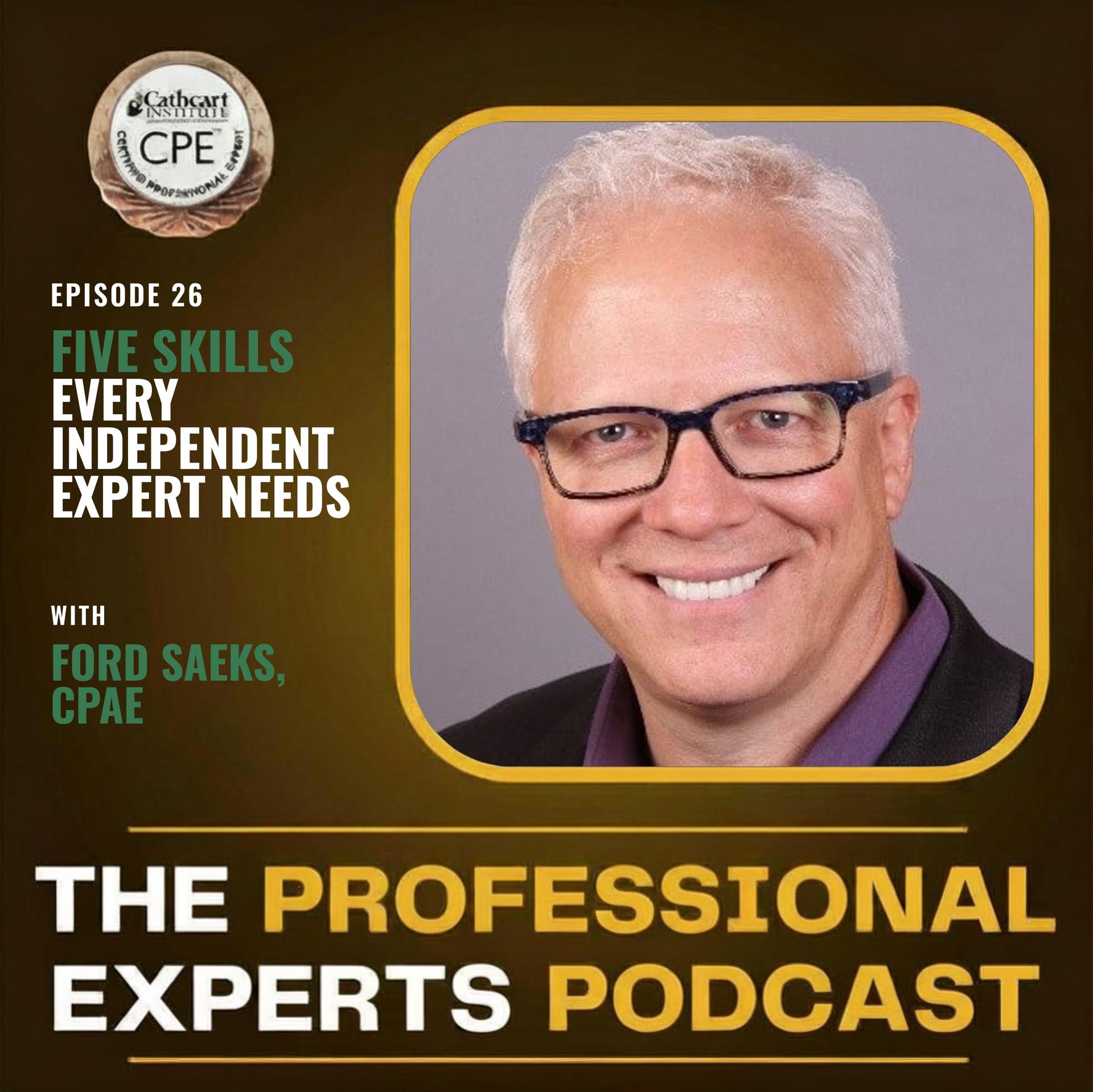
Five Skills Every Independent Expert Needs with Ford Saeks, CPAE
A conversation with Ford Saeks, CPAE
Watch This Episode
About This Episode
I sat down with Ford Saeks, CPAE, one of the sharpest marketing minds in the professional speaking world, to talk about what it actually takes to build a lasting expert business. Ford has been a colleague and a friend for decades. We were in Speakers Roundtable together for years. And the depth he brings to this conversation is the kind you only earn by doing the work, not just teaching it.
Two Sets of Five That Point the Same Direction
I opened with my own five areas every independent expert must develop: a clear value message, a strong brand identity, an optimum client profile, a sound business model, and the standards and systems that hold it all together. Ford came back with his own five, and the alignment was striking. He talks about a clear value proposition, a revenue model with multiple income streams, the ability to show up powerfully on screen, on stage, and on demand, a strong digital footprint, and a sales and marketing playbook you can actually execute. Different language, same roots.
The Question That Changes Everything
Ford put it plainly: what problem do you solve that people will pay to make go away? That one question cuts through years of confusion. He also made a point I think every expert needs to hear. If you front-load your offer with bonuses, modules, and extras, you are not adding value. You are adding friction. Make it easy to start. Let the depth reveal itself over time.
A Story Worth Sitting With
Ford shared how a payroll crisis with his sporting goods company pushed him to write a single email to 3,500 speakers. Nine people paid ten thousand dollars each. The lesson he took from that was not about the money. It was about access. People did not want the bonuses. They wanted him. That is a seed worth planting in your own thinking.
We also touched on Earl Nightingale, the Strangest Secret, and the long arc of what happens when you commit to one extra hour a day over a lifetime. In the spirit of growth.
About the Host: Jim Cathcart, CSP, CPAE is one of the top 5 most award-winning speakers in the world. His Top 1% TEDx video has over 2.8 million views, his 27 books are translated into multiple languages, including 3 International bestsellers. He is a Certified Virtual Presenter and past National President of the National Speakers Association. Jim’s PBS television programs, podcast appearances and radio shows have reached millions of Success Seekers and he is often retained to advise achievers and their companies.
Even his colleagues, some of the top speakers in the world, have hired Jim to speak at their own events. Jim is an Executive MBA Professor at California Lutheran University School of Management and serves as their first Entrepreneur in Residence. He has been inducted into the Sales & Marketing Hall of Fame in London for his pioneering work with his concept of “Relationship Selling.” He is also in the Professional Speakers Hall of Fame and has received The Cavett Award and The Golden Gavel Award.
Jim has written 27 books, hundreds of articles and he is always writing at least one new book. His most recent book is HI-REV for Small Business, The Faster Way to Profits. Audiences buy his books by the hundreds and he happily adds autograph sessions to his speeches.
https://www.linkedin.com/in/cathcartinstitute/
https://www.facebook.com/jim.cathcart
Chapters
- 0:00Welcome and what this podcast is for
- 6:58Ford's five skills for expert growth
- 12:25Revenue models and digital footprint
- 13:30Ford's origin story, from projects to platform
- 20:43Getting specific about who you serve
- 22:39Will they do the work? The hidden sales question
- 28:12The payroll story and what Ford learned
- 36:38Accountability, growth, and closing thoughts
Notable Moments
“If all you have is expertise, you're going to be irrelevant. It's your ability to communicate that expertise.”
“An acorn that remains an acorn is a loser. An acorn's job is to become an oak.”
“What problem do you solve that people will pay to make go away?”
“They didn't care about any of the bonuses. All they wanted was access to me.”
“In 1974 I was selling his programs. In 1984 he was selling mine.”
Full Transcript
Hey, folks, welcome aboard. This is the professional experts podcast for the Oaks Round Table, and I'm Jim Cathcart, your host. And today we've got a very, very special guest, a man that I've been in awe of for many years. Ford Sakes of Prime Concepts. Used to be out of Kansas. Was it Kansas City?
I was actually witch Kansas. And now it's Las Vegas there.
Now it's Las Vegas. Outstanding. Well, welcome aboard. And I. I see that you've chosen the right uniform today. This is. Yes, National Black T Shirt Day on the experts podcast.
I just find it's a lot easier to get ready in the morning. I just got a rack of them. Unless I'm on a keynote stage, this is what I'm wearing.
Absolutely. Yep. If what we're like, you know, Steve Jobs made a pattern of that as well. It was. Although his was a turtleneck, I think, or a mock. Anyway, the purpose of this podcast is for independent experts. Now, what's an independent expert? That's a professional speaker, an author, a person who sells their expertise, like even one that is a expert in court appearances, you know, as a certified expert. It's also for consultants, coaches, and anyone who they are, the product of their business. That's the whole point. They may have a lot of employees, they may have none, but the point is, what they're selling is their ability to either bring value or solve problems, one or the other. And those folks have that one thing in common is that their personal behavior is part of the company package, that their reputation reflects 100% on the company. There is no me and it. We are it. So a professional expert has five primary interests that I like to focus on. One of those is having a very crystal clear value message. What do you do or bring that's worth paying for? And a lot of people have difficulty with that when they think they've got it clear, but they're doing it from their point of view, not the receiver's point of view. Number two, what's your brand identity? Well, a lot of people talk about that, but here's the way I talk about that in a room full of people like you who do the same thing that you do generally. How do you stand out? So what really is your brand identity? Not your niche, but how do you stand out in a crowd of people that do what you do? Right. Number three, who's your optimum customer? Not your dream customer or client, but who is the person that's got the money. You can reach them. They have an ongoing need. They will stimulate more business for you when you do business with them and you find it pleasing to do business with them. So your optimum client. And then next, what is your business model? Should you be a gig worker like I was for so many years as a professional speaker just seeking yet another platform to get yet another speech? Should you be building a business where any speech you gives give drives revenue through the products and services that you sell? Should you be licensing other people? Should you be a licensee of others? You know, there's lots of ways. Should you be an author who agrees to go speak on the subject of your books? There are so many different ways to drive it. You could be a business driven by doing assessments and audits, and all of that drives the rest of the food chain. So business model. And then the fifth and final category is what are the standards and systems you operate by? Now, a system may be something like infusionsoft or Go High level or some kind of a software process like that, or it may be something completely different from a technological system. But there are systems which are the habits of a business. A system is to a business as a habit is to a person that drive the ongoing flow of revenue. And then finally, under that systems and standards is the standard size side of that. And what are the kind of like ethical lines in the sand that you're unwilling to cross or the standards that you aspire to? And you say everything we do must hit this level of quality. So, Ford, that's the template I give people when I'm talking about growing their independent expert business. How does that look from your point of view as a senior advisor and expert who's been doing this for decades?
Well, first of all, Jim, thanks for allowing me to be on the experts podcast. You know, I've been in organizations for years like you and, and I think it's great to have these types of conversations. And I just took notes on your five one, valuable message. Two, brand identity. Three, optimal customer. Four, business model. Five, standards and systems. And I am hearing a little bit of an echo. Your speakers might be a little bit loud, but as long as it's okay in the recording, I'm okay with it. It just means your speakers are coming back into the microphone a little bit on zoom.
Thank you for that.
This is, this is live, so it's up to you. All right, but let's get back to this. What we're really talking about is how do you Position yourself for value. I mean, you and I both work with speakers, authors, trainers, consultants, coaches. We work with businesses. We work with B2B and B2C and all different sizes around the globe. And when it turns into expertise, you're solving a problem. So I have my own five. You had your five. Again, valuable message. Make sure you have a brand identity. Make sure you have your optimal customer and you understand who you're targeting. Making sure you have a revenue. I. I call it revenue model. We'll talk about the mind in a minute. And then you have systems. So I'm going to give you a parallel five.
Okay?
So I. And I'm going to go through each five as quickly as I can. But this is relevant. It's going to be an alignment. At the end of the day, what you and I are both doing is we're helping people elevate their positioning in an overcrowded world where it's harder to get found, it's harder to get seen, and you need to stand out over the competition where everybody is a commodity. All boats rise with the tide. Everybody can write a blog and a book and content. So content's no longer it. In fact, I believe that if all you have is expertise, you're going to be irrelevant. So it's your ability to communicate that expertise. So I want to be very clear. We're on the experts podcast. This is for information and educational purposes only. Jim doesn't know what I'm going to say, so, you know, just be clear. If you agree with him, great. If you agree with me, great. But our whole goal is for you to be a critical thinker. All right? So I'm going to give you my five real quick. Sound good?
Yep.
Okay. Number one, you have to have a clear value proposition. Jim had valuable message. Value proposition. I think we both align on that, because if you're not communicating the value, it doesn't matter. So, number one checkbox. Number two for me is you need to have a revenue model. So I like the value, and I like to have a revenue model. Make sure I know how am I going to get paid. And in my revenue model, I have five income streams. So I'm a hall of fame keynote speaker. Like you, I speak to corporations and associations. My fees start at 25 grand and go up from there. I'm only mentioning the fee as a value proposition, not. I have speakers. And you and I both have friends of ours that make 125,000. So it's not. It's not about the money. It's the model.
Right.
And my speaking drives everything. So I have speaking corporations, associations and then I have public events where I actually, you know, put my own butts and seats. Then I have consulting which starts at a high figure five figures and goes up from there. Then I have all types of products and master classes and continuity programs and membership websites. I've packaged the content. So if you're an expert right now, think about this. Your expertise should be at the top. Top.
Yeah.
I don't want you to tie your identity to your delivery method. So I don't consider myself a speaker, trainer, author, coach. Yes, yes. If it's a meeting planner, I'm a speaker. If it's a client, I'm a consultant. But, but I want to be known for what I'm known for, which in my case is business growth. Right. So I'm known.
There you go. As business accelerator, quick interruption. Don Hudson, our colleague, professional hall of fame speaker, he says be known for the problems you solve and clearly you are 100%.
Now I just put my overlay on. If you're listening to the audio for this, you can find me at profit rich results.com and I am known as business growth acceleration. So yes, I'm a speaker, author, trainer, coach, consultant. But I want the result of those things. So number one's value, number two is revenue model number three. I believe that if you're really going to be an expert in today's day and age, you have to be great on screen, on stage and on demand. So on screen would be like we're doing today having this podcast and doing video and, and doing that. You having YouTube videos and being on social media, you're online all day long on stage as ability to deliver. And even if you're a business owner, stage might be in a sales presentation, might be in your team, maybe you're an organization and lead an organization or train the trainer. You still have to be able to communicate. And then on demand means that you're able to help leverage yourself by recording your content and delivering that content again, whether you're internal or external organization, I like that regardless. So I, I like to have re the core expertise is number one. Number two is a revenue model. Number three is great on stage. Number four is digital footprint. Are you findable? You and I like you. You were just recently on my episode of my podcast and and I said where can listeners find you? And you and you'd say the same thing I did. Well just go to Google or go to chat GPT and say who's Cat, who's Jim Cathcart? And let AI tell you, that has gotten me more bookings because when someone says, where can I find you? I just say, why don't you just open up, chat GPT and just ask who's forward sakes? Because AI knows who I am. Because I've worked really hard to make sure that those systems and you know, Grok and Perplexity and Copilot and Gemini, they all know who I am. All right, so 4 is your digital footprint. What shows up when someone Googles your name? Is it positive? It doesn't communicate value. And the fifth method or area of focus for someone to build their expert business is they have to have a sales and marketing playbook that they can actually execute. So real quick, off the top of my 5 value proposition revenue model, being great on screen, on stage, on demand, which is, you know, being able to present. Number four, your digital footprint. Number five is a sales and marketing playbook. So whether you take my five or Jim's five, anybody listening to this right now, if you want to expand and grow, and I'm just going to toss it back over to you in a second. So I'll just. The first thing is I want to expand my influence. I want to build my list.
Yep.
I want to generate leads and sales and I want to improve business operations. At the end of the day, as an expert, if you're not doing those things, if you're not helping someone expand their influence, if you're not helping them build their list and they're following their tribe, if you're not getting customers or getting, you know, email lists or followers on social media, if you're not getting repeat and referral sales, if you're not doing something to exchange value for value and get paid. And then number four, if you're not leveraging AI and technology to save time. So that's a lot to unpack. Appreciate being on the show today.
You bet. You bet. Well, the thing that amazes me is how you built virtually a marketing empire compared to where you started. You know, you started with you've told the story and I'll let you tell it here today. But give our listeners a short tour of where, where in the world Ford Sakes came from to get into this field that you're in now.
Well, I appreciate that. The short answer was, you know, I grew up in the projects and paid 17amonth for government housing and grew up kind of as a rough kid.
And
at 15 years old, I found myself in a jail cell 6 foot by 8 foot, thinking, you know, maybe I haven't made the best life choices up to this point. And one of the guards gave me a cassette program. For most of your listeners, you're gonna have to Google what a cassette is. It actually was in a Sony Walkman and had wires, wasn't wireless. And I listened to this cassette on the Strangest Secret for years and years and years. And that changed my life to where I'd said, okay, I need to do something different. I need to start getting attention by doing something good as opposed to getting attention by doing things that were bad. And so I decided I would start my first business. And my first business grew. And since that time, I've had 17 companies. Three were seven figures, one was eight figures. And I made a lot of mistakes along the way. And I learned, you know, you can either learn from your own experience or other people's experience. And I. I should have learned from other people's experience and saved millions of dollars on stuff that I spent my money on. And so I grew. And so, after having successful products and inventions in childcare, automotive, sporting goods, and medical, having sold through every channel of distribution, retail, wholesale dealer network, specialty catalogs, export, and importing, people started to come to me, Jim, and say, how do I take my idea to market? How do I grow my business? And so then I realized, wow, Jim, people will pay more for information than they will gold, than they will anything. And that's when I said, okay, I'm gonna figure out what this whole expert business is. Because you and I both know, like we just said, don't tie your. Your self worth to your delivery method. You're not a coach, you're not a consultant, you're not a speaker, you're not an author. Those are delivery methods. Yep, you're an expert. And that's why I love this podcast, because you're really focusing on what the real value is, is being an expert.
Absolutely. And what occurred to me, when I was in the National Speakers association, they. They would spend. We. I was on the board for 10 years, and we would spend wasted hours in the board meeting determining the criteria anew every year for what would be a certified speaking professional. And finally I said, excuse me, guys, but. And gals, this is. This is a frequent flyer award we're giving out. If you make enough sales and fly to enough meetings, you get to be a certified speaker. And I said, we've got to base this on true professionalism. You know, extra expertise, experience, a whole number of other things. And they said, okay, come up With a plan. So I created over a five year period with a lot of research what became the Certified Speaking Professionals foundation, which is the professional competencies, eight areas you need to be competent in in order to grow any kind of a speaking career. Well, years later now, Leslie, that was gad, that was over 40 years ago. I'm on my own and. Is that me?
I'm playing. I'm playing sound effects on your show.
Thank you. Now I'm out on my own again and I'm looking at what is it that's underneath speaking, underneath all these other things, like you were just saying. And it's expertise, it's whatever you're darn good at that other people want a piece of. Right. And how you bring value to the world. So that's why I created the Professional Experts certification, which is called Certified Professional Expert cpe. And then I, I wanted to, you know, you and I spent years together in Speakers Roundtable, which is a consortium of the people at the top of the professional speaking profession and included even the founders of nsa, Cabot, Robert, Bill Gove and so forth. Well, I love that. That experience for me was just the height of my professional experience. And so I wanted to create that, recreate that, and I created the Oaks Roundtable. Why the Oaks? Because I'm known as the guy who talks about acorns and potential. And an acorn that remains an acorn is a loser. An acorn's job is to become an oak. So the Oaks get together. That's the Oaks Roundtable. And I've now got 47 people I've certified who are some of the top experts in the world and a very impressive group of people. This podcast is about showcasing those people to the rest of the world to say, look, this person started as an immigrant. This person started as a dirt poor person in the projects. This person started as a street fighter and a punk. This person started going door to door trying to sell things. And look where all of them have become today as leading authorities and people who we buy their books by the thousands and millions in some cases. You know, you look at Les Brown and Brian Tracy and others in the group, oh my gosh. Well, they're shoulder to shoulder with Ford sakes. They're not an inch above you. Where you've come from and what you've done with your own life is absolutely inspiring. So the people that are early in their career, they've been doing something else and they say, no, I like what Jim does, what Ford does. I want to go in that direction. What do you tell them as they're, you know, they're struggling through those first few years and trying to kind of get known?
Well, you know, they, they have to know what, what problem do you solve that people will pay to make go away? I mean, that one. Yeah. What, what problem you solve that people will pay for? See, there's a difference. You can be an expert in solar eclipse, but you're only going to have two clients, NASA and Russia. Like, like you need to know, you know, what problem do you solve that people will actually pay to go away?
How do they. Let's say they've, they've defined that. Let's say it's a person who's been a leader of an organization. They've been in sales, sales management, maybe upper level management. And they decide, you know, I'm going to start my own practice and start consulting with clients. What they're, what they'd say to your, your challenge is, I bring business experience and expertise and I can help you make better decisions. Well, that's kind of like I bring vanilla and you're making food. Right. It's too generic.
Yeah.
How do they get more specific?
Well, I think, I think the key here, there's, there's two lessons here. One, you know, at the end of the day there's like 10 different things that people will pay for in 10 different categories, but there are thousands of modalities underneath that. You know, whether you're leadership or culture, communication or change or team building or, or marketing or diversity or innovation or creativity, like there's a lot of things, or personal growth or whatever. The key though is if you want to stand out of the competition, you have to understand that if you're an expert in today's day and age, you have to be the CEO of your own media company. There's never been a time in history where from your desk, from a laptop, anywhere in the world you can build this business. What's lifestyle friendly? So I always tell people, what problems do you solve that people will pay to make go away? What method does your ideal client want to consume? So, for example, maybe you're trying to go after the C level or the C suite. If you create a 58 module course, I don't care if it's the best course in the world, CEOs aren't going to take the time to go through it. So you can give a course away that has one or two modules and then 48 bonuses and it's the same course and sell a lot. So it's all in the mind of the position, how much time and am I willing to do it? Because at the end of the day, people want to know what's wrong with me. Can you fix it? How much does it cost and how long is it going to take?
Yeah, people want to get started, right?
Yeah. And then they want to know. I believe in you. So for example, I know you have a certification program that people can find out@cathcart.com where you can certify them. Right?
Yeah.
So, so let's go through this psychologically. Okay? Number one, do I believe in you? Yes. Jim Cathcart. Google his name. Ask AI. He's an icon in personal growth and development, the founder of so many methodologies that other speakers use. It's so interesting. If Jim goes to AI and says, I need you to source this, is it AI? AI will say, yes. But what it's not telling you is it was trained on Jim Cathcart. So it's really not AI. It's not built by AI, it's built by Cathcart because Cathcart was the foundation for AI. So you got to remember that if you're, if you think you're being found on something. Right? Okay, so, so one, Do I believe in Jim Cathcart Checkbox? Okay. Now, Jim has a certification program. Hypothetically, what's it cost to cost?
$7,500 for a three month process.
Okay, fine, we'll stop there.
Have all the qualifications, right.
Assuming you qualify. But, but here we're doing, what we're doing is we're talking about expertise here. So just use this. We're not talking about gyms expertise. But so if I want to get certified, I believe in Gym Checkbox. Now, value proposition is the next one. Do I believe in Jim's offer? Well, if I want to shortcut, cut years off my learning curve, learn from the masters and literally cut years of time and avoid the mistakes. So when you invest in 7, 500 to become certified, you're not paying 7, 500 for some badge on LinkedIn. You're paying for the what to do, what not to do, and how to avoid those landmines that will cost you way more than 7, 500, right? It's going to, it's going to save time. So now I say, okay, I believe in Jim's offer. I believe in Jim, I believe in his offer. It's worth the 7,500. But here's where experts go wrong when they're selling programs. The third question that they don't consider is will they do the work. So that's a big one.
That's really big.
It's huge. I. I was a pro cyclist and Olympic caliber speed skater. I was £168. I started sporting goods company. I invented some products and patented them. Was working 80 hours a week and went from 168 to 278 because I was eating the same way I was when I was training, but I wasn't training. All of a sudden one day I look in the mirror and I'm like, oh, my gosh, I'm, you know, I'm 100 and some pounds overweight. What's going on? You know, I control the fork. And so let's just say I'm looking for an expert to help me lose weight. I go online, I find this expert bodybuilder, whatever, health fitness guru. Yep, I like it. And then I look at their program. Okay, it's 7, $500. Well, I want to live. I want my suits to look better. I want to look better on stage. I want to fit better in the airplane seats, which are consistently getting smaller. I actually measure them. They started at 22 inches. The last one I measured was 16. Same thing on airplane. Yeah, I. Armrest. Armrest. I was measuring it.
Wow. All right.
But moving on. So do I believe in this guru? Yes. Do I believe that if I pay $7500, it's worth me to lose the weight? Yes. Yes. But here's the part. Will I do the work? Okay, I'm supposed to download the app. I'm supposed to count my calories. I'm supposed to do mental toughness training. I'm supposed to do flexibility training. I'm supposed to do cardio. I'm supposed to do resistance training. I. I'm supposed to do yoga. I'm supposed to do Pilates. I'm supposed to do. And I'm like, you know what? I believe in the guru, I believe in the offer, but there's no freaking way that I'm going to do the work. And so the lesson here to everybody is if you have an offer and you're an expert, what method do they want to consume it? Will they do the work? And if you don't make it easy, and this is where I'll turn it back over to you. I go into organizations like experts, and I help them increase the sales of what they're selling because they don't understand how to communicate. They're all excited or they took some seminar and they're like, well, I'm including 17 bonuses and three special reports and an assessment. And I'm like, you know what, they don't want any of that crap. You're actually causing a reason. It's a sales prevention device because you're making it too hard. So whatever you're selling, whatever area of expertise, whether you're a business owner or, or an internal external, if you're selling expertise, you have to have quick wins. It has to be easy to consume, easy to implement. Start simple, get complicated later. Doesn't mean. If that guru would have said, I have a 30 day quick start and this is all you do for 30 days, I would have spent the 7,500 bucks. And after the 30 days, I would have understood, oh, count your calories, do this. Get the, if you leave, if you front load it thinking that you're adding value because you're adding all this crap, it won't work. And I, I want you out one more minute. I'm gonna tell you real quick story.
Sure.
So I had a business with Randy Gage. I worked with him for 30 years. And I had a sporting goods company at the same time. And Walmart hadn't paid me. And it was a Thursday afternoon and on Friday I had to get ready for payroll, and my payroll was $40,000 every two weeks.
Weeks.
And I didn't have money. So I called my partner, Randy Gage, and I said, randy, we have a couple hundred grand in this other account. It's a joint venture account. Can I just take some 50 grand out, I'll make payroll and then when Walmart pays me, I'll put the money back. And he said, there's no free cheese in the mousetrap. He said, you got yourself into the mess. Get yourself out of it. And I'm like, but Randy, part of that money's mine. He said, no, that money's over here. That's our joint venture. That has nothing to do with your sporting goods company. Now. Yeah, it's Friday morning. I'm panicking. I'm going to have to let my employees go. I don't know how I'm going to make payroll. And Randy said something to me. He said, you know what? Go sell something. So I sat down and I thought, what can I sell? I'm an expert. What can I sell? And I'm an expert in marketing and go to market strategy. So I wrote a letter and this was back in the email days before social media. But I wrote a letter, an email that said, let me become your marketing makeover mentor. It's $10,000. I'm accepting the first five people in. I'll work with you for six months. I'll give you all my book. And I just loaded it up with all this crap. And I sent the email out to 3500 speakers that I had on my list, hoping that I could get five to give me ten grand so I could make payroll. All I wanted to do is make payroll.
Yeah.
The whole weekend I, I have panic attacks. I'm not sleeping, I'm sweating. I, I'm all scared. And Monday morning I open up my inbox and I start going through my email and I get the first sale. Second sale, I had nine people pay me ten grand.
Wow.
By sharing Max Feast. Now, you think that's great, right? But here's the fast, fast forward the next six months. I was like an indentured, indentured servant. I, I, I, I, I made no money on it. No. Even though I made 90 grand, believe me, with the time I spent, every single person treated me as if I was their personal employee for the next six months. So it didn't work. Right. But here's what I learned. I learned an important lesson. One, they didn't care about any of the bonuses. All they wanted was access to me. So then I relaunched the program after the first six months and instead of going six months, I did 90 days. Same amount, 90 days, half the time. And I got 30 people and I didn't give them anything except access to, yeah, access to me on a, as my schedule permits. No bonuses, no books, no assessment. And what I learned was the reason I got 30 was the prospect wanted to feel like they could get their problem solved sooner and they were willing to commit for 90 days and they weren't willing to commit for six months. And by shorting it, I thought I was taking value away. It actually was the opposite effect. They felt like they got more value because they felt like it could get done faster. So it's just logically different that.
Yeah. I found that people are slower to respond to my six month mentorship than a three month. And with the three month, I tell them, if you want to come to Austin and we spend a day together at first, we'll do it that way and then, then it'll be remote for the remainder of the, the 90 day period.
It's weird.
It's weird.
They'll take, they'll take the first action. If you make the first action easier. It's not even about the price. It's about the perception of the value. And if they, if they, once they're in, they'll stay with you six months. They'll come for three years. Like I've got long term clients. Yeah, they don't know what they don't know. So they're trying to make. It's just like if I talk to an expert expert and I'll work with them on a makeover and they'll say, I'll say, well, tell me about your coaching. And it doesn't matter what the topic is. You spin the bottle, doesn't matter. They'll say, well, I've got a one hour, I do a free one hour. Then I do a three hour and a six hour and a six week. And I'm like, here's my problem with that. How does the prospect have a clue how much time they need to fix their problem? You're asking them to make a buying decision on something that they don't even have a reference point. Yeah, I said, so don't do it that way. They're just selling it wrong. But the problem is there's a lot of people teaching master classes that the only thing they do is sell master classes. They don't actually do any work.
That's true. Our colleague David Averin just wrote a new book called Be Ridiculously Easy to Do Business With. And I love that because that's so compatible with what you're saying. Don Hudson, our colleague, who I quoted in an earlier conversation, Don hall of fame speaker, says, he calls me jc. He says, jc he said, I'll tell you something, he said, there's very few problems in the world that can't be solved with more sales. Well, ain't that the truth, man. Earl Nightingale, you mentioned the strangest secret. Earl Nightingale has a whole library or created a whole library of his recordings called Lead the Field. Great Ideas, Creative Thinking. And the Success series was 48 audio cassettes. And I bought them back in the day for what today would be 3, $500. I was making at the time, $525 a month. And I committed to that whole audio library and became a fanatic about listening to them hours every day until my life transformed because my mind, my worldview transformed. But when Nightingale made his big mega hit, it was the recording you heard. The strangest secret. The strangest secret is that you tend to become what you think about most. And he, in that recording, he said, spend the next 30 days listening to this message every day and applying its basic ideas. If people would do that short one, 30 days, and almost everybody would say, well, yeah, I can do that, then they could reach the tipping point where they'd want his entire library. I was pre sold. So I, I committed to a payment plan and bought it on time payment and became ultimately a salesperson for it. And here's a fun little footnote to that. More than fun, it's meaningful. In 1972, I heard Earl on the radio. In 1974 I was selling his audio programs on cassette door to door to businesses in Little Rock, Arkansas. And in 1984 I got a phone call. I was living in California at that time and it was Earl Nightingale calling me to see if he could produce my audio album, which he sold three and a half million dollars worth of. So in 74 I was selling his. In 84 he was selling mine. And when he passed away, his widow Diana invited me to be the only outside speaker at his memorial service.
Wow, that's, that's just a testament to, to the value add I, I, I. Congratulations. I think that's amazing.
Thank you. Well, last week at the Expert Summit in Westlake Village, California, Diana Nightingale joined us by video and I presented her with Earl's posthumous certified professional Expert certificate and medallion. And, and we shared those memories on the video chat with the group of experts there. But for to think about the distance you've come and the distance that I've come and so many of our other CPE colleagues have come is just mind boggling because you watching tv, they don't talk about that big of a possibility existing and reading. Most of the books you read, you know, they're not nearly as tuned in to the reality of personal growth when you don't see anything but personal grief, especially nowadays.
Right. I mean that's just the way it's going. I think that anybody listening to this, you know, for me, I take 100% accountability for everything in my life. The decisions, the actions, the mistakes. I've, I've interviewed hundreds of CEOs and experts like you and I've asked them what were the keys to success. And you know, they're very similar things. And like you, I've been a student, a long lifelong student of personal growth. You know, some people will say I've got 15 years experience and I'm like, really? Or do you have one year? You repeated 15 times? Like I do you really, are you really growing? Are you, are you actively doing it? I know for me I do spend time on TikTok and yes, I watch microlearning videos on AI because I like those quick sound bites and occasionally there'll be a video of someone dancing or, or some meme or some, some news thing on it. But, but I'm constantly looking at how do I add more value? How can I learn? I'm listening to different messages, some I, some speakers I go to and I'm like, you know what? Now I know what I don't want to do. Right? So, yeah, so not all speakers are good speakers, but you can learn something from every single one. I think that, that, that if you approach life as being open minded, proactive and a critical thinker and just willing to take personal accountability for your own success, that's how you grow as an expert. If you, if you start drinking your own Kool Aid and believe in your own bio and thinking that you're the next greatest God's gift to whatever problem you're solving, it's going to edge God out. You know, they talk about the ego, I think, yeah, ego, it just, it just changed it. Now I'm very opinionated. For those of you that know me, you know, yeah, I'm very opinionated, but I'm also very quick to be able to go, you know what? That's a good perspective. You know, I think I'm going to change my opinion. And we talked on my podcast about Marilyn Sherman, and I can't get on an episode without talking about my sweetheart and you know, from front row success. And it's interesting because now that I'm spending so much time around here and she knows she's a top inspirational motivational speaker, very, very positive person. And I mean, like, truly is really positive.
Like, I've known her for 30 years and I, I agree with you. Yeah.
I mean, I wake up and I'm a little grouchy and I'm, I can be passive aggressive and defensive and I got all my problems. I mean, I'm not showing up without my luggage. Okay, I got all my baggage. But she, her model of the world, how she looks at things. She gets up in the morning, we go outside and she goes, look at the sunset. Sunset. Oh, look at how like just the perspective. And so if you're someone who isn't necessarily like that, there are people like that that you can learn from and then you can practice. And she, she laughs at me and she'll punch me sometimes because we'll go to dinner. And I never used to talk to the wait staff. No way. Wasn't doing it. Wasn't going to have anything of it. And now I'll say, how's your day going? What are you doing? And then they leave the table. She Goes, I can't believe you just did that. And I'm like, well, I'm trying. So I think what you have to do, everybody who's listening to this and, and you know, I've got to jump on another episode here in about two minutes. But I would say, look, just take personal accountability. It doesn't matter what happened to you in your past. I appreciate you, you know, talking about my past and wearing. But again, I'm either going to be a victim or a victor. And I know, I've heard that either Tony Robbins or less or somebody told me that years ago, but it's so true. I mean, if you, you can listen to someone's psychology and you can determine their destination by.
If you have a language. Well, let's, let's respect your time, tell people the best way to reach you and interact with you.
Well, they can just Google, just like you said on my podcast, they can Google my name on the screen. If you're watching this live is my website, profit rich results.com connect with me on LinkedIn. Obviously, I have a fortify. I have my own podcast. Wednesdays, 11am Central on YouTube, LinkedIn and Facebook. You can check me out. Just type in Fortify, like the car F O R D. And I just appreciate being there. And I've known you. Like I said, I first saw you in 1991 or four. It was at Randy Gage's Speakers Institute.
Oh, and that was in Newport Beach, California. Bill Go was also on the program.
Yes. And I actually, I have photos of you and me, Jim, at that event from years ago.
Send me one, please.
I'll dig them out. Because I took pictures. I. Because, you know, I was that new speaker and I, I wanted pictures with the speakers. And it was interesting because years later, you know, a lot of them became my clients, including Les Brown and Randy and all these people. So it's just like you said. You, you join an organization, next thing you know, they're calling you, selling your stuff.
Dynamite. Dynamite. Wow. Well, I hope to include you in the future as a certified professional expert, that you definitely be the skip the line category.
Well, you let me know. I'll be happy to promote it and you just let me know what the details are.
Thank you. All right, well, thank you, my friend. Folks, this is the Professional Experts podcast. And we have been blessed by Ford Sakes today with some profound wisdom. See you soon. Bye.
Nurture Your Nature.
Never Miss a Conversation
New episodes drop regularly. Subscribe on your favorite platform and never miss a conversation.